A large burial mound with an internal stone chamber on the south shore of Rousay, named after the drystone tower beside it.
Twelve compartments open off a passage nearly twenty-four metres long inside this tomb. That is an extraordinary length for a burial monument of the Neolithic — the first farming age, roughly 4000–2500 BC — and it makes Midhowe the extreme development of a type that began in Caithness with no more than four compartments.
The form is called a stalled cairn — a central passage with paired transverse stones dividing the sides into bays, which struck early investigators as looking like horse stalls. The stones here stand two metres high, and the walls survive to two and a half. The original roof is gone, as at almost every Orkney tomb, and a modern hangar-like cover now protects the interior.
Nobody knows what that roof was. It may have been flat flagstone slabs at three metres or more; it may have been corbelled and vaulted like Maeshowe to as much as five. Those are two quite different buildings, and the evidence does not settle it.
The tomb was in use from early in the third millennium BC for several hundred years, and then somebody deliberately filled it with debris. That is a closing act rather than an abandonment, and it is recorded at other Orkney cairns as well.
It stands on the shore of Eynhallow Sound, a short walk from Midhowe Broch — an Iron Age tower some three thousand years younger, sharing the same stretch of coast and the same Norse name for a mound.
What follows is drawn from published sources, with each claim labelled by how firmly it is established.
The name
Midhowe takes its name from the neighbouring Iron Age broch: it is the middle of three nearby structures, while howe comes from Old Norse haugr, ‘mound’ or ‘barrow’.
History
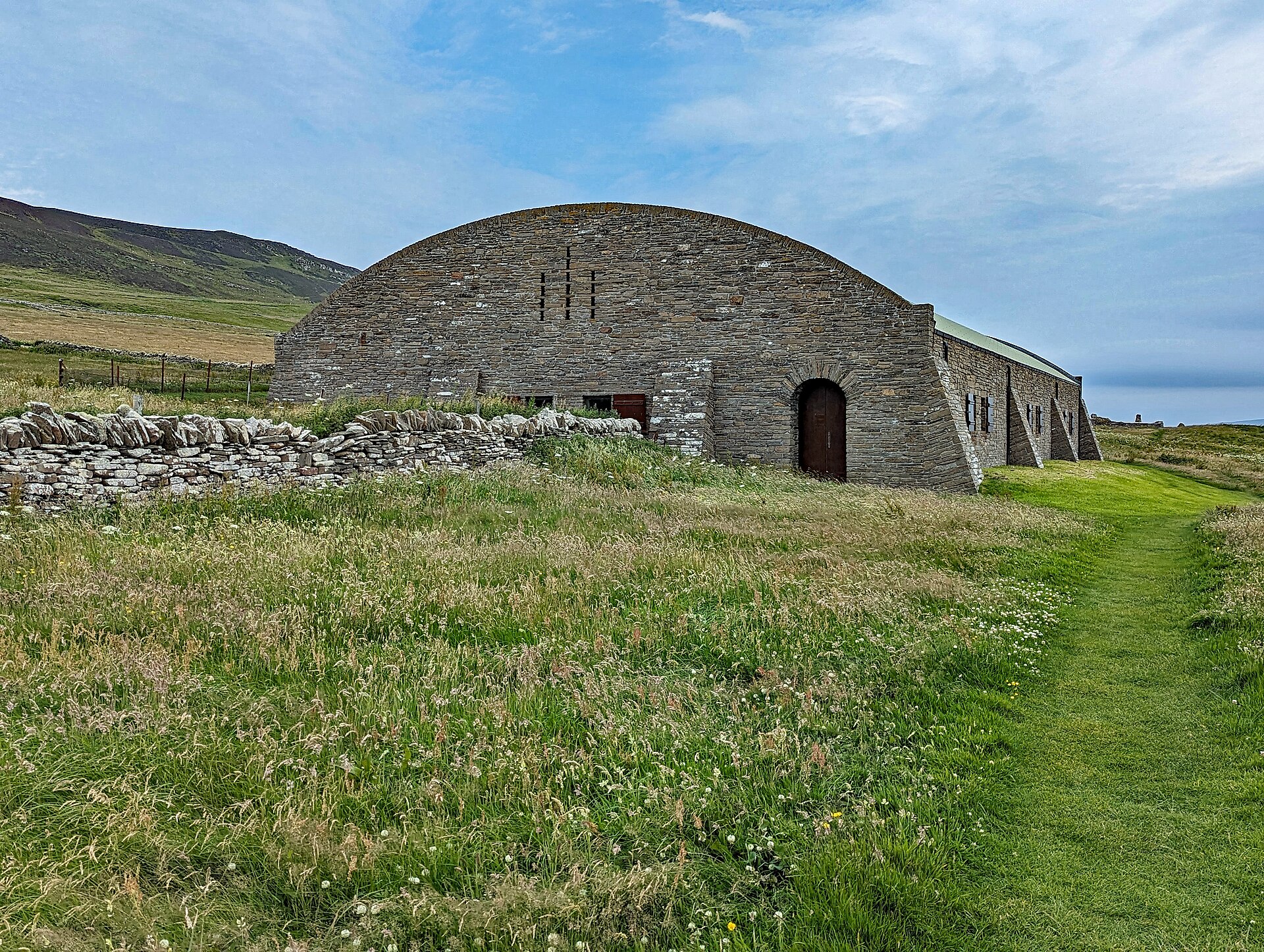
Midhowe is a large Neolithic chambered cairn on the shore of Eynhallow Sound on Rousay, standing just east of the Iron Age broch that shares its name. Together the tomb and the broch form part of a substantial complex of ancient structures along that shore, thousands of years apart in date. It is an exceptionally well preserved example of the Orkney–Cromarty type, the kind usually called a stalled cairn. Those tombs have a central passage flanked by paired transverse stones that divide the sides into compartments, which reminded early investigators of horse stalls and gave the type its name.
The earliest versions of the form are found in Caithness and rarely have more than four compartments. In Orkney the tombs became far more elaborate, and Midhowe is the extreme case — twelve chambers flanking a passage 23.6 metres long, which is a very long way to walk inside a Neolithic tomb. The transverse stones stand two metres high and the walls survive to two and a half. What has gone is the roof, as at almost every Orkney tomb — replaced now by a modern hangar-like structure built to protect the site from the weather.
How it was originally covered is not known. It may have been roofed with flat flagstone slabs at a height of three metres or more, or it may have been vaulted like Maeshowe to as much as five — two quite different buildings, and the evidence does not decide between them. Use began early in the third millennium BC and continued for hundreds of years. At the end of that period the cairn appears to have been deliberately filled with debris, which is a closing act rather than an abandonment and is recorded at other Orkney tombs too.
Cultural influences
-
An exceptional Orkney–Cromarty stalled cairn, whose long chamber and twelve compartments show how the Orkney form developed into a more elaborate communal-burial monument.
Connections
-

Photo: MichaelMaggs / Wikimedia Commons / CC BY-SA 4.0 Knowe of Yarso chambered cairn
Knowe of Yarso and Midhowe are Neolithic stalled cairns on Rousay’s south coast. Historic Environment Scotland presents them as part of the same prehistoric trail, while Midhowe’s twelve compartments show the form at a much larger scale.
-
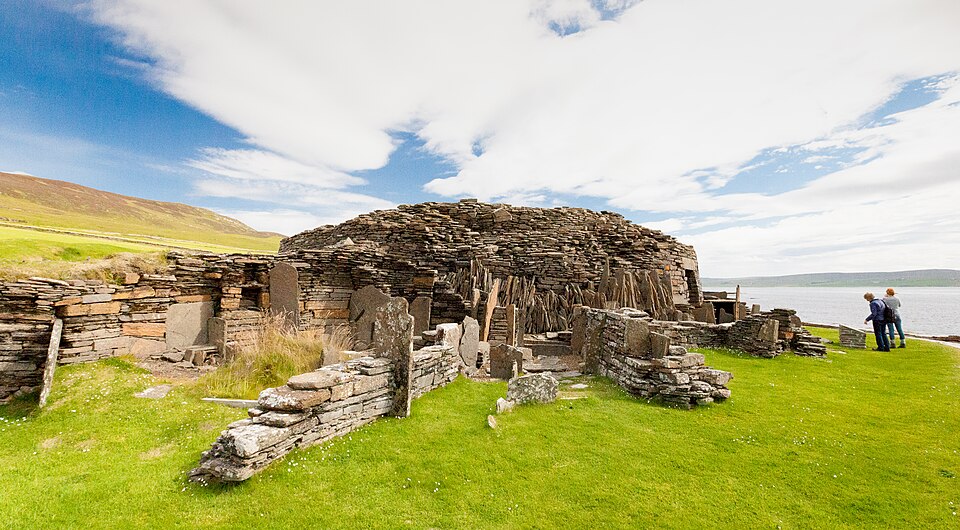
Photo: MichaelMaggs / Wikimedia Commons / CC BY-SA 4.0 Midhowe Chambered Cairn and Midhowe Broch share a Rousay shoreline but are separated by millennia: the cairn was a Neolithic communal burial place and the broch an Iron Age defended settlement.
-
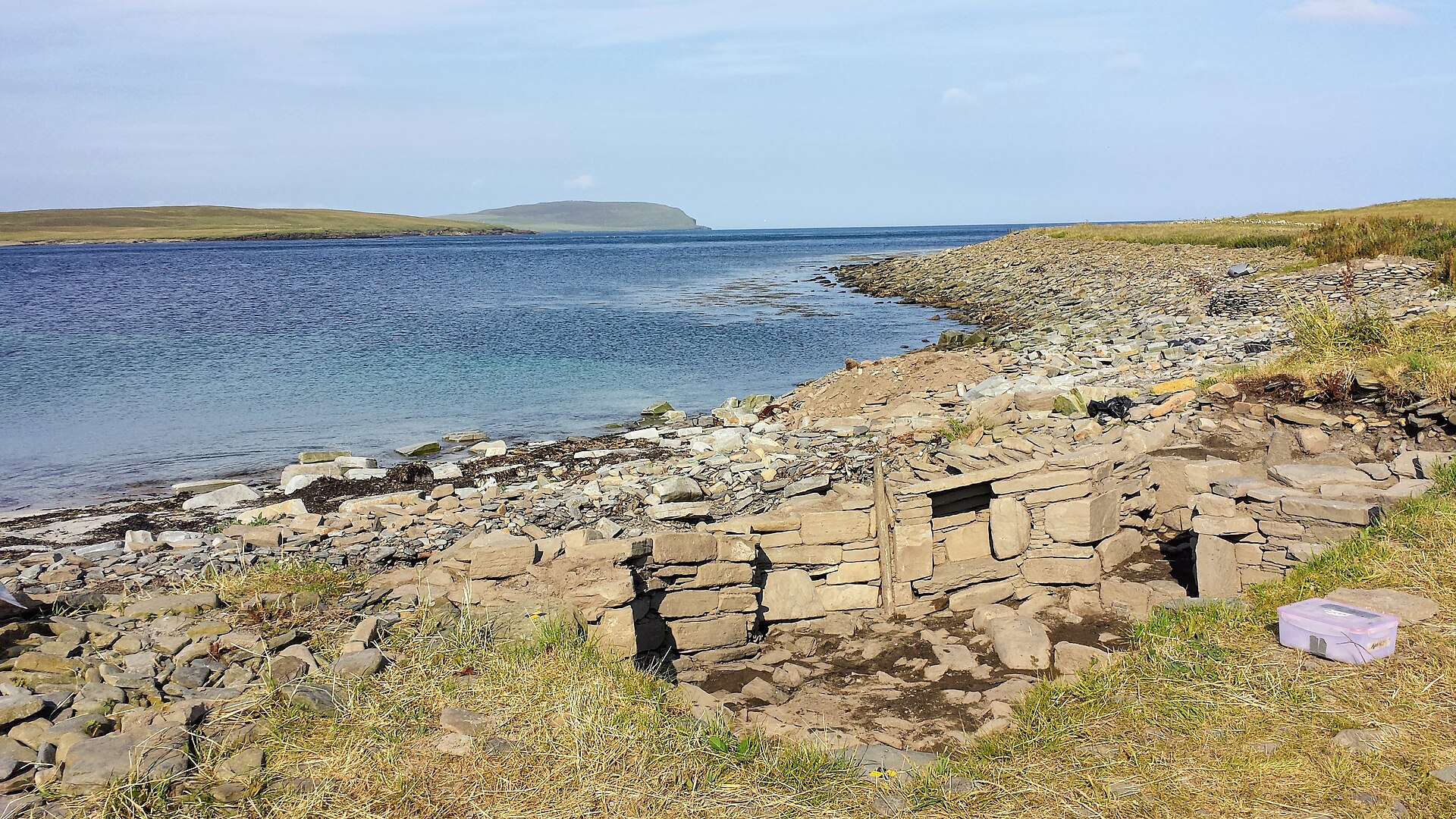
Photo: Bronwyn Chomitz / Wikimedia Commons / CC BY-SA 4.0 Knowe of Swandro’s sea-threatened multi-period mound lies on the same Rousay coastal archaeological zone as Midhowe. Its research excavation documents why this shoreline’s prehistoric monuments require active investigation and conservation.
-
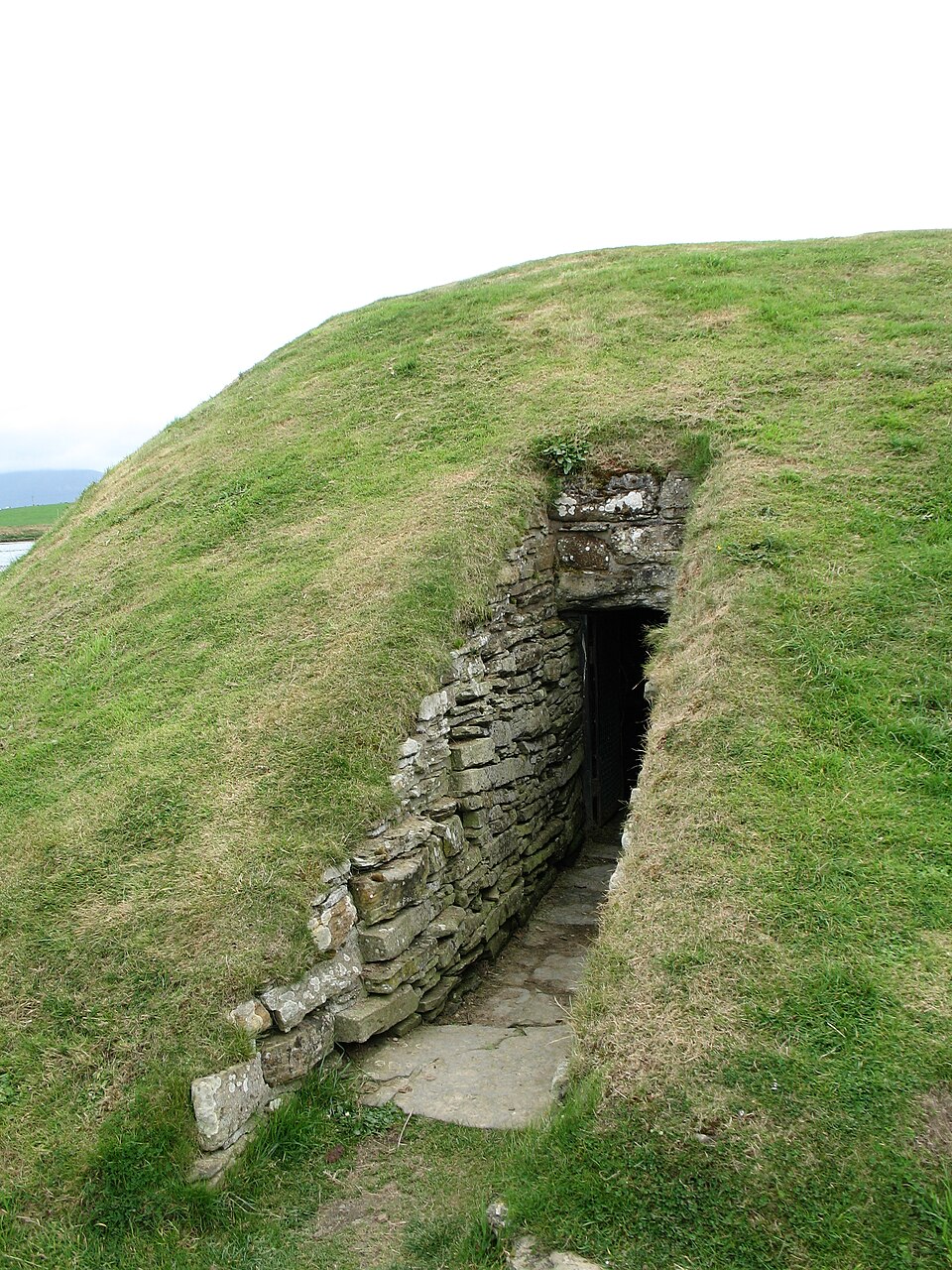
Photo: Bruce McAdam from Reykjavik, Iceland / Wikimedia Commons / CC BY-SA 2.0 Unstan is another Orkney chambered cairn whose tomb form provides a useful counterpart to Midhowe’s unusually long stalled chamber. Together they show the range of Neolithic communal-burial architecture across the islands.
-
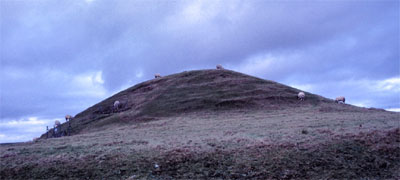
Photo: Otter at Dutch Wikipedia (Original text: Hopmans) / Wikimedia Commons / CC BY-SA 3.0 Maeshowe
Maeshowe provides the key architectural comparison when considering how Midhowe’s long chamber was originally roofed. Midhowe may have had a flat flagstone roof, or a high vault comparable to Maeshowe; the surviving evidence cannot decide between them.
Discovery & excavation
Excavation found the remains of at least 25 people in the chambers, alongside animal bones and Unstan ware pottery; the cairn had been filled with debris after centuries of use.
What to look for
-
The long stalled chamber
A 23.6-metre central passage is divided by paired transverse stones into twelve side compartments.
-
The protective shelter
The original roof is gone; the preserved chamber is covered by a modern hangar-like structure.
-
Horned forecourt
The cairn has a horned forecourt whose original ceremonial space may have been large enough to hold hundreds of people.
Plan your visit
- Location
- 59.1566°N · 3.0992°W
- Nearest settlement
- Rousay
- Access
- Open access
- Terrain
- Easy going
- Start point
- On the island of Rousay on the B9064, 5m from pier. Reached by Orkney Ferries from Tingwall Terminal. · Access to the site is across steep agricultural ground.
- Time needed
- About 45 minutes
- Best time
- Access restrictions remain in place for much of the ground level of the cairn.** Opening times Visitors can view the tomb via the raised walkways.
- What survives
- The long chamber, transverse slabs and side compartments are particularly well preserved under a modern protective shelter; the original roof no longer survives.
- Facilities
- Access restrictions remain in place; check local guidance and facilities before travelling.
- Start point
- Roadside parking on the B9064, Rousay (near Westside Church / Midhowe Broch path) — Rousay is reached by Orkney Ferries from Tingwall Terminal; the cairn is ~5 miles from the pier on the B9064. From the roadside parking the descent to the shore is across steep agricultural ground. The cairn itself is viewed from raised walkways inside its modern hangar shelter.
Opening & admission
Free to visit and open year-round.
- Visitors can explore inside the tomb by raised walkways; access restrictions remain in place for much of the ground level.
Nearby places

Fortified place · Iron Age
Midhowe Broch
Orkney Islands
An exceptionally well-preserved broch where a spring-fed tank, roasting hearth and converted workshop spaces make everyday life in an Iron Age coas…
- Near Rousay
- Some walking
Ancient place · Prehistoric
Knowe of Swandro
Orkney Islands
Knowe of Swandro is a coastal archaeological site on Rousay, where a burial tomb, settlement remains and Viking-age buildings are being eroded by t…
- Rough ground
Settlement · Prehistoric
Broch of Gurness
Orkney Islands
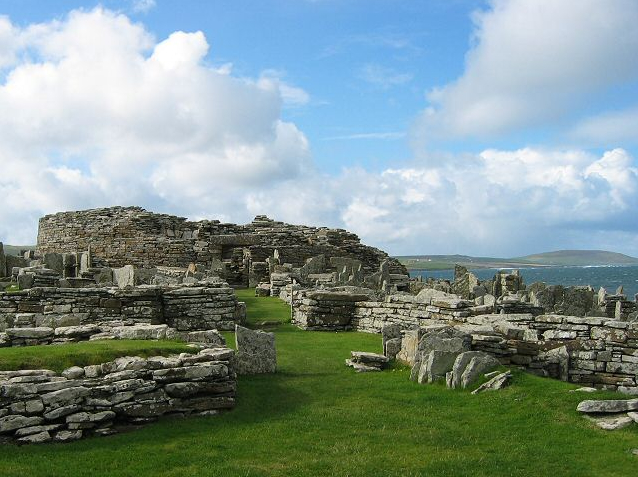
The Broch of Gurness is a stone tower and settlement on the north-east coast of Mainland Orkney, overlooking Eynhallow Sound.
- Near Evie
- 141 metres from car park
- Some walking
Ancient place · Prehistoric
Rousay
Orkney Islands
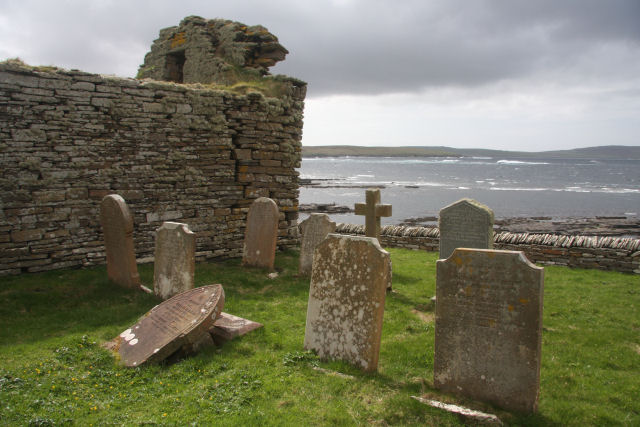
A small hilly island north of Mainland, whose density of remains has earned it a reputation of its own.
- Some walking
Questions people ask
- What is a stalled cairn?
- A tomb with a central passage flanked by paired transverse stones dividing the sides into compartments. Early investigators thought they resembled horse stalls, and the name stuck.
- How large is Midhowe?
- Twelve chambers flank a passage 23.6 metres long. The transverse stones stand two metres high and the walls survive to two and a half — the most elaborate example of the type.
- What happened to the roof?
- It is gone, as at almost every Orkney tomb. It may have been flat flagstone slabs at three metres, or a vault like Maeshowe reaching five; the evidence does not decide.
- Why is it filled with debris?
- The cairn appears to have been deliberately filled after several hundred years of use beginning early in the third millennium BC — a closing act rather than simple abandonment.
Sources
The Ancient Codex, in your pocket
Get the Pocket Codex app
Carry the directory with you — Midhowe Chambered Cairn and thousands of ancient places across Britain and Ireland, offline, wherever you roam.