
An exceptionally well-preserved broch where a spring-fed tank, roasting hearth and converted workshop spaces make everyday life in an Iron Age coastal settlement tangible.
A spring-fed tank sits in the floor of this tower — a broch, meaning a drystone round tower of a kind built only in the north of Scotland and the islands — and a hearth beside it still has the sockets that may have held a roasting spit. Domestic detail of that kind almost never survives in a broch, and it is what makes Midhowe worth the walk along the Rousay shore.
The tower stands on a narrow promontory between two steep creeks on the north side of Eynhallow Sound, nine metres across inside a wall four and a half metres thick, still over four metres high. Its name places it in a group: it is the middle of three similar structures within 500 metres of each other, and howe is the Old Norse haugr, mound.
Around it are smaller buildings, entered through a narrow gap into the defended settlement. They seem to have gone up as houses and to have been converted later into workshops — one of them still has its iron-smelting hearth in place.
Excavation between 1930 and 1933 recovered stone and bone tools for processing grain, spinning and weaving, and fragments of crucibles and moulds from bronzeworking. It also produced a piece of a Roman bronze vessel, which had travelled a long way to end up outside the empire on the coast of Rousay. Most of the finds are now displayed at the Broch of Gurness.
The sea is taking the site slowly; part of the settlement has already gone. A short distance to the south-east stands Midhowe Chambered Cairn, a large Neolithic tomb — two monuments thousands of years apart on the same stretch of shore.
What follows is drawn from published sources, with each claim labelled by how firmly it is established.
The name
Midhowe combines the Old Norse haugr, meaning a mound, with its position between two similar sites.
History
Midhowe Broch stands on a narrow promontory between two steep-sided creeks on the west coast of Rousay, on the north side of Eynhallow Sound. Part of the surrounding settlement has already been lost to coastal erosion. A promontory between two creeks gives water on three sides and one approach to defend, which is why the site was chosen. The name records its position within a group of three. It is the middle of three similar structures lying within 500 metres of one another, and the second element comes from the Old Norse haugr, meaning a mound or a barrow — a Norse word attached to an Iron Age tower.
The tower has an internal diameter of nine metres inside a wall 4.5 metres thick, and it still stands over four metres high. Those proportions are the defining feature of a broch — the wall takes up roughly as much ground as the space it encloses. A visitor standing inside is enclosed by as much stone as air. The interior is crowded with stone partitions. Set into the floor is a spring-fed water tank, and there is a hearth with sockets cut in it that may have held a roasting spit — domestic detail of a kind that very rarely survives in a building of this age.
Lesser buildings surround the tower, reached through a narrow entrance into the defended settlement. They appear to have been built as adjacent houses and were later turned over to industry; one still retains its iron-smelting hearth. The change from housing to industry is legible in the buildings themselves rather than inferred from finds alone. The broch and its attendant buildings were excavated between 1930 and 1933 and then taken into guardianship. The work recovered stone and bone tools for grain processing, spinning and weaving, along with crucible and mould fragments from bronzeworking.
One find sits oddly with the rest — a fragment of a Roman bronze vessel, recovered this far north and well outside the empire's frontier. Many of the artefacts from the excavation are now displayed at the Broch of Gurness rather than kept on site. How it reached Rousay, and whether by trade or by raid, is not recorded. A large Neolithic chambered cairn, Midhowe Chambered Cairn, lies a short distance to the south-east, so a burial monument and a defended settlement thousands of years apart occupy the same shore. Neither monument acknowledges the other, and the gap between them is longer than the whole of recorded British history.
Cultural influences
-
The broch, its surrounding buildings and later industrial hearths record a changing Iron Age settlement on the Rousay coast.
Connections
-
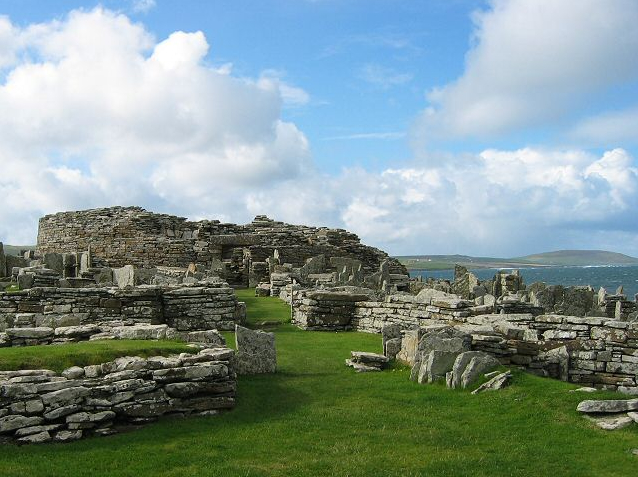
Photo: Rob Burke / Wikimedia Commons / CC BY-SA 2.0 Midhowe and Gurness are two major Orkney broch settlements preserved in Historic Environment Scotland care. Both allow visitors to compare a round tower with its surrounding domestic buildings, but Midhowe is dramatically confined to a Rousay coastal promontory.
-
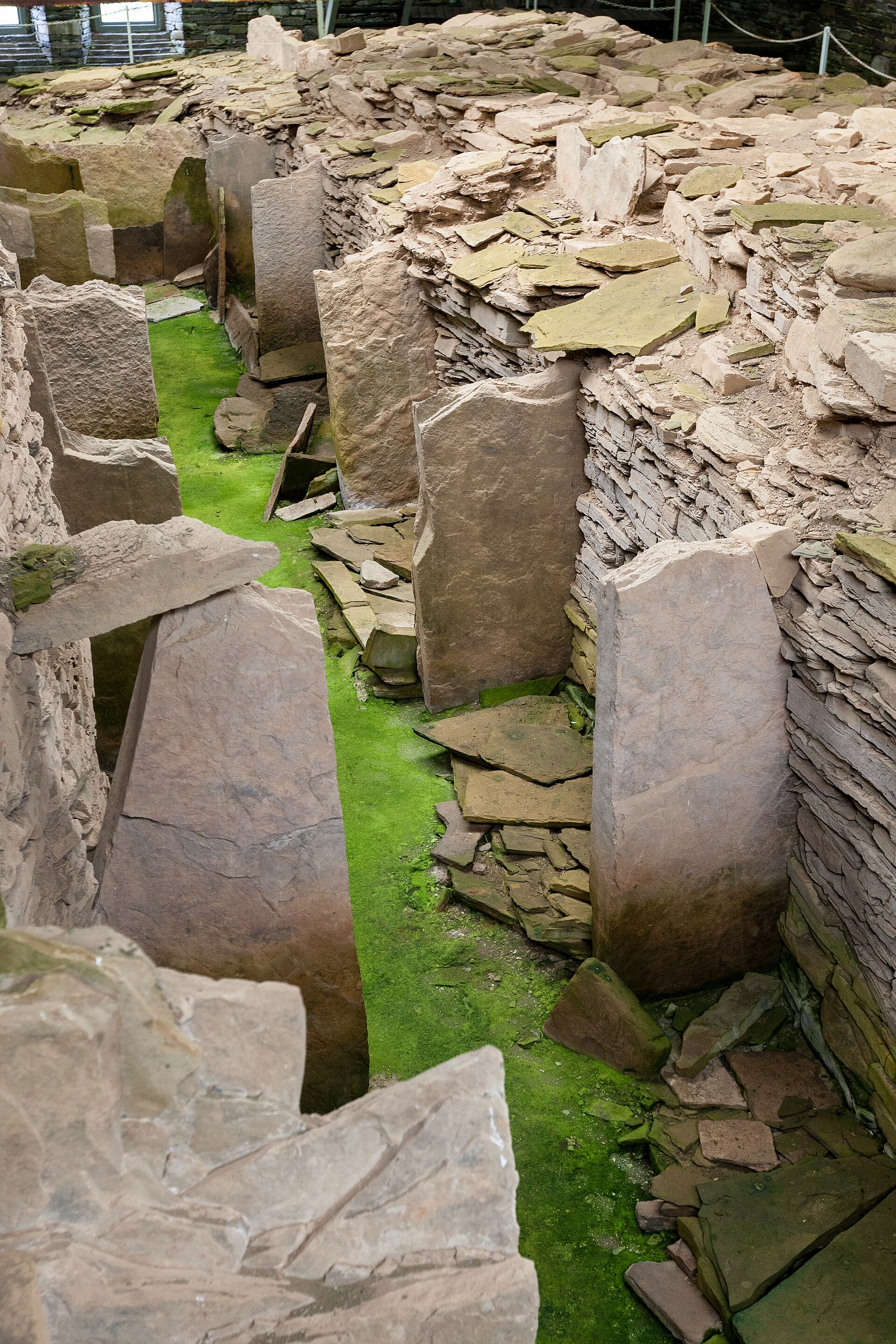
Photo: MichaelMaggs / Wikimedia Commons / CC BY-SA 4.0 Midhowe Broch and Midhowe Chambered Cairn share the same Rousay shore but belong to very different prehistoric communities: the cairn is a Neolithic communal tomb, while the broch is an Iron Age defended settlement.
-
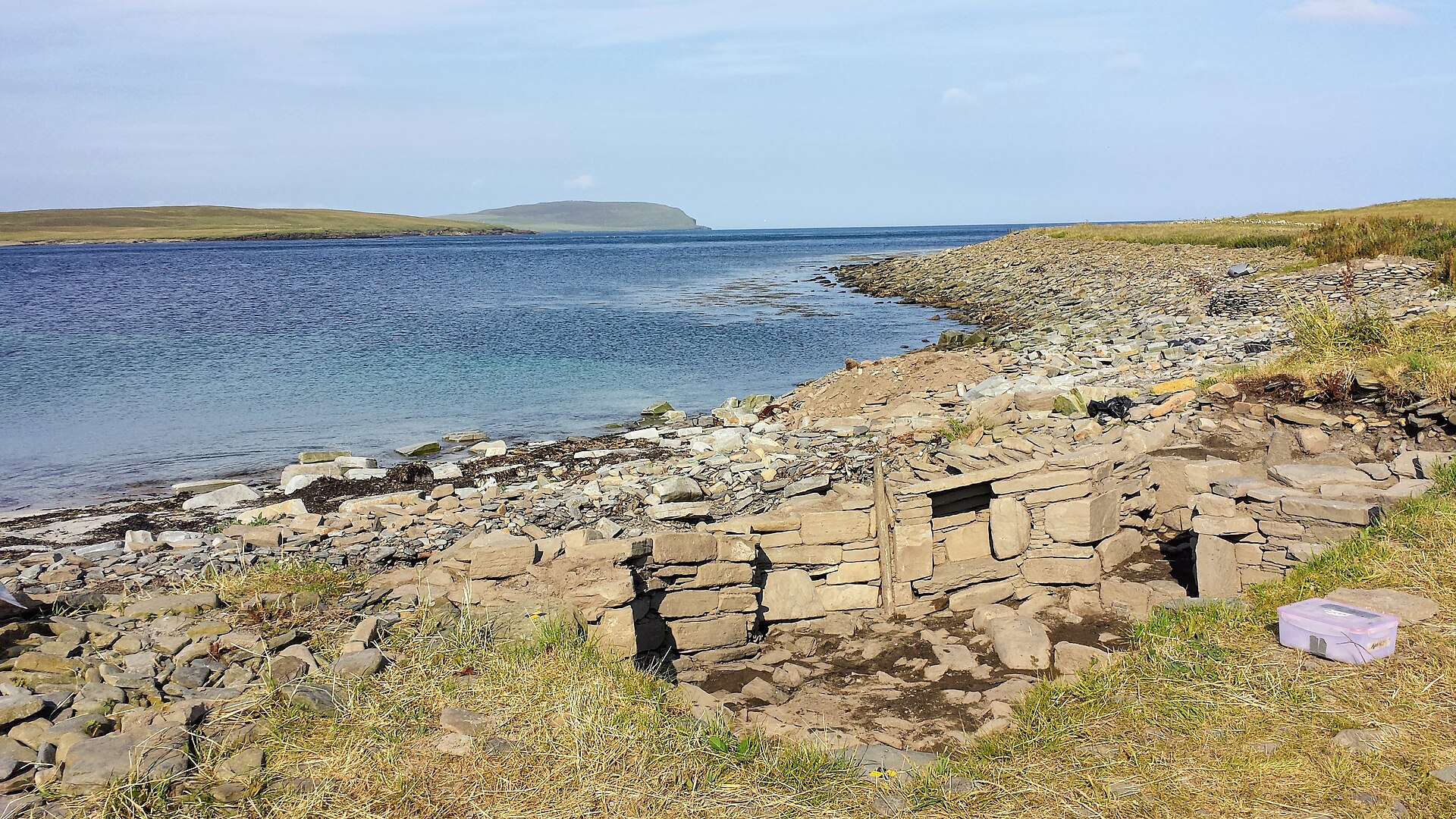
Photo: Bronwyn Chomitz / Wikimedia Commons / CC BY-SA 4.0 Knowe of Swandro is an eroding multi-period mound on the Rousay shore, investigated before loss to the sea. Its excavation places Midhowe Broch within the same threatened coastal archaeological landscape rather than treating the broch as an isolated tower.
Discovery & excavation
Excavation between 1930 and 1933 revealed the broch’s partitions, water tank, hearth, surrounding buildings and Roman-period finds.
What to look for
-
Stone partitions
Internal stone partitions crowd the round tower, preserving a detailed domestic layout inside walls 4.5 metres thick.
-
Water tank and hearth
A spring-fed water tank and hearth survive within the broch, including sockets that may have held a roasting spit.
-
Later working buildings
Surrounding buildings began as houses but were adapted for industry; one retains an iron-smelting hearth alongside the defended settlement.
Plan your visit
- Location
- 59.1574°N · 3.1003°W
- Nearest settlement
- Rousay
- Access
- Open access
- Terrain
- Moderate walking
- Time needed
- About 45 minutes
- Best time
- Daylight hours
- What survives
- The broch’s walls stand more than four metres high, while coastal erosion has removed parts of the surrounding settlement.
- Facilities
- Facilities are limited on the island; check transport and local visitor guidance before travelling.
Opening & admission
No reliable current admission details are recorded; verify before travelling.
- The broch is on a narrow promontory between steep-sided creeks and was taken into guardianship.
Nearby places
Tomb or burial place · Prehistoric
Midhowe Chambered Cairn
Orkney Islands
A large burial mound with an internal stone chamber on the south shore of Rousay, named after the drystone tower beside it.
- Near Rousay
- 10 min walk from car park
- Easy path
Ancient place · Prehistoric
Knowe of Swandro
Orkney Islands
Knowe of Swandro is a coastal archaeological site on Rousay, where a burial tomb, settlement remains and Viking-age buildings are being eroded by t…
- Rough ground
Settlement · Prehistoric
Broch of Gurness
Orkney Islands
The Broch of Gurness is a stone tower and settlement on the north-east coast of Mainland Orkney, overlooking Eynhallow Sound.
- Near Evie
- 141 metres from car park
- Some walking
Ancient place · Prehistoric
Rousay
Orkney Islands
A small hilly island north of Mainland, whose density of remains has earned it a reputation of its own.
- Some walking
Questions people ask
- Why is it called Midhowe?
- Because it is the middle of three similar structures grouped within 500 metres of one another. Howe comes from the Old Norse haugr, meaning mound or barrow.
- How big is the tower?
- Nine metres across inside a wall 4.5 metres thick, still standing over four metres high on a narrow promontory between two steep-sided creeks.
- What is inside?
- Stone partitions crowd the interior, with a spring-fed water tank set into the floor and a hearth whose sockets may have held a roasting spit.
- What were the surrounding buildings?
- They appear to have started as adjacent houses and were later used as workshops. One still retains its iron-smelting hearth.
- What did the excavations find?
- Work between 1930 and 1933 recovered stone and bone tools for grain processing, spinning and weaving, crucible and mould fragments from bronzeworking, and a fragment of a Roman bronze vessel. Many of the finds are displayed at the Broch of Gurness.
Sources
The Ancient Codex, in your pocket
Get the Pocket Codex app
Carry the directory with you — Midhowe Broch and thousands of ancient places across Britain and Ireland, offline, wherever you roam.