One of the best-preserved Clava cairns in the Highlands, its passage still roofed by the original cup-marked capstone and its burial chamber found in 1952 to hold a crouched Bronze Age (roughly 2500–800 BC, when metal tools first spread) skeleton.
Stoop low to pass through the entrance and the passage narrows to barely a metre in height before opening into a chamber built of huge waterworn boulders, its roof formed by a single flat slab carved with shallow cup marks and weighted down under a heap of small stones. It is an oddly intimate space for a tomb: dark, close, and clearly built to be sealed rather than displayed.
The cairn belongs to a small and distinctive family of Bronze Age burial monuments called Clava cairns, a type of round mound with a chambered tomb inside, ringed by a circle of standing stones, that has been found only in the Highlands of Scotland. At Corrimony the mound is edged by a stone kerb and surrounded by eleven large stones, four of which are later replacements, ranging from around 1.5 to 2.7 metres tall. The chamber itself is some 18 metres across and 2.5 metres high, built from vertical boulders and drystone walling, with two extra lintel stones added west of the entrance after the tomb was first raised.
When archaeologists opened the chamber in the twentieth century they found it had done exactly what its builders intended: beneath a floor of flagstones lay a single crouched burial, undisturbed for millennia, and one small personal object left with the dead.
What follows is drawn from published sources, with each claim labelled by how firmly it is established.
History
During the Bronze Age, builders in this part of the Highlands raised Corrimony as one of the Clava cairns, a regional tradition of burial monuments unique to the area: a stone-kerbed mound covering a passage and chamber, ringed by a circle of standing stones. The design allowed a single low entrance to be sealed once the burial rite inside the chamber was complete, leaving the outer ring of stones as the only visible marker of what lay within.
The builders capped the central chamber with one large flat stone, carved with cup marks, and piled small stones over the top, while two further lintel stones were added west of the passage entrance after the initial construction. This later addition suggests the monument was reopened or reinforced at some point after it was first built, rather than sealed once and left entirely untouched.
In 1952 the archaeologist Professor Stuart Piggott excavated the cairn and opened the central chamber for study. Beneath a floor of flagstones he found a single crouched inhumation burial, the body drawn up into a curled position in the manner typical of the period, undisturbed since it was placed there in the Bronze Age. Piggott's excavation recovered only one artefact from the chamber, a bone pin buried alongside the body, which passed into the collection of the National Museum of Scotland, where it remains today as the sole surviving object associated with the burial.
In 1994 Historic Environment Scotland designated Corrimony chambered cairn a scheduled monument, giving the site legal protection in recognition of its condition and its importance among the small number of surviving Clava cairns in the Highlands.
People
-
Stuart Piggott
Archaeologist who excavated the chamber in 1952 and uncovered its crouched burial and bone pin.
Cultural influences
-
The Clava cairn tradition
Corrimony’s kerbed mound, narrow passage, chamber and outer stone circle belong to the local Clava tradition of Bronze Age tombs.
Connections
-
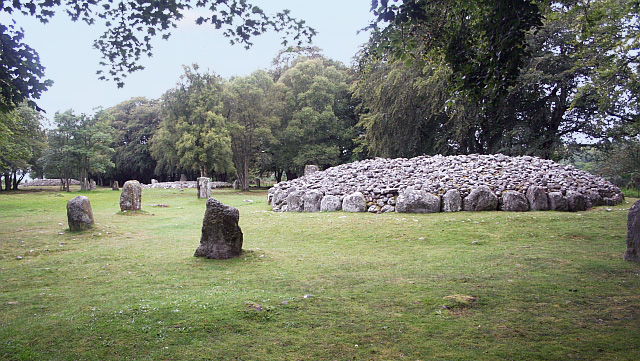
Photo: Bob Embleton / Wikimedia Commons / CC BY-SA 2.0 The type site for the Clava cairn tradition: both groups have a passage and chamber within a stone mound, surrounded by standing stones, and Historic Environment Scotland notes that Corrimony’s south-west-facing passage and cup-marked capstone closely parallel the Clava monuments near Inverness.
Discovery & excavation
The cairn was excavated in 1952 by the archaeologist Stuart Piggott, who opened the central chamber and found a crouched inhumation burial beneath a floor of flagstones, along with a single bone pin left as a grave good.
Finds now held at: National Museum of Scotland.
What to look for
-
The cup-marked capstone
The chamber's roof is a single flat slab carved with shallow cup marks, thought to be the tomb's original capstone, now buried under a cairn of small stones.
-
The narrow entrance passage
A passage only about a metre high leads from outside the mound into the central chamber, forcing a stoop to pass through.
-
The outer stone circle
Eleven large stones, four of them later replacements, ring the mound at heights of roughly 1.5 to 2.7 metres, marking the boundary of the monument.
-
The burial chamber
Built from massive waterworn boulders and drystone walling, the chamber measures around 18 metres across and 2.5 metres high, and once held a single crouched skeleton.
Plan your visit
- Location
- 57.3346°N · 4.6878°W
- Nearest settlement
- Drumnadrochit
- Access
- Open access
- Terrain
- Easy going
- Time needed
- About 45 minutes
- Best time
- Daylight, when the cup-marked capstone and outer ring can be seen clearly.
- What survives
- A well-preserved chambered cairn with its passage, capstone and surrounding stone circle still legible.
- Facilities
- No dedicated visitor facilities are documented at the cairn; plan to use facilities in nearby settlements.
Opening & admission
- Well-preserved scheduled cairn near Glen Urquhart.
Nearby places

Building or ruin · Medieval
Urquhart Castle
Highland
Blown up in 1692 to deny it to Jacobite forces, its shattered gatehouse and leaning tower still mark almost four centuries of siege along the Great…

Tomb or burial place · Prehistoric
Carn Glas
Highland
At 116 metres long, this three-part cairn (a mound of piled stones, often covering a burial) is the longest chambered burial monument yet recorded…
- Near Inverness
- Some walking

Ancient tree · Medieval
The Last Ent of Affric
Highland
An elm that outlived both the forest around it and the disease that took most of its kind, saved by standing somewhere nothing would sensibly have…
- Near Highland
Fortified place · Iron Age
Craig Phadrig
Highland
Its stone rampart was fused to glass by fire in the 4th century, and tradition: never proven: casts it as the seat where a Pictish (of the Picts, t…
- Near Inverness
- Some walking
The setting
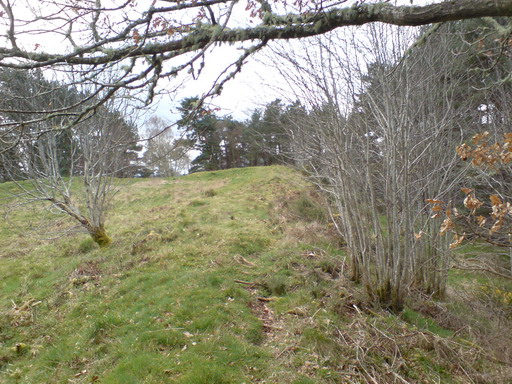
Wayfinding path towards Corrimony chambered cairn; retained as a contextual approach view.
Photo: Bill Harrison / Wikimedia Commons / CC BY-SA 2.0
Questions people ask
- What type of monument is Corrimony chambered cairn?
- It is a Bronze Age burial monument known as a Clava cairn, a chambered tomb under a stone mound ringed by standing stones, a type found only in the Scottish Highlands.
- Who excavated the site and when?
- The archaeologist Professor Stuart Piggott excavated the cairn in 1952, opening the central chamber for study.
- What was found inside the chamber?
- Excavation uncovered a single crouched inhumation burial beneath a flagstone floor, along with one bone pin, now held by the National Museum of Scotland.
- How is the cairn's stone circle arranged?
- Eleven large stones ring the mound, ranging from about 1.5 to 2.7 metres in height; four of them are later replacements rather than original.
- Is the site legally protected?
- Yes. Historic Environment Scotland designated it a scheduled monument in 1994.
Sources
The Ancient Codex, in your pocket
Get the Pocket Codex app
Carry the directory with you — Corrimony chambered cairn and thousands of ancient places across Britain and Ireland, offline, wherever you roam.