
At 116 metres long, this three-part cairn (a mound of piled stones, often covering a burial) is the longest chambered burial monument yet recorded anywhere in Scotland.
On a low ridge above Essich Moor, south-east of Achvraid near Inverness, three mounds of stone lie joined in an unbroken line, together forming a single burial monument far longer than any other of its kind known in Scotland. Each mound is a chambered cairn, a prehistoric (predating the written record in Britain) burial mound built over one or more stone-lined chambers, but here three such structures were fused end to end rather than built as separate, freestanding monuments.
The combined cairn runs to some 116 metres, or 381 feet, in length, a scale that sets it apart from the round or horned cairns found in isolation elsewhere in the Highlands. It was raised during the Neolithic period, several thousand years before the present day, by communities who chose to extend rather than duplicate their monument, building outward along the ridge instead of starting afresh nearby.
Today the moor around it holds other prehistoric remains, among them a stone circle at Torbreck and a further chambered cairn at Culduthel, suggesting Essich Moor was a chosen place for burial and ceremony over a sustained period. The cairn has been under legal protection as a scheduled monument since 1964, recognising it as a nationally significant survival of Neolithic Scotland.
What follows is drawn from published sources, with each claim labelled by how firmly it is established.
The name
Càrn Glas means ‘green or grey cairn’ in Gaelic, combining càrn, a stone mound, with glas, a colour word that can mean green or grey.
History
During the Neolithic period, likely in the fourth or third millennium BC, communities working on Essich Moor built three separate chambered cairns end to end along a low ridge, joining them into a single continuous monument. The result, stretching some 116 metres, linked burial chambers that elsewhere in Scotland stood apart, making this one structure rather than a cluster of smaller ones.
The finished cairn came to be recognised as the longest known chambered cairn in Scotland, its 116-metre span, 381 feet, unmatched among the surviving Neolithic burial monuments of the country. Its distinction rests not on height or elaborate chamber design but on sheer continuous length, three cairns fused into one earthwork running along the ridge above the moor.
In 1964 the site was designated a scheduled monument, protection that covers the buried structure as much as the mound visible above it. The designation recognised both its unusual length and its place among a wider group of prehistoric monuments on and around Essich Moor, including a stone circle at Torbreck and a further chambered cairn at Culduthel.
Cultural influences
-
A connected Neolithic cairn
Three chambered cairns were built end to end along one ridge, making a single 116-metre monument rather than separate burial mounds.
Connections
-
Torbreck stone circle
A stone circle standing nearby on Essich Moor, part of the same cluster of prehistoric ceremonial and burial sites as Carn Glas.
-
Culduthel chambered cairn
A further chambered cairn near Inverness, grouped with Carn Glas as part of the same regional tradition of Neolithic burial monuments.
What to look for
-
Three linked cairns
The monument is formed of three distinct cairns built in a continuous line along the ridge rather than as separate mounds, visible as a single elongated earthwork.
-
Exceptional length
At 116 metres (381 feet), the combined structure is markedly longer than typical chambered cairns, making its scale the most immediately striking feature on the ground.
Plan your visit
- Location
- 57.4150°N · 4.2500°W
- Nearest settlement
- Inverness
- Access
- Open access
- Terrain
- Moderate walking
- Time needed
- About 45 minutes
- Best time
- Daylight, when the long ridge-top earthwork is easiest to trace.
- What survives
- The surviving monument is a long, low earthwork on Essich Moor, with its chambered structure largely buried.
Opening & admission
- Ridge monument on Essich Moor; public access not established by the record.
Nearby places

Building or ruin · Medieval
Inverness Castle
Highland
The red sandstone towers standing today are the third castle on this cliff: successor to a fortress whose 1428 parley ended with fifty Highland chi…
Fortified place · Iron Age
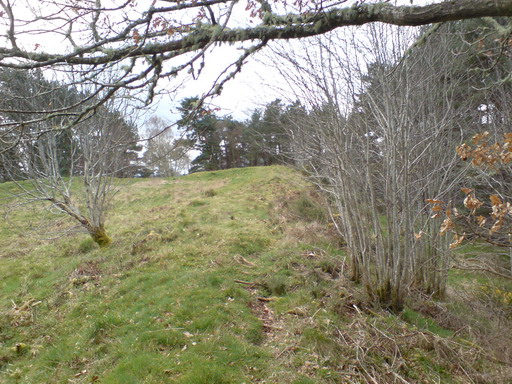
Craig Phadrig
Highland
Its stone rampart was fused to glass by fire in the 4th century, and tradition: never proven: casts it as the seat where a Pictish (of the Picts, t…
- Near Inverness
- Some walking
Tomb or burial place · Prehistoric
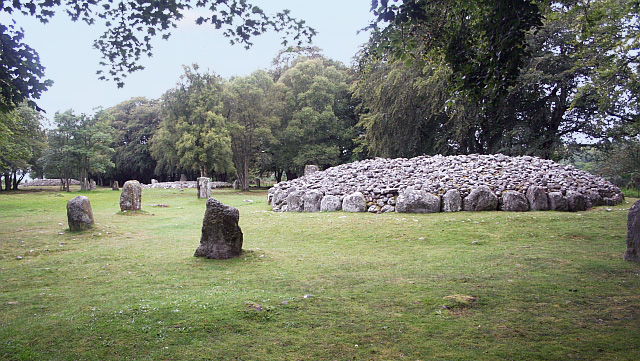
Clava Cairns
Highland
Clava’s planned arrangement of cairns and standing stones offers rare evidence of a single communal decision about burial and remembrance, rather t…
- Near Inverness
- 149 metres from car park
- Easy path

Tomb or burial place · Prehistoric
Clava cairn
Highland
A burial mound of piled stones at Balnuaran of Clava, whose kerb stones were sorted by colour before they were laid.
- Near Inverness
- Some walking
The setting
Near Carn Glas, about 40 metres away.
Photo: valenta / Wikimedia Commons / CC BY-SA 2.0
Near Carn Glas, about 499 metres away.
Photo: Peter Wood / Wikimedia Commons / CC BY-SA 2.0
Questions people ask
- What is Carn Glas?
- A Neolithic chambered cairn burial site on Essich Moor near Inverness, formed of three linked cairns on a ridge.
- How long is Carn Glas?
- It measures about 116 metres (381 feet), making it the longest known chambered cairn in Scotland.
- Where is Carn Glas located?
- South-east of Achvraid on Essich Moor, near Inverness in the Scottish Highlands.
- Is Carn Glas a protected site?
- Yes, it was designated a scheduled monument in 1964, protection that covers the buried structure as much as the mound visible above it.
- Are there other ancient sites nearby?
- Yes, a stone circle at Torbreck and a further chambered cairn at Culduthel stand nearby on the same moor.
Sources
The Ancient Codex, in your pocket
Get the Pocket Codex app
Carry the directory with you — Carn Glas and thousands of ancient places across Britain and Ireland, offline, wherever you roam.