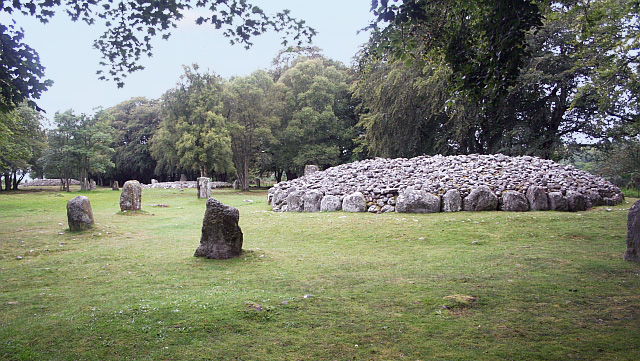
A burial mound of piled stones at Balnuaran of Clava, whose kerb stones were sorted by colour before they were laid.
About fifty tombs around Inverness and the Moray Firth belong to a single type of the Bronze Age — roughly 2500–800 BC — named after the three that stand together at Balnuaran of Clava. A cairn is a mound of heaped stone raised over a burial, and the Clava sort comes in two forms — one a passage grave with a single chamber reached by a short passage, the other a ring cairn enclosing an open area with no way in at all.
What follows is drawn from published sources, with each claim labelled by how firmly it is established.
History
The Clava cairn is a class of Bronze Age circular chambered tomb, named from the group of three cairns at Balnuaran of Clava east of Inverness. Roughly fifty examples are known in the country around Inverness, and they divide into two sub-types. The first is a corbelled passage grave — a burial chamber roofed by overlapping stone courses and reached along a short stone corridor — holding a single chamber beneath a covering cairn of stones, with the entrance turned to the south-west and midwinter sunset. The second is an annular ring cairn, which encloses an area that appears never to have been roofed and has no formal way in from outside.
Both sub-types share the same outer arrangement: a stone circle set round the whole tomb, and frequently a kerb of stones running about the cairn itself. The standing stones are graded in height, the tallest placed to the south-west at the entrance and the shortest directly opposite. Where burial remains survived in Clava-type tombs, only one or two bodies seem to have been placed in each; and because the ring-cairn sub-type offers no access at all, the design suggests there was no intention of returning to the dead or of adding further burials over time, as had been the practice in Neolithic cairn tombs of the preceding farming centuries.
At Balnuaran of Clava itself three Bronze Age cairns lie close together on a line running north-east to south-west, and it is these that give the whole class its name and serve as its type site for the fifty or so comparable monuments around Inverness and the Moray Firth. The cairns at either end are passage graves; the middle one is a ring cairn, and it is the only known example with stone paths or causeways forming rays that run out from the platform, across the kerbs, to three of the standing stones.
Stones bearing cup and ring marks were built into the fabric, the carving done before they were set in place, so the builders were reusing worked stone rather than decorating a finished monument. The kerb stones were sorted for size and for colour as well: larger and redder towards the south-west, smaller and whiter towards the north-east. Nothing about the arrangement reads as piecemeal addition — the graded stones, the sorted kerb and the causeways appear to belong to a single operation, and to a design settled before building began. The Balnuaran group stands at grid reference NH757445.
Cultural influences
-
A regional Bronze Age tomb tradition
Clava cairns share a deliberate regional design: a stone circle and kerb around a passage grave or ring cairn, with the largest stones placed on the south-west side.
Connections
-
Balnuaran of Clava
The three cairns at Balnuaran of Clava are the type site from which this class of tomb takes its name.
-
Moray Firth
The fifty or so cairns of this type are distributed around Inverness and the Moray Firth.
What to look for
-
The south-west entrance side
In passage-grave examples, the entrance and tallest standing stones are set to the south-west, opposite the smaller stones.
-
Ring-cairn interiors
Some Clava cairns enclose an apparently unroofed central space with no formal external entrance.
-
Graded kerbs
At Balnuaran, larger redder kerb stones lie to the south-west while smaller paler ones run to the north-east.
Plan your visit
- Location
- 57.4737°N · 4.0743°W
- Nearest settlement
- Inverness
- Access
- Open access
- Terrain
- Moderate walking
- Time needed
- About 60 minutes
Opening & admission
Balnuaran of Clava is the named type site for this class of cairn; check current access information for the specific monument you plan to visit.
- The type is named after Balnuaran of Clava east of Inverness.
- The record includes about 50 examples in the Inverness and Moray Firth area.
Nearby places
Tomb or burial place · Prehistoric
Clava Cairns
Highland
Clava’s planned arrangement of cairns and standing stones offers rare evidence of a single communal decision about burial and remembrance, rather t…
- Near Inverness
- 149 metres from car park
- Easy path
Minor monument · Medieval
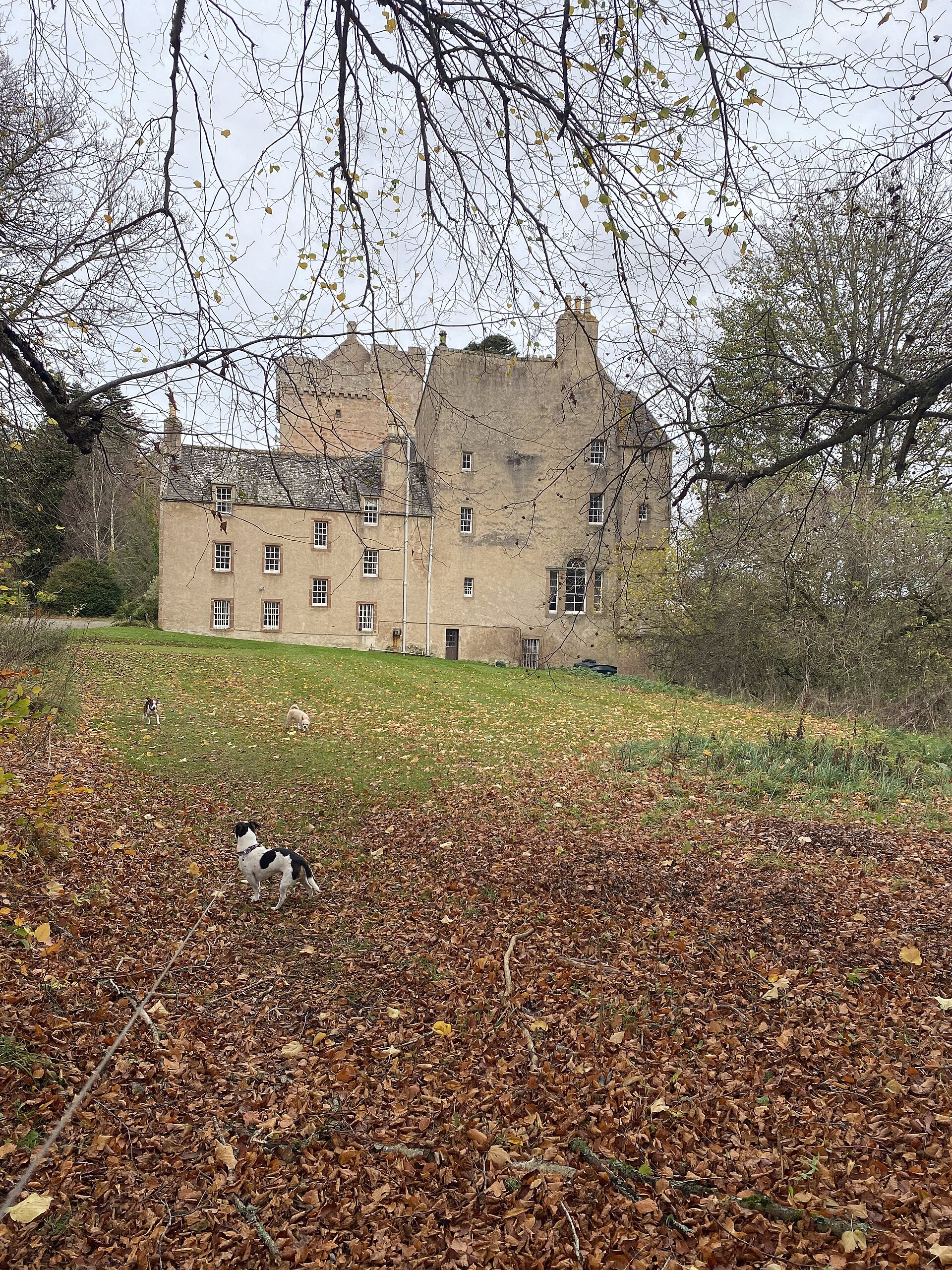
Dovecot, Kilravock Castle
Highland
Kilravock’s pigeon house, built to keep birds for winter meat, makes the estate’s long-running economy tangible within a building altered from medi…
- Near Cawdor

Fortified place · Iron Age
Dun Evan
Highland
A double ring of vitrified (burnt so fiercely that the stone melted and set again) and rebuilt walls crowns a rock between two river valleys, with…
- Near Cawdor
- Some walking

Building or ruin · Medieval
Inverness Castle
Highland
The red sandstone towers standing today are the third castle on this cliff: successor to a fortress whose 1428 parley ended with fifty Highland chi…
Questions people ask
- Why is Clava cairn significant?
- The three cairns at Balnuaran of Clava give their name to a class of Bronze Age tomb, of which some fifty examples are known around Inverness and the Moray Firth.
- What should a reader focus on?
- Kerb stones sorted by size and colour, standing stones graded in height towards the south-west, and the stone causeways running out from the central ring cairn to three of the uprights.
- How certain is the interpretation?
- The two sub-types and the graded settings are well recorded. Why the ring-cairn form was built with no way in at all is inferred from the design rather than documented.
Sources
- Wikipedia: Clava cairn
- Wikidata: Q457879
- Canmore 14275 — BALNUARAN OF CLAVA (bank (earthwork) (period unassigned)) (accessed 2026-08-03)
Explore more: Tomb or burial places · Prehistoric · Highland
The Ancient Codex, in your pocket
Get the Pocket Codex app
Carry the directory with you — Clava cairn and thousands of ancient places across Britain and Ireland, offline, wherever you roam.