
A slab of red granite standing some three metres high, carved on every face with Christian crosses, Pictish beasts and a legend of the Devil's forfeit — one of the tallest Pictish monuments to survive at all.
A triangular notch bites into the shoulder of the stone, high up where the granite has worn thin. Local tradition says it marks the grip of the Devil’s hand, closing on a fleeing girl in the instant before she turned to stone — and it is that notch, more than anything else carved into the slab, that gave the monument its name.
The stone itself stands near Inverurie in Aberdeenshire, close to a farm called Drumdurno, from which it takes its alternative name, the Drumdurno Stone. It is red granite, roughly three metres tall, some 0.9 metres broad and 0.3 metres thick, making it one of the largest Pictish monuments known to survive, even allowing for several centimetres lost from the top to weathering over more than a thousand years. Every face carries carving: a ringed cross and a human figure flanked by two fish-monsters on one side, a large centaur and a menagerie of Pictish symbols on the other.
It belongs to a class of monument scholars call Class II — cross-slabs that fuse the new Christian imagery of the ringed cross with the older symbol-system of the Picts, carved side by side on the same stone. Its sheer scale suggests it was never a quiet marker but a deliberate landmark, meant to be seen and understood from a distance across the surrounding land.
What follows is drawn from published sources, with each claim labelled by how firmly it is established.
The name
The name comes directly from a local legend attached to the stone's most obvious scar: a triangular notch near the top, which tradition holds was left by the grasp of a pursuer as a fleeing woman was turned to stone.
History
.jpg?width=1000)
During the late 8th or early 9th century AD, carvers raised the stone as a Class II Pictish monument, combining the new Christian cross with older, pre-Christian Pictish symbols on the same slab. Its unusual height and bulk, among the largest of all surviving Pictish monuments, suggest it was intended from the outset as a landmark, a deliberate statement carved to be seen across the surrounding landscape rather than a modest local marker.
Across the centuries that followed, exposure to weather steadily eroded the carved surfaces, and several centimetres were lost from the top of the stone altogether. The western face, carrying the cross and the flanking figures, suffered the heaviest wear, while a portion of the north edge has been lost outright, leaving some of the finer knotwork and symbol detail badly blurred and difficult to read today.
At some point in its long life the stone acquired the local legend that still gives it its name: the tale of the Laird of Balquhain's daughter, who wagered she could bake a bannock faster than a stranger could build a road to the top of Bennachie, lost when the stranger proved to be the Devil, and was turned to stone by God as she fled him in prayer, the notch near the stone's top marking where his hand closed on her shoulder.
The stone survives today as a scheduled monument in the care of Historic Environment Scotland, and remains open to visitors at all times, standing much as it has for over a thousand years despite the losses weathering has inflicted on its carved faces.
Cultural influences
-
Pictish Christian art
The monument follows the Class II Pictish cross-slab tradition, bringing a Christian ringed cross together with older Pictish symbols and animal imagery on the same stone.
Connections
-
Stones of Scotland
The Maiden Stone is counted among the Stones of Scotland, a recognised national collection of the country's most significant standing stones.
-
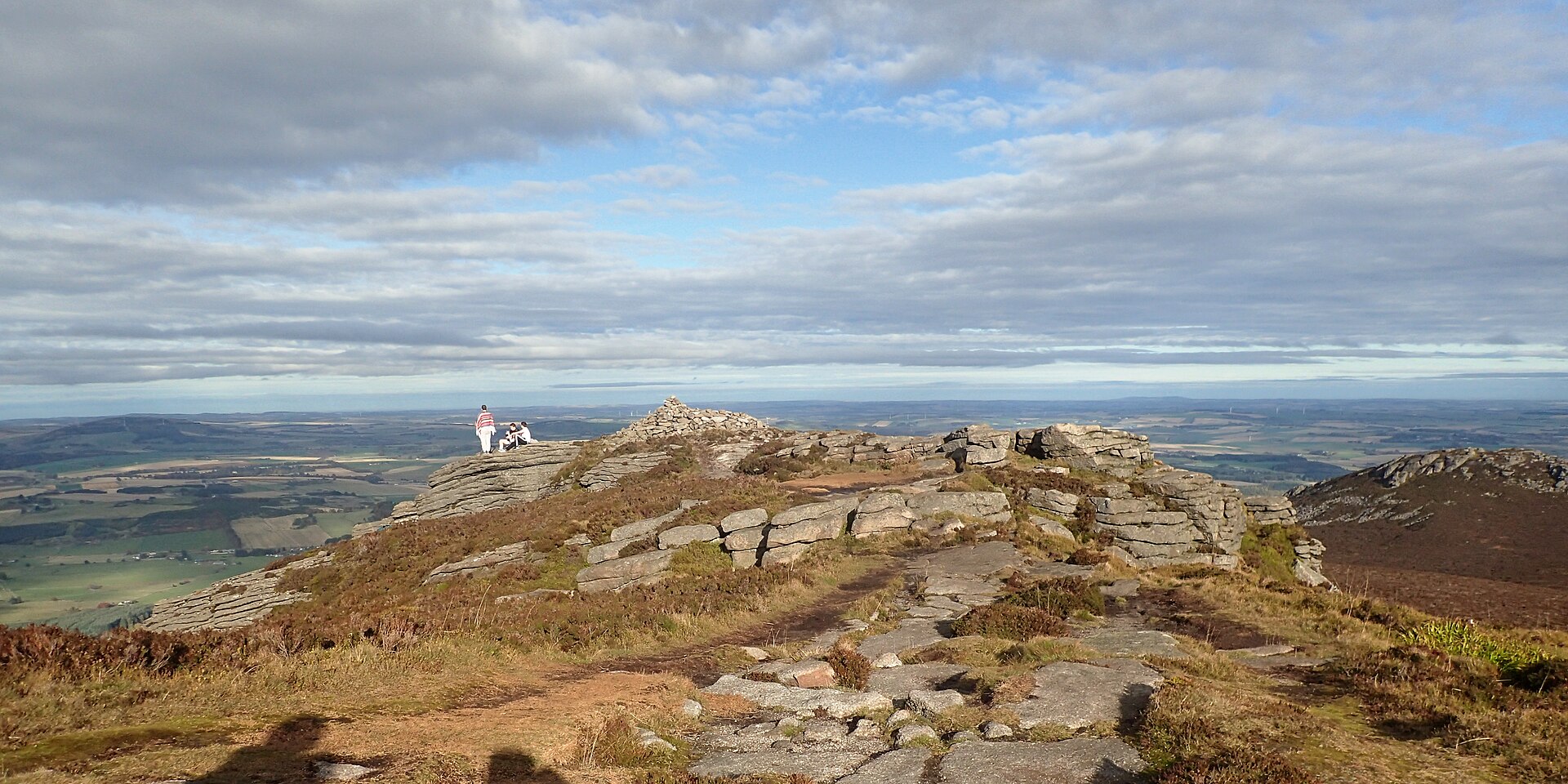
Photo: Andy Waddington / Wikimedia Commons / CC BY-SA 2.0 The Maiden Stone’s local legend is set against Bennachie: the Laird of Balquhain’s daughter races a stranger building a road to the hill’s summit, then is turned to stone as she flees. The story ties the carved monument to the wider Aberdeenshire landscape.
What to look for
-
The triangular notch
A distinctive triangular notch near the top of the stone, the wear that gave the monument its name and its attached legend.
-
The ringed cross and fish-monsters
On the western face, a ringed cross sits below a human figure positioned between two carved fish-monsters, a scene possibly representing the Biblical story of Jonah and the whale, doubled for symmetry.
-
Spiral and knotwork panel
Below the cross, a square panel holds a disc carved with a Celtic spiral motif, ringed by a key pattern and infilled at the corners with knotwork.
-
The centaur panel
On the reverse face, a large centaur is carved beneath three heavily weathered figures, thought to be two smaller wrestling centaurs and a dog.
-
Pictish symbols
Further panels on the reverse carry a notched rectangle and Z-rod symbol and a Pictish Beast symbol, alongside carvings of a mirror and a comb.
-
Edge carvings
The narrow north edge bears a knotwork pattern and the south edge a keywork pattern, though part of the north edge has been lost.
What is said
Folklore and tradition, recorded as what is said — not as established fact.
-
The Maiden and the Devil
Local tradition holds that the Laird of Balquhain's daughter bet a stranger she could bake a bannock faster than he could build a road up Bennachie, and that the stranger was the Devil, who won the wager and pursued her until she prayed and was turned to stone, with the notch on the stone said to mark where his hand caught her shoulder.
Plan your visit
- Location
- 57.3120°N · 2.4934°W
- Nearest settlement
- Inverurie
- Access
- Open access
- Terrain
- Easy going
- Time needed
- About 20 minutes
- Best time
- Clear daylight, when the weathered carvings on both faces can be examined.
- What survives
- A weathered but standing Pictish cross-slab, retaining its ringed cross, symbols, animal figures and distinctive triangular notch.
- Facilities
- No dedicated visitor facilities are recorded at the stone.
Opening & admission
Free to visit; check Historic Environment Scotland's site for any current guidance before travelling.
- Scheduled monument, open at all times
Nearby places
Fortified place · Roman
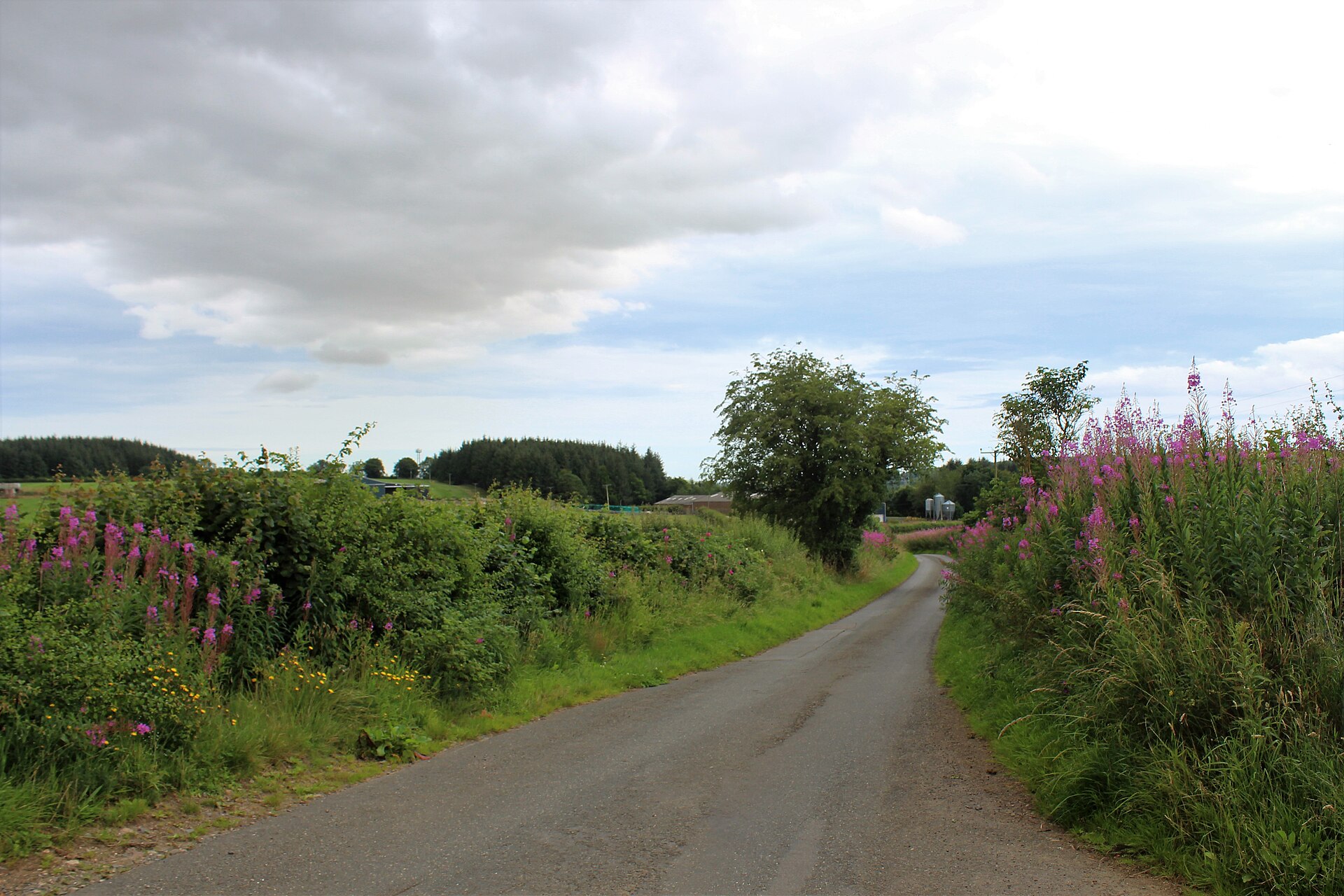
Durno
Aberdeenshire
The largest Roman marching camp yet found north of the Antonine Wall, revealed only by a chance aerial photograph after two millennia buried beneat…
- Near Inverurie
- Easy path
Fortified place · Iron Age
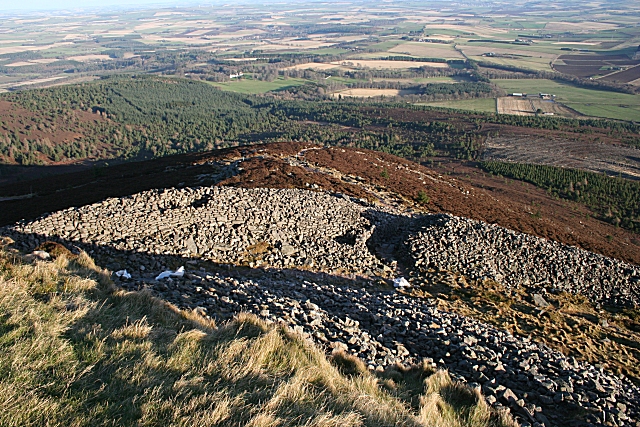
Mither Tap hillfort
Aberdeenshire
Excavation found an intact crucible and iron slag inside the ramparts: proof this granite summit was a working metalworking centre, not just a look…
- Rough ground
Sacred place · Prehistoric
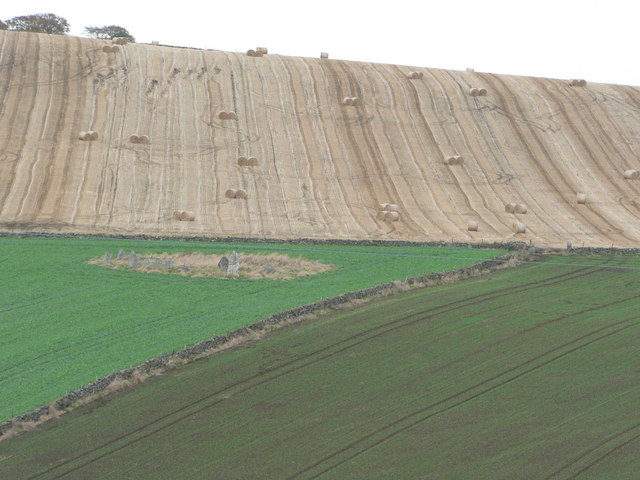
Balquhain
Aberdeenshire
A rounded hump on its ten-tonne recumbent stone echoes the outline of Mither Tap behind it, and 1980s survey work found its flanking stones deliber…
- Some walking
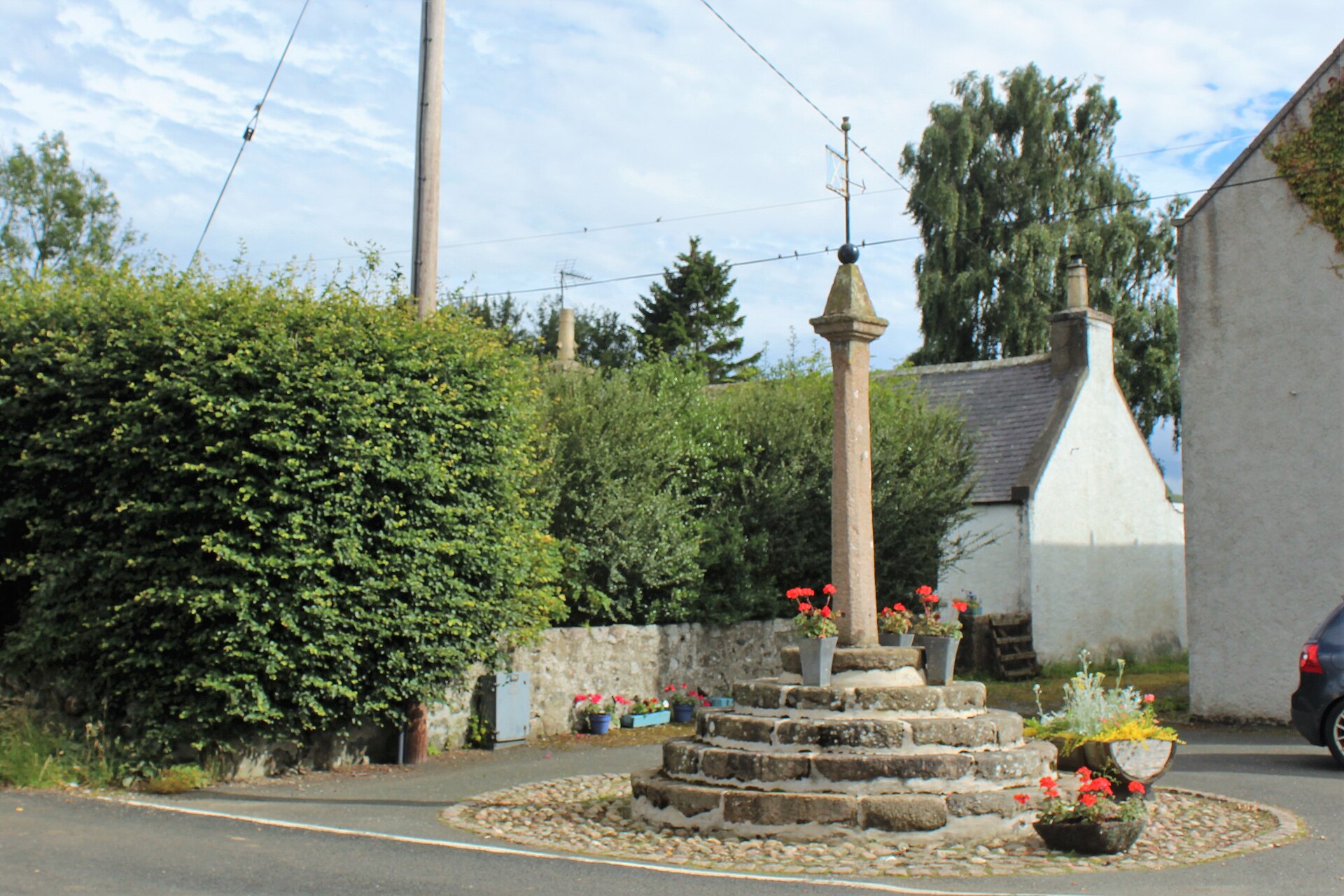
Minor monument · Medieval
Market Cross, Old Rayne
Aberdeenshire
A granite market cross on five circular steps preserves Old Rayne’s status as a burgh of barony created in 1492.
- Easy path
Questions people ask
- What is the Maiden Stone?
- A Pictish cross-slab of red granite near Inverurie, Aberdeenshire, carved in the late 8th or early 9th century AD with Christian and Pictish symbols.
- Why is it called the Maiden Stone?
- The name comes from local legend: a triangular notch on the stone is said to mark where the Devil grasped a fleeing woman before she turned to stone.
- How tall is the Maiden Stone?
- It stands about 3 metres high, 0.9 metres broad and 0.3 metres thick, making it one of the tallest surviving Pictish monuments.
- What is carved on the stone?
- A ringed cross, a human figure between fish-monsters, spiral and knotwork panels, a centaur, Pictish symbols, a mirror and a comb.
- Can visitors see the Maiden Stone today?
- Yes. It is a scheduled monument cared for by Historic Environment Scotland and is open to visitors at all times.
Sources
- Wikipedia: Maiden Stone
- Wikidata
- Historic Environment Scotland
Explore more: Carved stones · Pictish & early medieval · Aberdeenshire
The Ancient Codex, in your pocket
Get the Pocket Codex app
Carry the directory with you — Maiden Stone and thousands of ancient places across Britain and Ireland, offline, wherever you roam.