
A rounded hump on its ten-tonne recumbent stone echoes the outline of Mither Tap behind it, and 1980s survey work found its flanking stones deliberately aligned to specific moonrises and moonsets.
Near Inverurie, four uprights remain on a terraced field shoulder with Mither Tap on the horizon. Between two of them sits a white-grained granite slab weighing more than ten tonnes, its flat placement identifying Balquhain as a recumbent stone circle: a Bronze Age (roughly 2500–800 BC) ring in which the largest stone lies horizontally between two flankers.
The flankers themselves are worth stopping to look at: one is dark grey basalt with a rounded top, the other reddish quartzite flecked with white quartz and rising to a point, as if the builders had deliberately chosen contrasting stone for each side of the recumbent. A separate outlying stone, veined with rose-coloured quartz, stands a short distance to the southeast. Carved into the recumbent itself is a low, rounded bump that seems to mirror the shape of the hill rising behind it, alongside faint cup-shaped hollows pecked into the stone’s surface.
Balquhain belongs to a distinctive local tradition — more than seventy recumbent stone circles survive across lowland Aberdeenshire, a concentration found nowhere else in quite the same form except among the axial stone circles of south-west Ireland. Antiquarians and archaeologists have returned to Balquhain repeatedly since the turn of the twentieth century, drawn partly by its scale and partly by a discovery, made only in the 1980s, that its stones were set out with the moon in mind.
What follows is drawn from published sources, with each claim labelled by how firmly it is established.
History
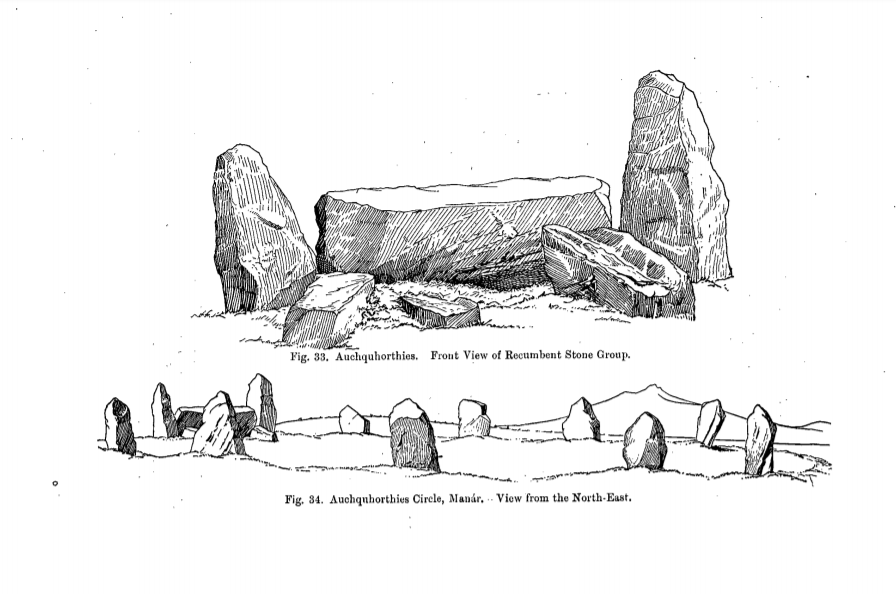
During the early Bronze Age, builders raised twelve stones on a terraced shoulder of hillside near Inverurie, choosing a spot with clear views toward the summit of Mither Tap. The largest block, a slab of white-grained granite weighing over ten tonnes, was hauled to the site and laid on its side rather than stood upright, flanked by two tall uprights, in the manner distinctive to this part of north-east Scotland.
The builders graded the remaining stones by size around the ring, placing the smallest to the northeast, and enclosed the whole arrangement within a low cairn of stones at its centre. Over the following millennia that cairn largely vanished, and of the original twelve uprights only four still stand; four more lie fallen where they toppled, and the last four were removed altogether, most likely cleared for farming.
In 1900 the antiquarian Fred Coles surveyed Balquhain as part of a systematic report on the stone circles of the Inverurie district, recording its layout and estimating the ring's diameter at around 19.5 metres. His survey placed the circle within a wider catalogue of monuments across north-east Scotland and remains one of the earliest detailed records of the site's condition.
In 1980 the surveyor Alexander Thom included Balquhain in his large-scale study of British megalithic rings, measuring its diameter at closer to 20.7 metres, a modest but telling disagreement with Coles's earlier figure. Thom's work formed part of a wider argument that stone circle builders had worked to consistent geometric and astronomical schemes across Britain.
During the 1980s further investigation uncovered lunar alignments built into the circle's design: the eastern flanker points toward the most southerly moonrise, the western flanker toward a minor moonset, and the major moonset falls directly over the raised hump on the recumbent stone. The discovery reframed Balquhain as a monument oriented as much to the sky as to the land around it.
In 2005 the archaeologist Richard Bradley examined Balquhain alongside two other north-east Scottish circles for a study of lunar and fire evidence at recumbent monuments, published as The Moon and the Bonfire. The site continues to be recorded as a scheduled monument, protecting its stones and the farmland setting that has preserved them for roughly four thousand years.
People
-
Fred Coles
Antiquarian who surveyed Balquhain in 1900 as part of a report on the stone circles of the Inverurie district and estimated its diameter at 19.5 metres.
-
Portrait: Charles Grey (1808-1892) / Wikimedia Commons / Public domain Alexander Thom
Surveyor who measured Balquhain in 1980 as part of a national study of megalithic rings, recording its diameter at 20.7 metres.
-
Richard Bradley
Archaeologist who examined Balquhain in a 2005 study of lunar and fire evidence at recumbent stone circles, published as The Moon and the Bonfire.
Cultural influences
-
Clava cairns
Researchers have proposed that Balquhain's recumbent-circle design may relate to the Clava cairns of nearby Inverness-shire, earlier chambered burial monuments enclosed by stone kerbs.
Connections
-
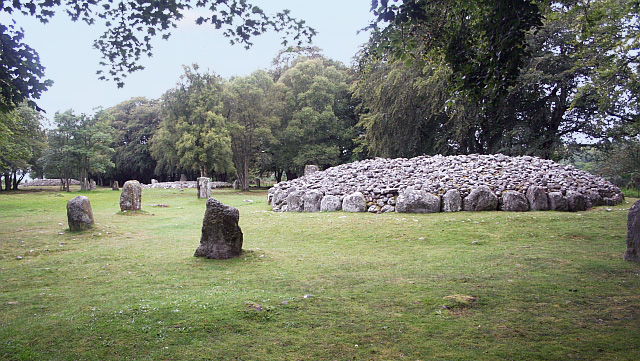
Photo: Bob Embleton / Wikimedia Commons / CC BY-SA 2.0 Recumbent stone circles like Balquhain may represent a later development from these earlier chambered cairn monuments.
-
Axial stone circles of south-west Ireland
The closest architectural parallel to Aberdeenshire's recumbent stone circles, sharing the principle of one dominant stone set on the circle's axis.
-
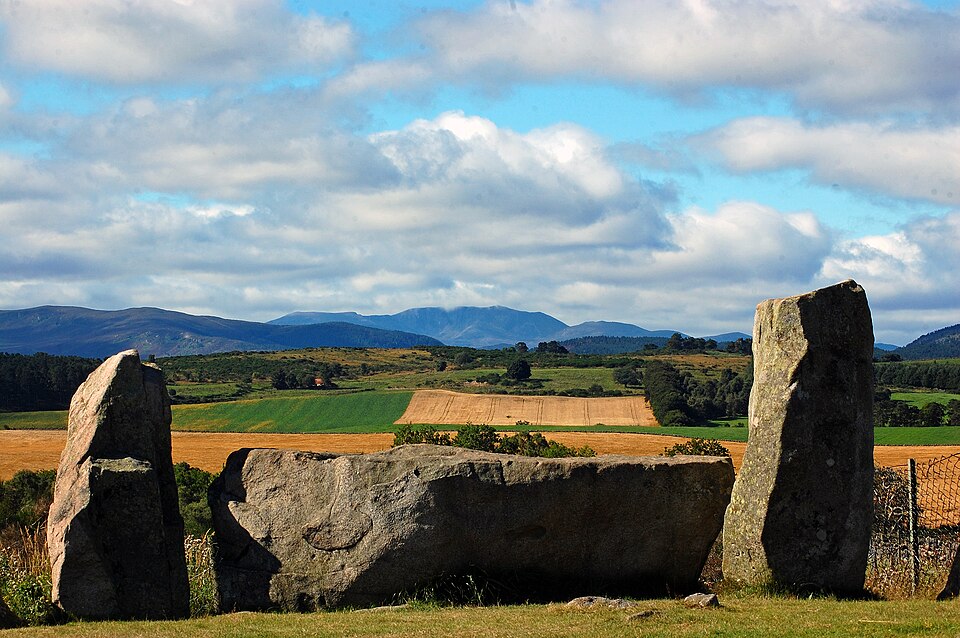
Photo: Silkie / Wikimedia Commons / CC BY-SA 3.0 Tomnaverie stone circle, Aberdeenshire
One of the other north-east Scottish recumbent circles examined alongside Balquhain in Richard Bradley's study of lunar and fire evidence, The Moon and the Bonfire.
-
The recumbent stone circles of lowland Aberdeenshire
Balquhain is one of more than seventy surviving examples of this regional monument type, unique in Britain to north-east Scotland.
Discovery & excavation
Balquhain's lunar alignments were identified only in the 1980s, long after the circle itself had been repeatedly surveyed. Investigators found that the eastern flanker stone points toward the most southerly moonrise at 172 degrees, the western flanker toward a minor moonset at 232 degrees, and that the major moonset falls directly over the raised hump on the recumbent stone at 190 degrees — evidence that the builders had set out the ring with specific lunar events in mind.
In culture
-
The Moon and the Bonfire (2005)
Richard Bradley and colleagues examined Balquhain alongside two other north-east Scottish stone circles in this monograph for the Society of Antiquaries of Scotland, investigating lunar alignments and evidence of fire at recumbent stone circle sites.
What to look for
-
The recumbent stone
A slab of white-grained granite 3.8 metres wide, 1.7 metres high and over ten tonnes in weight, laid on its side between the two flanking uprights — the defining feature of the circle.
-
The contrasting flankers
The eastern flanker is dark grey basalt with a rounded top; the western flanker is reddish quartzite flecked with white quartz and rises to a point, a deliberate contrast in colour and shape.
-
The hump on the recumbent
A rounded swelling on the upper edge of the recumbent stone that echoes the silhouette of Mither Tap rising on the skyline behind it.
-
Cup-marked rock art
Faint cup-shaped hollows pecked into the stone surfaces, a form of prehistoric rock art found at several recumbent stone circle sites in the region.
-
The outlying quartz stone
A separate standing stone six metres southeast of the circle, 3.1 metres high and veined with rose-coloured quartz seams running through white quartz.
Plan your visit
- Location
- 57.3066°N · 2.4415°W
- Access
- Open access
- Terrain
- Moderate walking
- Time needed
- About 45 minutes
Opening & admission
No current admission details are recorded — check with Historic Environment Scotland or local sources before travelling.
- Stands in farmland on a terraced hillside, so ground conditions may be uneven
- A scheduled monument
Nearby places
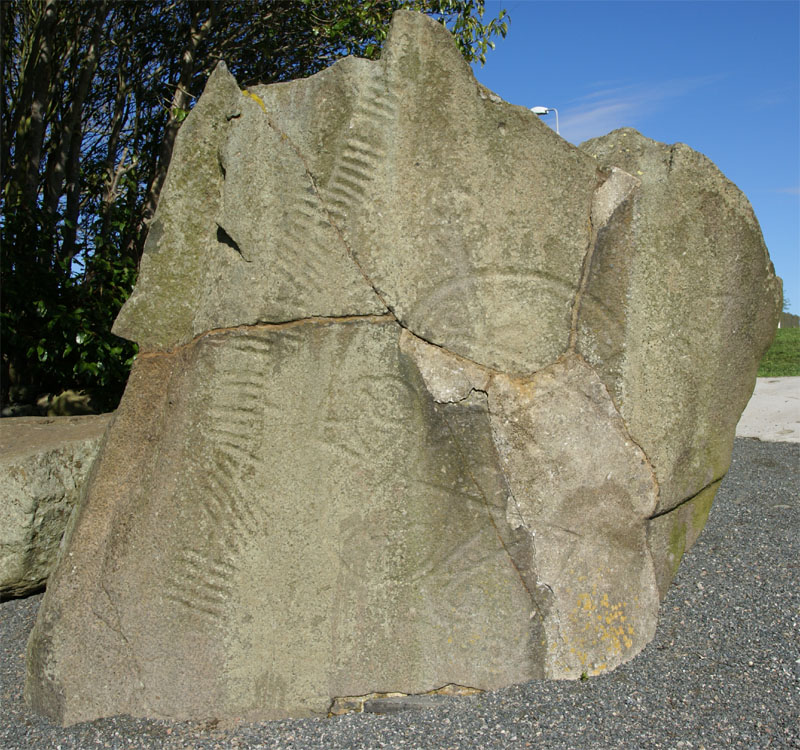
Carved stone · Pictish & early medieval
Brandsbutt Stone
Aberdeenshire
Brandsbutt preserves the symbols of the Picts, people of northern and eastern Scotland from about AD 300 to 900, beside an Ogham inscription still…
- Near Inverurie
- 1 min walk from car park
- Easy path
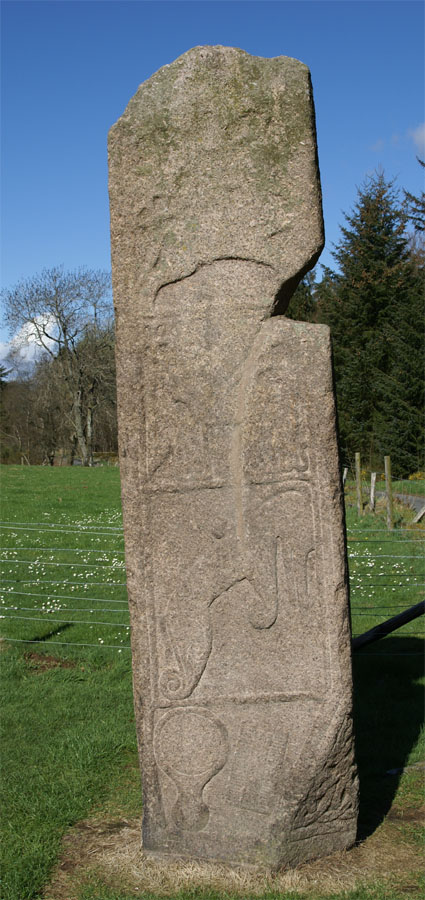
Carved stone · Pictish & early medieval
Maiden Stone
Aberdeenshire
A slab of red granite standing some three metres high, carved on every face with Christian crosses, Pictish beasts and a legend of the Devil's forf…
- Near Inverurie
- Easy path

Sacred place · Prehistoric
Easter Aquhorthies stone circle
Aberdeenshire
One of Scotland's best-preserved recumbent stone circles, and the only one where every stone still stands exactly where its Bronze Age (roughly 250…
- Easy path
Fortified place · Roman
Durno
Aberdeenshire
The largest Roman marching camp yet found north of the Antonine Wall, revealed only by a chance aerial photograph after two millennia buried beneat…
- Near Inverurie
- Easy path
Questions people ask
- What is a recumbent stone circle?
- A recumbent stone circle is a Bronze Age ring in which the largest stone is laid on its side rather than stood upright, flanked by two tall uprights, a design found almost only in lowland Aberdeenshire.
- How old is Balquhain stone circle?
- Balquhain was built during the early Bronze Age, one of more than seventy recumbent stone circles known across lowland Aberdeenshire, a design closest in form to the axial stone circles of south-west Ireland.
- How many stones remain standing at Balquhain?
- Four of the original twelve stones still stand, four lie fallen, and the remaining four were removed altogether over the centuries, most likely cleared for farming.
- What is unusual about Balquhain's alignment?
- Investigation in the 1980s found the flanking stones aligned to the most southerly moonrise and a minor moonset, with the major moonset falling directly over the recumbent stone's central hump.
- Can Balquhain stone circle be visited?
- Balquhain is a scheduled monument standing on private farmland roughly three miles from Inverurie, with clear views toward the summit of Mither Tap.
Sources
- Wikipedia: Balquhain
- Bradley et al. (2005), The Moon and the Bonfire
- Welfare (2011), Great Crowns of Stone
- Coles (1900), Report on the Stone Circles of the North-East of Scotland
- Thom, Thom & Burl (1980), Megalithic Rings
Explore more: Sacred places · Prehistoric · Aberdeenshire
The Ancient Codex, in your pocket
Get the Pocket Codex app
Carry the directory with you — Balquhain and thousands of ancient places across Britain and Ireland, offline, wherever you roam.