
One of Scotland's best-preserved recumbent stone circles, and the only one where every stone still stands exactly where its Bronze Age (roughly 2500–800 BC) builders raised it, with none re-erected.
Between two tall reddish granite uprights at Easter Aquhorthies lies the circle’s huge quartz-streaked recumbent slab, tipped on its edge rather than raised like the other stones. Grey stones answer the reddish blocks from the opposite side of the ring, which stands on a gentle slope a mile west of Inverurie. Every stone remains in its original position, with none toppled and re-erected by later hands.
Beneath the centre of the ring, investigation once uncovered a stone-lined pit sealed under a capstone, together with a low, telltale swelling in the turf suggesting a burial cairn once stood there, its stones perhaps later cleared or reused elsewhere. The ring itself is not a true circle but a slightly flattened oval, close to 18 metres across, with the stones stepped in height around its circumference: the lowest stone sits opposite the recumbent, and each pair grows taller moving round the ring until reaching the two flanking pillars, each roughly 2.5 metres tall, either side of the reclining slab.
The recumbent’s flat top is levelled so precisely that, sighted along it, the moon at its southernmost setting drops low over the distant Hill of Fare – a piece of astronomical intent built into the stone rather than left to chance. The place-name Aquhorthies itself comes from a Scottish Gaelic phrase meaning ‘field of prayer’, a name that may bridge, however loosely, the prehistoric builders of the circle and the Gaelic-speaking people who came to name it many centuries afterwards.
What follows is drawn from published sources, with each claim labelled by how firmly it is established.
The name
Aquhorthies derives from a Scottish Gaelic phrase meaning 'field of prayer', a name that may point to a long continuity of sanctity linking the Stone or Bronze Age builders of the circle to the much later Gaelic-speaking communities who named it.
History
The ring of nine stones was raised in the Stone or Bronze Age by communities in north-east Scotland who built this distinctive form of monument – a recumbent stone circle – setting a horizontal slab between tall flanking pillars on one side and grading the rest of the stones in height around the circle. At the centre they set a stone-lined pit under a capstone, perhaps marking a burial, later covered by a cairn whose mound can still be traced as a low swelling in the turf.
Sometime between 1847 and 1866–7 a stone dyke known as a roundel was built enclosing the circle, quite possibly reusing stones cleared from the demolished central cairn. The late 19th century also saw the site's surroundings landscaped, formalising the small walled and fenced enclosure that still frames the stones today and giving the monument the tidy, tended setting later visitors would come to know.
During the 1870s and 1880s the circle drew wider public attention through a run of paintings, drawings and written descriptions, though not every account was reliable: the antiquarian Christian Maclagan controversially reimagined it in print as the remains of a broch, a tower-like drystone structure, rather than the open ring of standing stones it actually is.
In 1884 the circle caught the interest of the pioneering archaeologist Augustus Pitt Rivers, and five years later, in 1889, his assistants William Tomkin and Claude Gray travelled to the site to measure, document and photograph every stone in careful detail, work precise enough to let them build a scale model of the circle that is now held in the collection of the Salisbury Museum in Wiltshire.
In 1900 the antiquarian Coles found the circle in an excellent state of preservation, undamaged by grazing cattle and free of the shrubbery that troubled many comparable sites, and carried out a careful survey of its stones and layout, leaving one of the fullest early records of the monument as it then stood.
Within the first quarter of the twentieth century, neglect took hold: when the antiquarian George Browne visited in 1920 he described the circle as filled with a forest of whin bushes as high as visitors' heads. The Ministry of Works scheduled it as an ancient monument in 1925, and in 1963 the State formally took the site into guardianship, committing to its long-term upkeep and clearance.
In 1985 the stones were cleaned so that casts could be taken for an exhibition in Edinburgh, work that revealed previously undetected subtleties in their colouring. Later investigation also found that the ring has noteworthy acoustic properties, though whether this held true before the central cairn was removed and the roundel built – possibly reusing the cairn's own stones – remains unclear.
People
-
Augustus Pitt Rivers
Pioneering archaeologist who took an interest in the circle in 1884, prompting his assistants' detailed survey five years later.
-
William Tomkin
Assistant to Pitt Rivers who measured, documented and photographed the circle in 1889 to build a scale model of it.
-
Claude Gray
Assistant to Pitt Rivers who worked alongside William Tomkin recording the circle in detail in 1889.
-
Coles
Antiquarian who surveyed the circle in 1900, finding it in an excellent state of preservation.
-
George Browne
Visited the circle in 1920 and recorded it as heavily overgrown with whin bushes.
-
Christian Maclagan
Antiquarian whose published account controversially reimagined the circle as the remains of a broch.
Cultural influences
-
The north-east recumbent stone-circle tradition
Easter Aquhorthies follows the distinctive north-east Scottish practice of placing a massive recumbent stone between tall flankers on the south-west side of a ring. Its deliberate contrast of red and grey stones and graded uprights show a regional monument tradition rather than an isolated arrangement.
Connections
-
Hill of Fare
The recumbent stone's levelled top is aligned so that the southern moonset drops low in its direction, tying the monument's design to this distant hill.
-
The Salisbury Museum, Wiltshire
Holds the scale model of the circle built from the measurements and photographs Pitt Rivers's assistants took on site in 1889.
-
the recumbent stone circles of north-east Scotland
Easter Aquhorthies shares the regional design tradition of pairing a horizontal recumbent and tall flankers with stones graded in height around the rest of the ring, as seen at other circles in the area.
Discovery & excavation
Investigation at the circle's centre uncovered a stone-lined cist sealed by a capstone, together with a low mound in the ground consistent with a former burial cairn – evidence that the monument may have had a funerary role at its core before later clearance and rebuilding altered its appearance.
In culture
-
19th-century antiquarian illustration
The circle featured in a run of paintings, drawings and written accounts published during the 1870s and 1880s, the most fanciful being Christian Maclagan's account reimagining the ring as the remains of a broch, a tower-like drystone structure, rather than an open circle of standing stones.
What to look for
-
The recumbent stone
A red granite slab laid on its side between two tall flanking pillars, streaked with quartz veins and flecked with crystal, and levelled so its top lines up with the southern moonset over the Hill of Fare.
-
The colour scheme of the ring
Eight grey granite stones and one of red jasper make up the ring, with reddish stones deliberately grouped on the south-south-west side opposite the grey ones.
-
The graded height of the stones
Paired stones rise in height around the circle from a single low stone opposite the recumbent up to the two tall flankers either side of it.
-
The central mound
A low, conspicuous swelling in the ground at the circle's centre marks where a stone-lined cist and, probably, a burial cairn once stood.
-
The enclosing roundel
A stone dyke built around the circle in the mid-19th century, within the small walled and fenced enclosure that still frames the monument today.
What is said
Folklore and tradition, recorded as what is said — not as established fact.
-
'Field of prayer'
Some have suggested that the Gaelic place-name reflects a long continuity of sanctity linking the prehistoric circle-builders with the much later communities who named the site, though this remains a matter of interpretation rather than established fact.
Plan your visit
- Location
- 57.2770°N · 2.4456°W
- Access
- Open access
- Terrain
- Easy going
- Time needed
- About 30 minutes
Opening & admission
Free to visit; check Historic Environment Scotland's site for any current details before travelling.
- Sits within a small fenced and walled enclosure on a gentle hillside
- In State guardianship since 1963
Nearby places
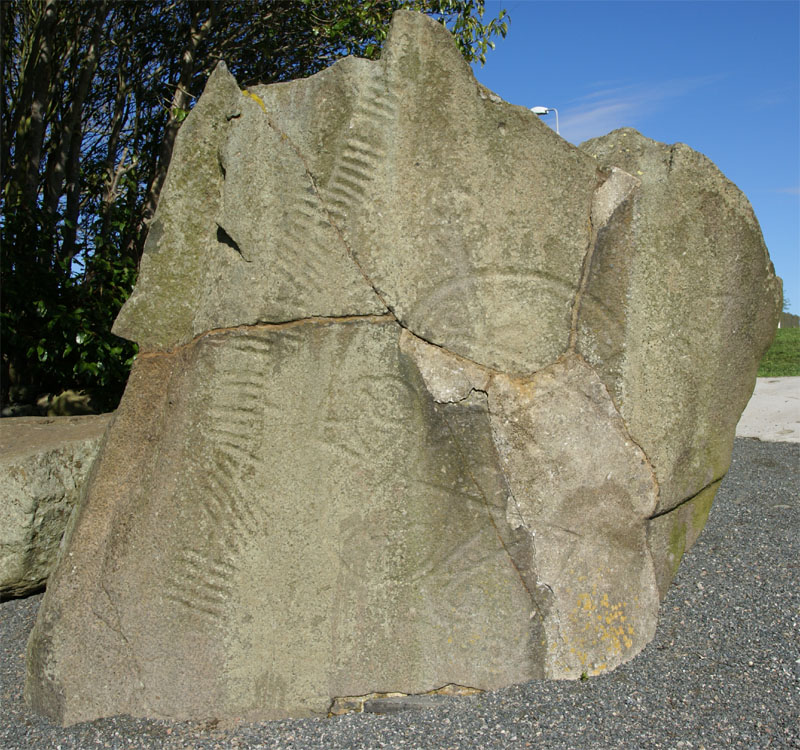
Carved stone · Pictish & early medieval
Brandsbutt Stone
Aberdeenshire
Brandsbutt preserves the symbols of the Picts, people of northern and eastern Scotland from about AD 300 to 900, beside an Ogham inscription still…
- Near Inverurie
- 1 min walk from car park
- Easy path
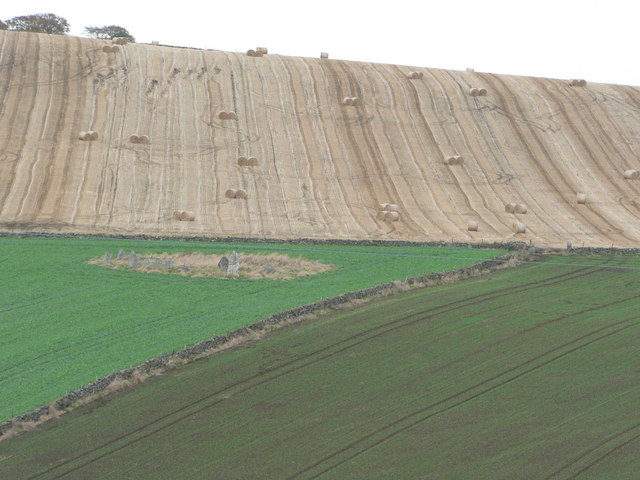
Sacred place · Prehistoric
Balquhain
Aberdeenshire
A rounded hump on its ten-tonne recumbent stone echoes the outline of Mither Tap behind it, and 1980s survey work found its flanking stones deliber…
- Some walking
_(geograph_5555392).jpg?width=800)
Carved stone · Pictish & early medieval
Broomend of Crichie stone
Aberdeenshire
A Pictish symbol stone: the Picts held northern and eastern Scotland from about AD 300 to 900: carved with the enigmatic 'beast' and crescent-and-V…
- Near Port Elphinstone
- Easy path
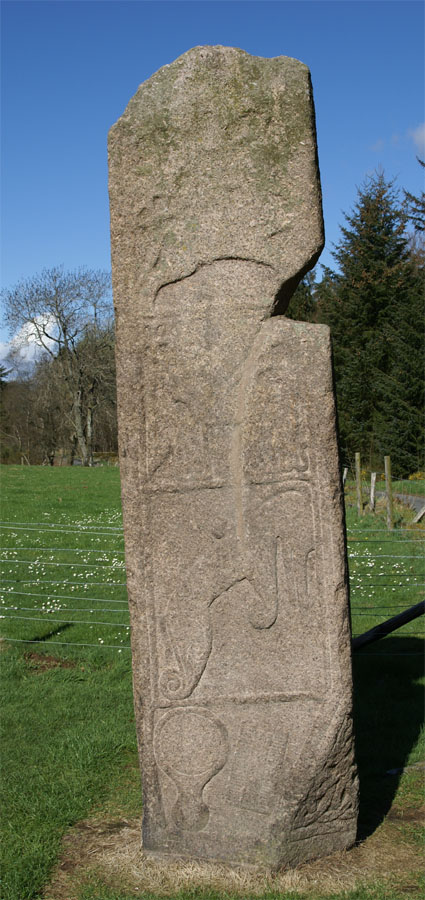
Carved stone · Pictish & early medieval
Maiden Stone
Aberdeenshire
A slab of red granite standing some three metres high, carved on every face with Christian crosses, Pictish beasts and a legend of the Devil's forf…
- Near Inverurie
- Easy path
Questions people ask
- What makes Easter Aquhorthies unusual among stone circles?
- It is one of the few recumbent stone circles to keep its full set of stones, and the only one where every stone still stands exactly as first raised, with none re-erected.
- What is a recumbent stone circle?
- A regional Bronze Age monument type found mainly in north-east Scotland, where one large stone lies flat between two tall pillars and the rest are graded in height around the ring.
- Why is the recumbent stone aligned toward the Hill of Fare?
- Its levelled top lines up with the moon setting at its southernmost point in that direction, suggesting the builders deliberately built lunar observation into the design.
- What happened to the circle in the 20th century?
- It became overgrown with whin bushes by 1920, was scheduled as an ancient monument in 1925, and was taken into State guardianship in 1963.
- What does the name Aquhorthies mean?
- It derives from a Scottish Gaelic phrase meaning 'field of prayer', possibly reflecting long-continued sacred use of the site across many centuries.
Sources
- Wikipedia: Easter Aquhorthies stone circle
- Historic Environment Scotland — Scheduled Monument record (SM90126)
Explore more: Sacred places · Prehistoric · Aberdeenshire
The Ancient Codex, in your pocket
Get the Pocket Codex app
Carry the directory with you — Easter Aquhorthies stone circle and thousands of ancient places across Britain and Ireland, offline, wherever you roam.