Roughly 200 carved stone fragments, most no bigger than a handspan, add up to one of the largest collections of Pictish (of the Picts, the people of northern and eastern Scotland from about AD 300 to 900) sculpture ever recovered from a single site.
A churchyard on the Tarbat peninsula has given up pieces of at least four monumental crosses, a carved sarcophagus lid, a shrine screen and a scatter of plain incised grave markers, all broken into handspan-sized fragments and buried in the ground around a small parish church. Nineteen pieces turned up before 1994, found by chance in and around the churchyard at Portmahomack. Everything else came out of the soil between 1994 and 2007, when archaeologists from the University of York dug the site systematically as part of the Tarbat Discovery Programme.
Put back together in the mind if not in stone, the fragments describe crosses covered in Pictish symbols, snake-headed interlace, spirals, and a row of apostles each carrying a book. One stone bears a Latin inscription cut along its edge, commemorating a person whose name has not survived. Other pieces show a boar and a wolf-like creature on what was once a sarcophagus lid, and a bull and cow tending a calf on what is thought to have been part of a shrine or screen. Radiocarbon dating of the layers in which they lay points to the 8th century for most of the collection, a period when the Tarbat peninsula produced some of the finest stone carving in early medieval Europe.
What follows is drawn from published sources, with each claim labelled by how firmly it is established.
History
During the 8th century, masons working on the Tarbat peninsula carved at least four monumental crosses or cross-slabs and set them around St Colman's Church at Portmahomack. One carried four Pictish symbols, a second was covered in snake-headed interlace, a third combined a complex beast with a row of apostles carrying books and a Latin inscription along one edge, and the fourth was decorated with spirals and interlace. Alongside them stood a carved sarcophagus lid, a shrine or screen panel, and plainer grave markers cut with simple crosses.
The same period saw the production of architectural carving for the church itself, including a probable label-stop and a gable finial, pieces that point to a stone building of some ambition standing on the site rather than a simple timber chapel. Together with the crosses and grave markers, this architectural stonework forms part of what is now regarded as the most extensive collection of sculpture to survive from any early medieval site in Scotland.
At some point after the crosses fell or were deliberately broken up, their fragments were dispersed into the ground in and around the churchyard, where they lay undisturbed for centuries. The circumstances of that destruction are not recorded, but the scattering of pieces across the site, rather than their survival as standing monuments, is what ultimately protected them from later stone-robbing and weathering above ground.
Before 1994, chance finds in and around the churchyard at Portmahomack turned up nineteen carved fragments, enough to show that something substantial lay beneath the ground but far too little to reveal the scale of what was still buried.
Between 1994 and 2007, the University of York carried out systematic excavation at Portmahomack under the Tarbat Discovery Programme, recovering the remaining fragments of the collection now numbering around two hundred pieces. The excavation director, Martin Carver, went on to propose that the bulk of the carved stone had originally formed four large crosses or cross-slabs of exceptional size, raised around the church before being broken apart.
Radiocarbon dating of the archaeological layers in which the fragments were found assigned much of the sculpture to the 8th century, tying the Portmahomack carvings to the same period and artistic tradition as the great cross-slabs elsewhere on the Tarbat peninsula. Scholars have suggested a single school of masons based on the peninsula may have produced all of these works. The Portmahomack collection remains not yet fully published, and is regarded as probably the most extensive body of early medieval sculpture to survive from any one site in Scotland, still yielding detail to researchers working through its fragments.
People
-
Martin Carver
Director of the Tarbat Discovery Programme excavation, who proposed that most of the Portmahomack fragments came from four large Pictish crosses or cross-slabs raised around St Colman's Church.
Cultural influences
-
Tarbat Peninsula sculpture school
The crosses, grave markers and architectural fragments belong to the eighth-century Christian carving tradition shared with Nigg, Shandwick and Hilton of Cadboll.
Connections
-
Hilton of Cadboll
One of the other great Tarbat peninsula cross-slabs thought to share the closest artistic affiliation with the Portmahomack sculpture, possibly the work of the same school of masons.
-
Shandwick
Another Tarbat peninsula cross-slab site regarded as artistically closest to the Portmahomack fragments among surviving Pictish monuments.
-
Nigg
A further Tarbat peninsula cross-slab whose style links it to Portmahomack, together forming a probable single centre of 8th-century masonry.
-
Iona
The simple incised grave markers found at Portmahomack are comparable to examples known from Iona and other early Christian sites in Argyll and western Scotland, and Portmahomack's sculpture also shows artistic points of contact with Iona carving.
-
Northumbria
The Portmahomack sculpture shows artistic points of contact with Northumbrian carving of the same period, reflecting wider connections across early medieval Britain.
Discovery & excavation
Nineteen carved fragments were found in and around the churchyard at Portmahomack before 1994. Systematic excavation by the University of York between 1994 and 2007, under the Tarbat Discovery Programme, recovered the remainder of the roughly two hundred fragments now known, alongside architectural pieces such as a probable label-stop and a gable finial.
What to look for
-
Pictish symbol stone (TR1)
A fragment carrying four Pictish symbols, identified by excavators as part of one of the four monumental crosses proposed to have stood around the church.
-
Snake-headed interlace stone (TR2)
A fragment decorated with interlace ornament terminating in snake heads, thought to belong to a second large cross-slab.
-
Apostles and inscription stone (TR10, 20)
A fragment showing a complex beast alongside a row of apostles carrying books, with a Latin inscription cut along one edge commemorating an unnamed person: IN NOMINE IHU XRI CRUX XRI IN COMMEMORATIONE REO... LII... DIE HAC...
-
Spiral and interlace cross
The fourth proposed monumental cross, covered across its surface in spiral and interlace ornament.
-
The Boar Stone
A large fragment identified as a sarcophagus lid, carved with images of a boar and a wolf-like creature.
-
The Calf Stone
A fragment thought to belong to a shrine or screen, depicting a bull and a cow tending to their calf.
-
Incised grave markers
Plainer fragments cut with simple crosses, marking individual graves and comparable to grave markers known from Iona and other early Christian sites in western Scotland.
-
Architectural fragments
Carved stonework including a probable label-stop and a gable finial, thought to have adorned an early stone church on the site.
Plan your visit
- Location
- 57.8372°N · 3.8275°W
- Nearest settlement
- Portmahomack
- Access
- Open access
- Terrain
- Easy going
- Time needed
- About 45 minutes
- Best time
- During current Tarbat Discovery Centre or church display hours; verify before travelling.
- What survives
- The early-medieval sculptures survive as a large dispersed group of carved fragments rather than intact standing crosses.
Opening & admission
- Fragments are associated with St Colman’s Church/Tarbat displays and research context; verify current display before travelling.
Nearby places
Carved stone · Pictish & early medieval
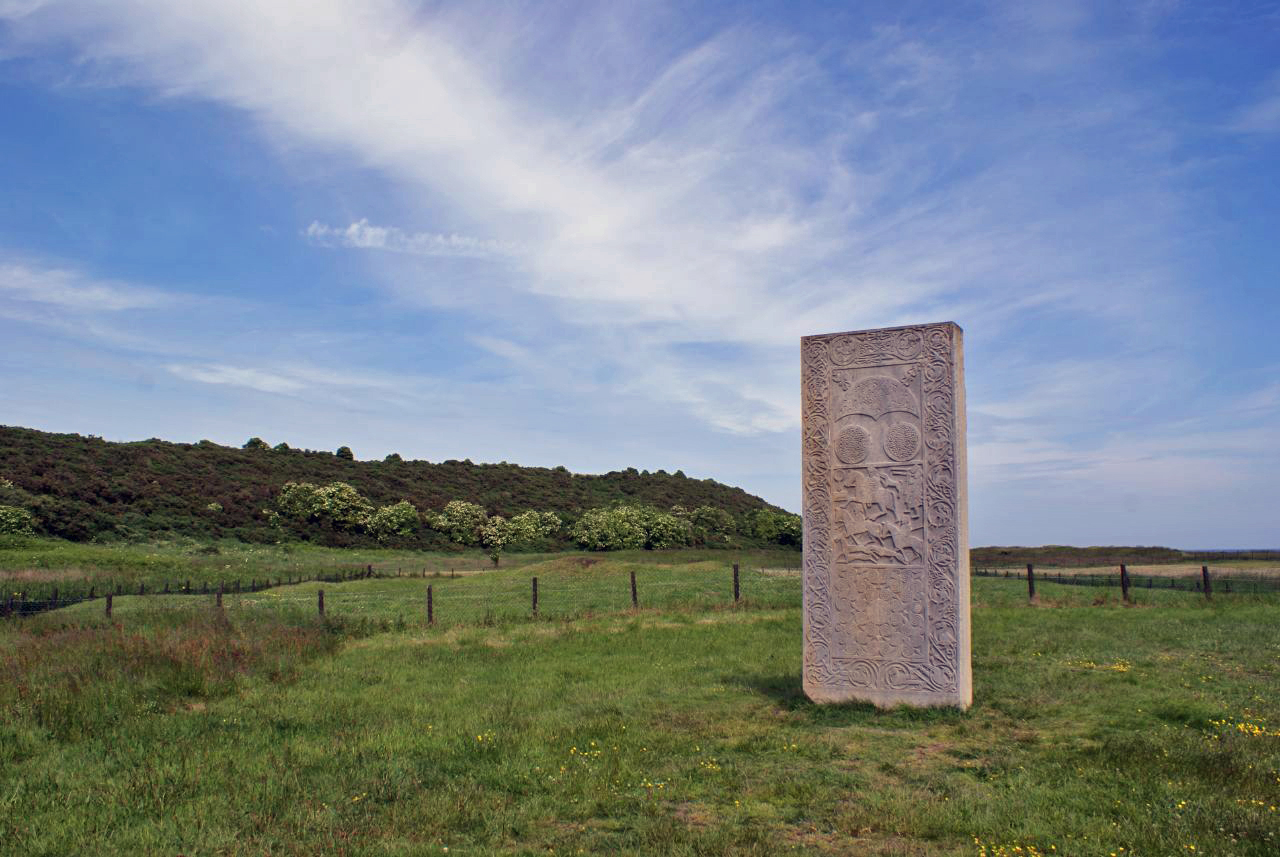
Hilton of Cadboll Stone
Highland
Broken by a storm, stripped for a memorial, and split between two museums and a modern replica, this Pictish (of the Picts, the people of northern…
- Near Hilton of Cadboll
- Easy path
Carved stone · Pictish & early medieval
Clach a' Charridh
Highland
A carved cross faces the sea while Pictish beasts and a hunting scene face the land on the reverse: a single stone holding two entirely different v…
- Near Inverness
- Easy path

Sacred place · Medieval
Dornoch Cathedral
Highland
Burned by feuding clansmen in 1570 and rebuilt on a narrower plan in the 1830s, it still holds the graves of earls, dukes and the bishop-saint who…
- Near Dornoch

Carved stone · Pictish & early medieval
Ardjachie Stone
Highland
A single red sandstone boulder carries two carving traditions centuries apart: Bronze Age (roughly 2500–800 BC) cup-and-ring marks beneath a Pictis…
- Near Tain
- Easy path
Questions people ask
- What are the Portmahomack sculpture fragments?
- Around 200 carved stone fragments recovered from the churchyard at Portmahomack, Easter Ross, mostly pieces of Pictish crosses, a sarcophagus lid, a shrine screen and grave markers.
- How were the fragments discovered?
- Nineteen pieces were found before 1994; the rest were excavated by the University of York between 1994 and 2007 during the Tarbat Discovery Programme.
- How old is the sculpture?
- Radiocarbon dating of the layers where most fragments were found assigns them to the 8th century.
- How many monumental crosses do the fragments come from?
- Excavation director Martin Carver proposed the majority of the carved pieces came from four large monumental crosses or cross-slabs raised around St Colman's Church.
- Which other sites are the fragments linked to?
- Their closest artistic affiliation is with the cross-slabs at Hilton of Cadboll, Shandwick and Nigg, also on the Tarbat peninsula, with further links to Iona and Northumbria.
Sources
- Wikipedia: Portmahomack sculpture fragments
- Wikidata: Q7232113
- Fraser, Ritchie et al. — Pictish Symbol Stones: An Illustrated Gazetteer (RCAHMS, 1999)
- Carver — Sculpture in Action: contexts for stone carving on the Tarbat peninsula (2005)
Explore more: Carved stones · Pictish & early medieval · Highland
The Ancient Codex, in your pocket
Get the Pocket Codex app
Carry the directory with you — Portmahomack sculpture fragments and thousands of ancient places across Britain and Ireland, offline, wherever you roam.