
A carved cross faces the sea while Pictish beasts and a hunting scene face the land on the reverse — a single stone holding two entirely different visual worlds back to back.
On the reverse of the tall red sandstone slab near Shandwick, a mounted hunting party chases a stag: three riders on horseback, two men trading sword blows behind their shields, and a bowman in a peaked cap taking aim. It is one of the liveliest scenes carved anywhere on a Pictish stone, crowded with men and animals in a single frozen chase.
The other face carries a different kind of image altogether. A jewelled cross rises the height of the stone, its surface studded with 54 raised spiral bosses, flanked by four-winged cherubim and, lower down, tangled serpents and paired discs whose bodies interlock at the centre. Between the two faces, the stone shifts from a public act of Christian devotion to a scene that reads like a record of ordinary Pictish life — riders, hunters, and a stag caught mid-flight across the same slab.
The stone still stands close to where it has stood for over a thousand years, on the Tarbat peninsula in Easter Ross, though it has not gone untouched by time: a storm brought it down in the nineteenth century, and it now stands inside a glass cover building built to protect it from the weather that once felled it.
What follows is drawn from published sources, with each claim labelled by how firmly it is established.
The name
The Gaelic name Clach a' Charaidh translates as 'stone of the grave-plots', a name that points directly to the burial ground once recorded around the site rather than to the carvings themselves.
History
The earliest known published record of the stone appears in 1780, in the Reverend Charles Cordiner's Antiquities and Scenery of the North of Scotland, written as a series of letters to the antiquarian Thomas Pennant. Cordiner's account illustrated the reverse face of the stone, giving later scholars a fixed point of comparison for how the carving has weathered and changed in the centuries since.
A more detailed account followed from Charles Petley, who wrote his description of the stone around 1811 to 1812. Petley died before it could be presented, and the paper was delivered posthumously to the Society of Antiquaries of Scotland in 1831, finally reaching print in 1857. His illustrations captured both faces of the stone, labelling the cross face as facing west and the carved reverse as facing east.
By the early nineteenth century a burial ground stood at the site, and local record holds that it saw its last use during the cholera epidemic of 1832, when the disease swept through communities across Scotland and left many such small burial grounds with a final, grim purpose before they fell out of use.
In 1846 a storm brought the standing stone down. It was re-erected afterwards, but not necessarily in its original orientation: today the carved cross faces east towards the sea, while the Pictish symbol panel faces west towards the land, a reversal from the arrangement Petley had recorded decades earlier, when the cross was described as facing west.
The old burial ground around the stone was ploughed under around 1885, erasing its physical traces from the surrounding land. It was still recorded in written accounts as recently as 1889, preserving a memory of its existence and its use during the 1832 cholera outbreak even after the ground itself had been turned over for other purposes. In 1988 the stone was enclosed within a glass cover room, a modern structure built to shield the carved sandstone from the coastal weather that had already brought it down once, in 1846, and to allow it to remain on public display near its original site rather than being removed to a museum.
People
-
Rev Charles Cordiner
Author of the 1780 Antiquities and Scenery of the North of Scotland, containing the earliest known published illustration of the stone.
-
Charles Petley
Antiquarian who documented both faces of the stone in a paper written c. 1811–12, delivered posthumously to the Society of Antiquaries of Scotland in 1831 and published in 1857.
Cultural influences
-
Pictish symbol-stone art
The stones jewelled cross, Pictish symbol panel and narrative hunting scene place it within the artistic traditions of early medieval Pictland.
Connections
-
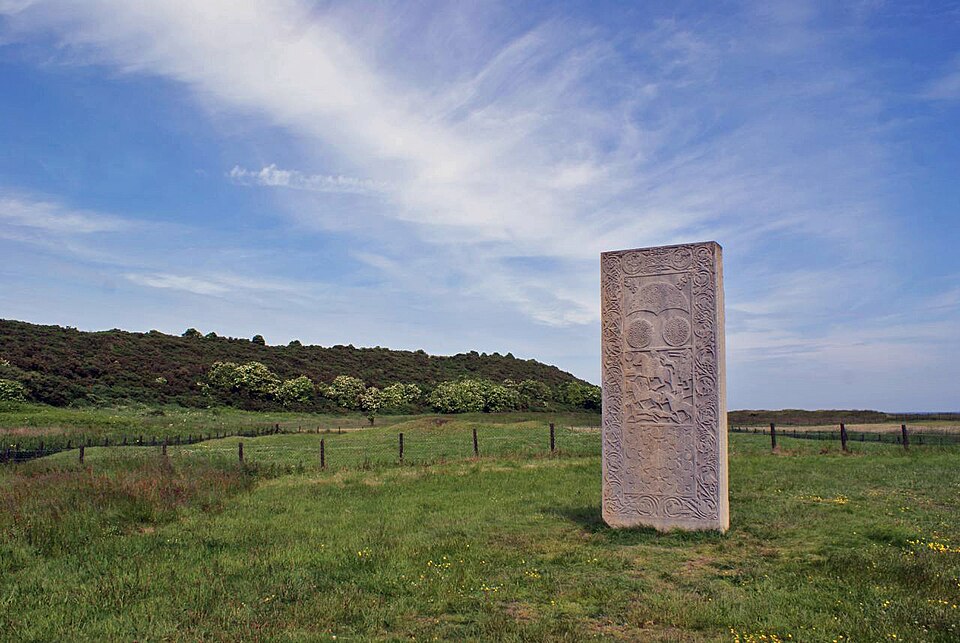
Photo: Richard Dorrell / Wikimedia Commons / CC BY-SA 2.0 The concentric triple-spiral panel on the reverse of the Shandwick stone closely resembles the equivalent panel on the Hilton of Cadboll Stone, which has been interpreted as a depiction of the four rivers of paradise.
-
Society of Antiquaries of Scotland
Received Charles Petley's detailed paper on the stone in 1831, after his death, and eventually published it in 1857.
Discovery & excavation
No excavation record survives for the site; what is known comes instead from antiquarian illustration and written description, beginning with Cordiner's 1780 account and followed by Petley's more detailed record of both faces in the early nineteenth century.
In culture
-
Antiquarian illustration
Cordiner and Petleys published illustrations preserve a record of both faces of the stone and its former orientation before later weathering and re-erection.
What to look for
-
The jewelled cross and bosses
The cross face carries 54 raised spiral bosses set across a jewelled cross, one of the most elaborately studded cross designs among surviving Pictish stones.
-
Cherubim and serpent panels
Four-winged cherubim flank the cross-shaft, with panels beneath showing indeterminate beasts above interlaced serpent-like creatures, and two double-discs formed from interlocking serpent bodies near the base.
-
The hunting scene
The third panel on the reverse shows mounted riders hunting a stag, two men fighting with swords and shields, and a bowman in a peaked cap taking aim, one of the most animated narrative scenes on any Pictish stone.
-
The triple-spiral panel
The lowest full-width panel on the reverse contains 48 triple-spirals arranged in concentric circles around four double-spirals, closely paralleling the equivalent design on the Hilton of Cadboll Stone.
-
The glass cover building
Since 1988 the stone has stood inside a purpose-built glass cover room, protecting the carved sandstone from the coastal weather while keeping it visible on its original site.
Plan your visit
- Location
- 57.7475°N · 3.9247°W
- Nearest settlement
- Inverness
- Access
- Open access
- Terrain
- Easy going
- Time needed
- About 45 minutes
Opening & admission
- Stone is protected in a glass cover room near Shandwick.
Nearby places
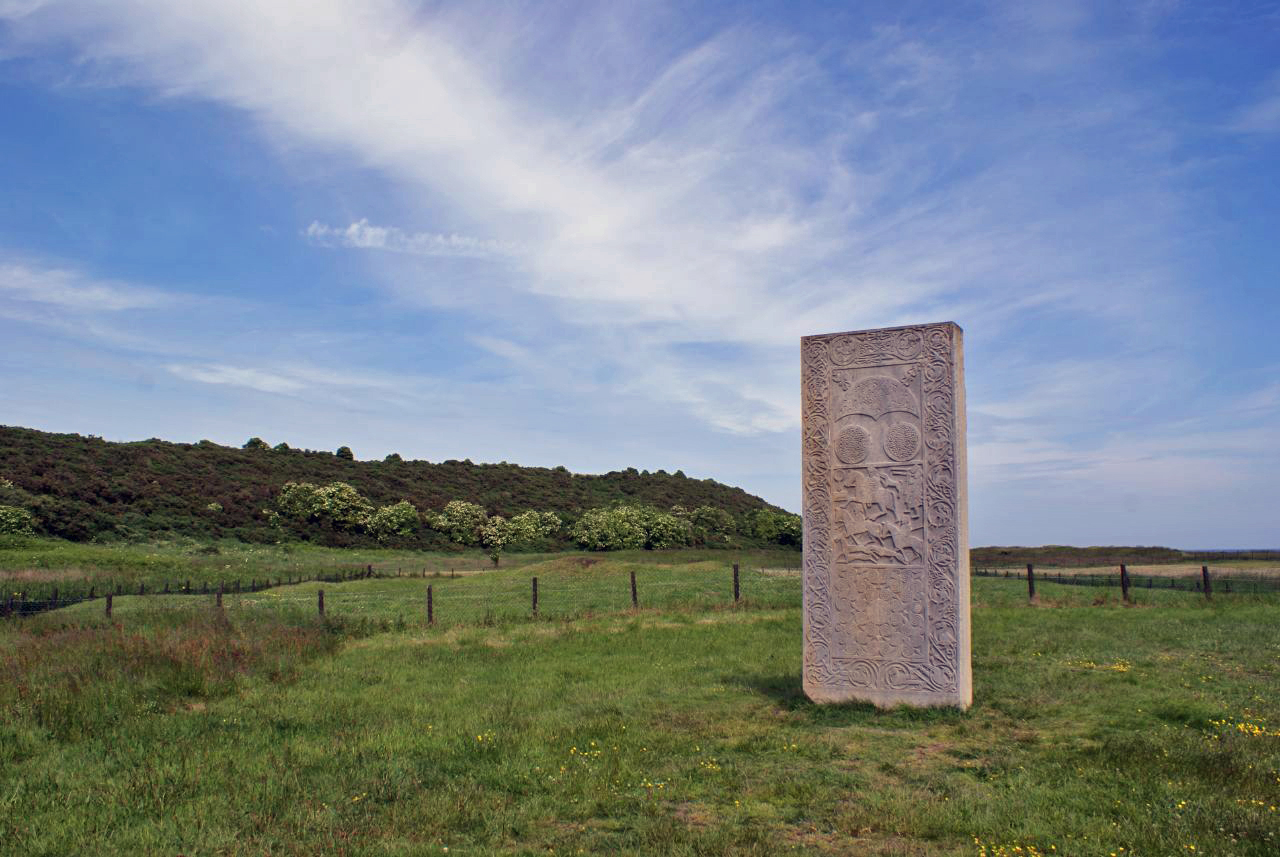
Carved stone · Pictish & early medieval
Hilton of Cadboll Stone
Highland
Broken by a storm, stripped for a memorial, and split between two museums and a modern replica, this Pictish (of the Picts, the people of northern…
- Near Hilton of Cadboll
- Easy path
.jpg?width=800)
Carved stone · Pictish & early medieval
Nigg Stone
Highland
A shattered, staple-mended slab carries the oldest known depiction of a European triangular harp alongside carving so fine it is thought to share c…
- Near Nigg
- Easy path
Minor monument · Medieval
Market Cross, Church Street, Cromarty
Highland
Cromarty’s market cross, the stone cross marking a burgh’s right to hold a market, preserves a rare civic document in stone: its 1578 shaft and Geo…
- Near Cromarty
- Easy path
Carved stone · Pictish & early medieval
Portmahomack sculpture fragments
Highland
Roughly 200 carved stone fragments, most no bigger than a handspan, add up to one of the largest collections of Pictish (of the Picts, the people o…
- Near Portmahomack
- Easy path
Questions people ask
- What is the Clach a' Charridh?
- It is a Class II Pictish stone, also called the Shandwick Stone, carved with a jewelled cross on one face and Pictish symbols including a hunting scene on the other.
- Why is the stone kept in a glass room?
- Since 1988 it has been enclosed in a glass cover room to protect the carved sandstone from coastal weather, after an 1846 storm had already brought it down once.
- What does the name Clach a' Charaidh mean?
- The Gaelic name translates as 'stone of the grave-plots', referring to a burial ground once recorded at the site.
- What does the hunting scene on the stone show?
- Three mounted riders hunting a stag, two men fighting with swords and shields, and a bowman in a peaked cap, all carved on the reverse panel.
- Is the stone linked to any other Pictish carvings?
- Its triple-spiral panel closely resembles the equivalent design on the Hilton of Cadboll Stone, thought to represent the four rivers of paradise.
Sources
- Wikipedia: Clach a' Charridh
- Scott, Douglas — The Stones of the Pictish Peninsulas (Hilton Trust, 2004)
- Wikidata: Q2276815
Explore more: Carved stones · Pictish & early medieval · Highland
The Ancient Codex, in your pocket
Get the Pocket Codex app
Carry the directory with you — Clach a' Charridh and thousands of ancient places across Britain and Ireland, offline, wherever you roam.