
Broken by a storm, stripped for a memorial, and split between two museums and a modern replica, this Pictish (of the Picts, the people of northern and eastern Scotland from about AD 300 to 900) cross-slab survives today only because thousands of buried carved fragments let archaeologists piece its lost face back together.
A rider faces straight out from the stone, sitting side-on to no one, while hounds harry a deer at her feet and a hunting party crowds the panel around her — carved into sandstone on the Tarbat Peninsula around AD 800 by hands working for a monastery a few miles up the coast. The scene reads, at first glance, as an aristocratic hunt. Modern scholarship reads it instead as sacred: the rider identified with Christ or the Virgin Mary, the pursued deer a figure for a soul thirsting toward salvation, drawn from the words of Psalm 42.
The cross-slab that carried this imagery was never simple to protect. Its front face, once carved with a cross surrounded by scenes of Death, Judgement, Heaven and Hell, began to be chiselled away in the late sixteenth century, and in 1674 a storm toppled the stone and broke it, after which its remaining cross face was removed altogether and replaced with a memorial to a local laird and his three wives. What followed was two centuries of separation, relocation and rediscovery — a surviving top section carried off to a castle garden and then to a museum in Edinburgh, a buried lower section only recovered by archaeologists digging near the old chapel site in 1998 and 2001.
Today the story is told in three places at once: the upper three-quarters in the National Museum of Scotland, the recovered lower quarter on display in Hilton of Cadboll’s own village hall, and a full-scale carved replica standing close to where the original was raised, carrying a front face reconstructed from thousands of excavated stone chips.
What follows is drawn from published sources, with each claim labelled by how firmly it is established.
History
About AD 800 a community linked to the monastery at Portmahomack raised the cross-slab on the Tarbat Peninsula in Easter Ross, setting it within a natural amphitheatre roughly 100 metres from the shore. The whole peninsula, from the Cromarty Firth to Tarbatness, is thought to have formed the monastery's estate, and the carving was probably commissioned at its instigation.
During the thirteenth century a chapel was built only six metres to the east of the standing stone, and the settlement of Hilton of Cadboll later grew up along the coast to its south-west. The stone's position, close to a stream and the water table, would have made immersion possible during rites performed nearby.
Chips buried at the site show that the cross carved on the front began to be defaced in the late sixteenth century, during the Scottish Reformation. In 1674 a storm felled the stone, breaking off its top three-quarters; the remaining cross face was then removed entirely and replaced with a memorial inscription to Alexander Duff and his three wives.
Left at Hilton rather than pressed into service as a grave marker, the broken stone remained exposed to the weather and was shown to travelling antiquarians, among them Rev. Charles Cordiner, who brought it to wider public notice in his 1780 book Antiquities and Scenery of the North of Scotland, published in London.
In the late 1860s the Macleods of Cadboll moved the surviving top portion to Invergordon Castle, where it became a garden feature. When the estate was sold in 1921 the stone was gifted to the British Museum, but a rearguard campaign by Scottish antiquarians persuaded the Museum's Trustees to release Macleod of Cadboll from that gift so he could redonate it to the National Museum of Antiquities of Scotland, now the National Museum of Scotland.
Excavations around the chapel site in 1998 by Kirkdale Archaeology, working for Historic Scotland, recovered some 40 fragments of carved sandstone thought to belong to the lost cross face. A further campaign in 2001 recovered 740 more carved fragments and located the missing lower portion of the slab, which Angus Mackintosh found still in situ before it was lifted later that year by Glasgow University Archaeological Research Division.
Analysis of the recovered fragments allowed Isabel Henderson to reconstruct the lost cross-face iconography by art-historical comparison, work that guided sculptor Barry Grove's carving of a full-scale replica erected near the original site between 2003 and 2005. The excavation and its findings became the foundation of a monograph published by the Society of Antiquaries of Scotland in 2008.
People
-
Rev. Charles Cordiner
Antiquarian who was shown the fallen stone and brought it to public attention in his 1780 book Antiquities and Scenery of the North of Scotland.
-
Barry Grove
Local sculptor who assisted the 2001 excavation and carved the full-scale replica of the stone, completed between 2003 and 2005.
-
Isabel Henderson
Art historian whose analysis of the recovered fragments reconstructed the iconography of the lost cross face.
-
Angus Mackintosh
Archaeologist who located the missing lower portion of the cross-slab during the 2001 excavation.
-
Martin Goldberg
Scholar who proposed that the cross-slab had a particular role in the Easter vigil and the rite of Baptism.
-
Alexander Duff
Local figure to whom a memorial was inscribed on the stone after its cross face was removed following the 1674 storm.
Cultural influences
-
Tarbat Peninsula Christian sculpture
The cross-slab belongs to the eighth-century Christian sculpture of the Tarbat Peninsula, with artistic links to Portmahomack, Nigg and Shandwick.
Connections
-
Portmahomack monastery
The Tarbat Peninsula is thought to have formed the monastery's estate, and the stone was probably carved at its instigation.
-
Shandwick Stone
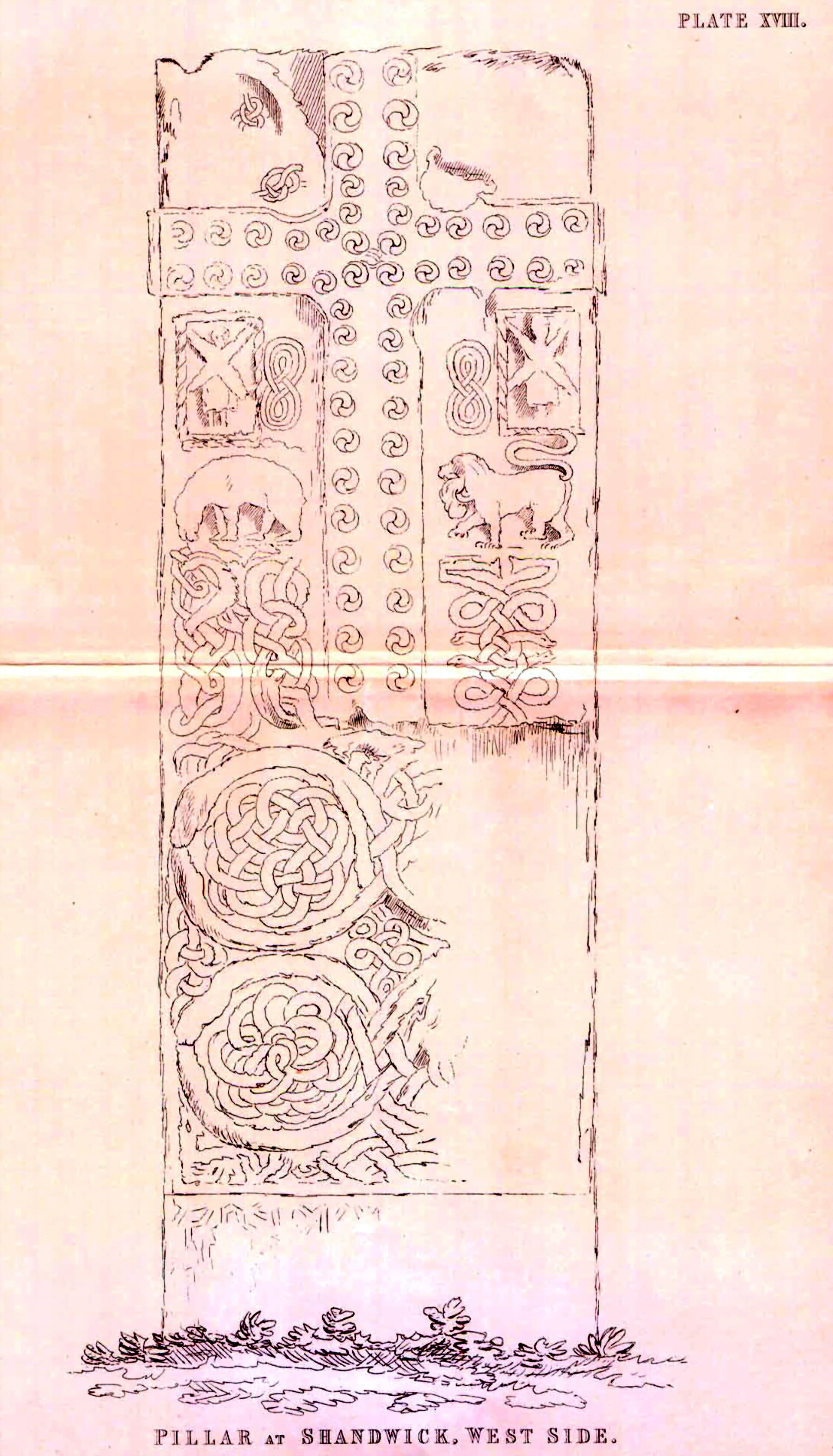
A nearby Pictish cross-slab carrying bosses similar to those on the Hilton of Cadboll stone's cross base.
-
.jpg?width=320)
Photo: Julian Paren / Wikimedia Commons / CC BY-SA 2.0 Another Pictish cross-slab on the Tarbat Peninsula sharing the boss motifs found on the Hilton of Cadboll stone's cross base.
-
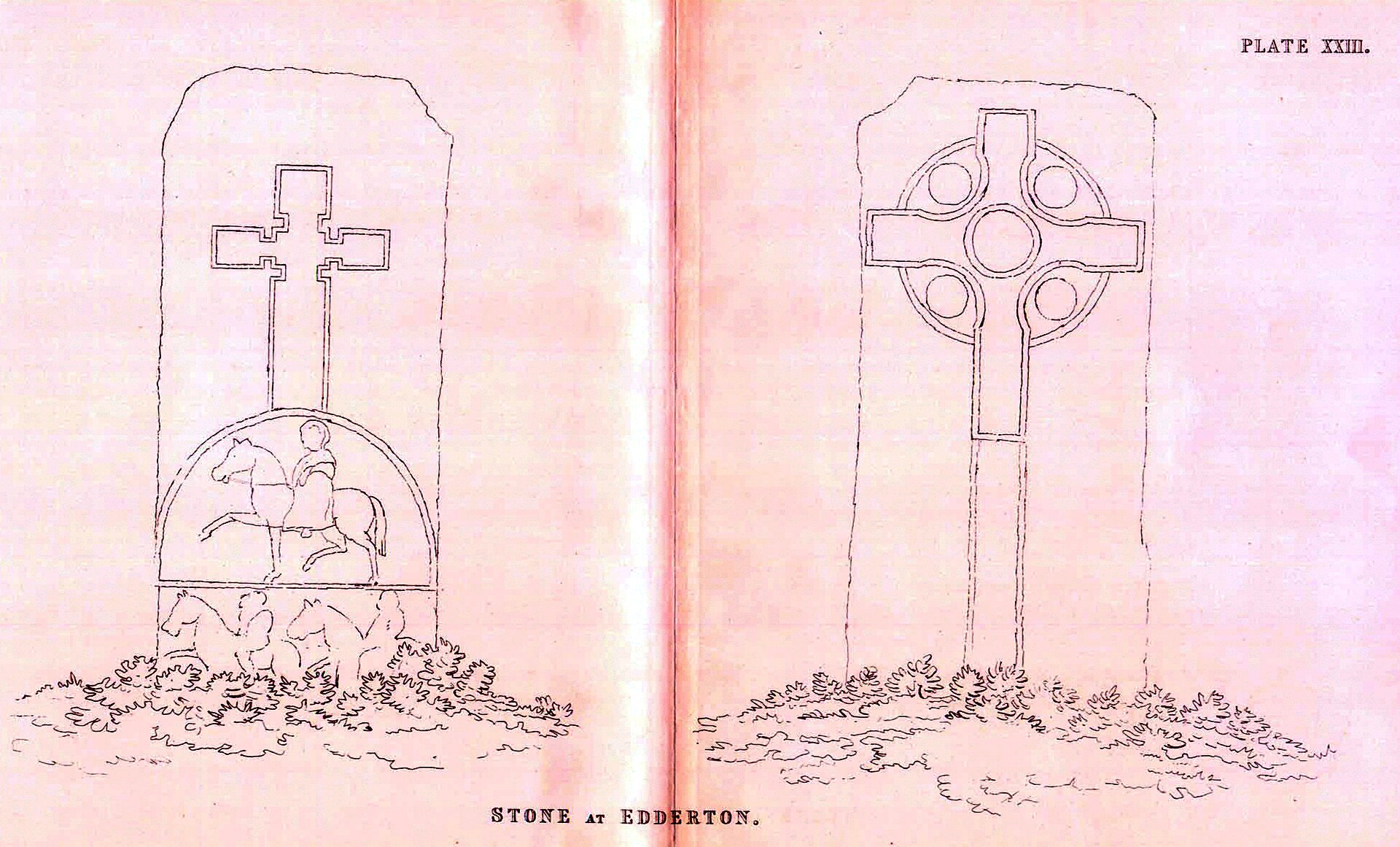
Photo: Charles Carter Petley (1780-1830) / Wikimedia Commons / Public domain Its east face carries a cross design comparable to the reconstructed centre of the Hilton of Cadboll stone's bottom panel.
-
National Museum of Scotland, Edinburgh
Holds the upper three-quarters of the original stone, along with a copper representation of the recovered lower quarter.
-
Glenmorangie distillery
The neighbouring distillery adopted the triskele scrollwork design from the stone's bottom panel as its company logo.
-
John Ross Visitor Centre, Balintore
Displays the reconstructed lower portion of the original stone, restored with excavated carved fragments.
Discovery & excavation
In 1998 Kirkdale Archaeology, working on behalf of Historic Scotland, excavated near the Hilton of Cadboll chapel site and recovered around 40 fragments of carved micaceous sandstone believed to belong to the stone's lost cross face. A larger 2001 campaign by the same team recovered 740 further carved fragments and 122 possibly carved pieces, and located the missing lower portion of the slab in situ. Later that year Glasgow University Archaeological Research Division lifted the lower portion along with several thousand more carved fragments, whose distribution suggested the original stone had been deliberately dug for and then defaced where it lay after that attempt failed.
Finds now held at: National Museum of Scotland, Edinburgh; John Ross Visitor Centre, Balintore; Hilton of Cadboll village hall.
What to look for
-
The replica's hunting scene
The full-scale copy erected near the original site carries a hunting scene showing a rider facing outward, with hounds harrying a deer at the base of the panel.
-
Vine-scroll border
A vine-scroll border, read as a symbol of the Eucharist, runs down the left, right and bottom edges of the reverse face.
-
Double disc and Z-rod
Pictish symbols of a double disc and Z-rod appear at the top of the reverse face, above the hunting panel.
-
Reconstructed lower panel
The bottom panel, rebuilt from excavated fragments, shows a scrollwork design of triskeles springing from a central cross, read as the four rivers of paradise.
Plan your visit
- Location
- 57.7672°N · 3.8960°W
- Nearest settlement
- Hilton of Cadboll
- Access
- Open access
- Terrain
- Easy going
- Time needed
- About 45 minutes
- Best time
- Daylight, to compare the replica near the original site with the original portions in museum displays.
- What survives
- The original slab survives in separate museum-held portions; a full-scale replica near the original site restores the lost cross face and hunting scene.
Opening & admission
- Original portions are in museum/visitor-centre display, with a modern copy near the original location.
Nearby places
Carved stone · Pictish & early medieval
Clach a' Charridh
Highland
A carved cross faces the sea while Pictish beasts and a hunting scene face the land on the reverse: a single stone holding two entirely different v…
- Near Inverness
- Easy path
.jpg?width=800)
Carved stone · Pictish & early medieval
Nigg Stone
Highland
A shattered, staple-mended slab carries the oldest known depiction of a European triangular harp alongside carving so fine it is thought to share c…
- Near Nigg
- Easy path
Carved stone · Pictish & early medieval
Portmahomack sculpture fragments
Highland
Roughly 200 carved stone fragments, most no bigger than a handspan, add up to one of the largest collections of Pictish (of the Picts, the people o…
- Near Portmahomack
- Easy path
Minor monument · Medieval
Market Cross, Church Street, Cromarty
Highland
Cromarty’s market cross, the stone cross marking a burgh’s right to hold a market, preserves a rare civic document in stone: its 1578 shaft and Geo…
- Near Cromarty
- Easy path
Questions people ask
- Where is the Hilton of Cadboll Stone now?
- The upper three-quarters are in the National Museum of Scotland, Edinburgh; the recovered lower quarter is displayed in Hilton of Cadboll village hall; a full-scale replica stands near the original site.
- Why is the stone broken?
- A storm felled it in 1674, breaking off the top three-quarters; the cross face had already been defaced from the late sixteenth century onward, during the Scottish Reformation.
- How was the lost cross face reconstructed?
- Excavations in 1998 and 2001 recovered thousands of carved sandstone fragments and the buried lower portion, which Isabel Henderson used to reconstruct the iconography for sculptor Barry Grove's replica.
- What does the hunting scene on the back represent?
- Once read as a secular hunt, it is now identified as a version of the Roman Adventus, with the central rider seen as Christ or the Virgin Mary and the pursued deer symbolising the soul.
- What connection does the stone have to Glenmorangie whisky?
- The neighbouring distillery adopted the triskele scrollwork design from the stone's reconstructed bottom panel as its company logo.
Sources
- Wikipedia: Hilton of Cadboll Stone
- Wikidata: Hilton of Cadboll Stone
- National Museum of Scotland
Explore more: Carved stones · Pictish & early medieval · Highland
The Ancient Codex, in your pocket
Get the Pocket Codex app
Carry the directory with you — Hilton of Cadboll Stone and thousands of ancient places across Britain and Ireland, offline, wherever you roam.