One slab, two scenes: a plain ringed cross on one face, three processing horsemen beneath a cross on the other, recently raised to reveal riders buried underground for years.
Stand in the old graveyard at Edderton and the cross slab shows two quite different faces depending on which side is approached. Carved from a slab of red sandstone, one side carries a plain Celtic cross, its ring left standing proud of the surrounding stone so that the circle within the cross catches the light rather than sinking into shadow. Turn around and the other face tells a livelier story: a second cross sits above a shallow arch, and beneath it rides a single horseman, with two more riders incised lower down the stone.
That lower scene went unseen for a long time. The slab had settled, or been set, deeper into the graveyard soil than the carvers intended, burying the two lower horsemen and leaving only the topmost rider visible above ground. Recently the stone has been raised closer to what is thought to be its original height, and the join is easy to read once pointed out: the newly exposed lower section is noticeably cleaner of lichen than the upper stone, which has weathered in the open air for far longer.
The Edderton Cross Slab is easily confused with a different, older monument nearby: the Edderton Symbol Stone, known locally as Clach Biorach (“Pointed Stone”), a red sandstone pillar of Bronze Age origin carrying incised Pictish symbols, which stands in a field a little to the west of the village. Further fragments of early medieval cross-slabs from the same churchyard, too broken to remain in place, are now kept in Tain Museum.
What follows is drawn from published sources, with each claim labelled by how firmly it is established.
History
Carved from red sandstone, the Edderton Cross Slab presents two distinct faces meant to be read differently. On the west side an undecorated Celtic cross rises plain and elegant, its ring left in relief so the encircling bands stand slightly proud of the surface. On the east side a second cross sits above a shallow arch enclosing a mounted horseman, with two further riders incised beneath. As a Class III Pictish monument it carries none of the older incised symbols of earlier stones.
Over an unrecorded span of years the slab settled, or was deliberately set, deeper into the graveyard soil than its carvers intended, burying the lower portion of the eastern face and with it the two lower horsemen below the arched rider. Only the upper scene remained visible above ground, so that anyone visiting the churchyard for generations would have seen a single mounted figure rather than the fuller procession the stone actually carries.
The slab has since been raised back to what is thought to be its original height, bringing the two buried horsemen into view for the first time in living memory. The join between old and new exposure is legible in the stone itself: the previously buried lower half is markedly cleaner of lichen than the long-exposed upper portion, a visible record of how long each section spent below ground.
Further fragments of early medieval cross-slabs from Edderton churchyard, too damaged to display in place, are held in Tain Museum, a reminder that the surviving slab is only one survivor among a larger scatter of carved stone that once stood in the same burial ground.
Cultural influences
-
Pictish Christian sculpture
The cross and mounted figures place the slab within the Christian sculpture tradition of later Pictish monuments, rather than the earlier symbol-stone style.
Connections
-
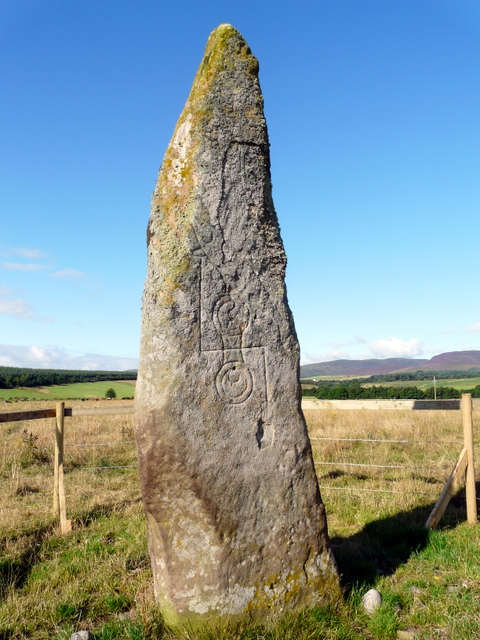
Photo: sylvia duckworth / Wikimedia Commons / CC BY-SA 2.0 Edderton Symbol Stone (Clach Biorach)
A separate, older monument standing in a field a little to the west of the village — a Bronze Age red sandstone pillar re-carved with Pictish symbols, often confused with the cross slab despite being a different stone and period.
-
Tain Museum
Holds further fragmentary early medieval cross-slabs recovered from Edderton churchyard, kept there because they survive in too poor a condition to remain in place.
Discovery & excavation
The slab was formerly sunk considerably deeper in the earth than it now stands, concealing its lower two horsemen, but has recently been raised to its presumed original height. The lack of lichen on the newly exposed lower half, compared with the long-weathered upper stone, records how long each part spent buried.
What to look for
-
The west face
A plain, undecorated Celtic cross with its ring left in relief, so the circular band stands slightly proud of the stone's surface.
-
The east face
A second cross set above a shallow arch, within which a mounted horseman rides in relief, with two further riders incised lower down the slab.
-
The lichen line
A visible boundary partway down the east face marking where the slab was formerly buried — the lower stone is noticeably cleaner than the long-exposed upper section.
Plan your visit
- Location
- 57.8336°N · 4.1733°W
- Nearest settlement
- Edderton
- Access
- Open access
- Terrain
- Easy going
- Time needed
- About 15 minutes
- Best time
- Daylight, when the two faces and the lichen line can be read clearly.
- What survives
- The cross slab remains upright in the graveyard and has been raised to reveal its lower horsemen; the lower face is visibly cleaner where it was long buried.
Opening & admission
- Stone stands in the old graveyard at Edderton.
Nearby places
%2C_Edderton_-_geograph.org.uk_-_915406.jpg?width=800)
Carved stone · Pictish & early medieval
Clach Biorach
Highland
A Bronze Age pillar over three metres tall was reused two thousand years later as a canvas for Pictish carving: a salmon, a double-disc and a Z-rod…
- Near Edderton
- Easy path

Carved stone · Pictish & early medieval
Ardjachie Stone
Highland
A single red sandstone boulder carries two carving traditions centuries apart: Bronze Age (roughly 2500–800 BC) cup-and-ring marks beneath a Pictis…
- Near Tain
- Easy path

Sacred place · Medieval
Dornoch Cathedral
Highland
Burned by feuding clansmen in 1570 and rebuilt on a narrower plan in the 1830s, it still holds the graves of earls, dukes and the bishop-saint who…
- Near Dornoch

Carved stone · Pictish & early medieval
Clach a' Mheirlich
Highland
A single monolith carries two separate ages of use: raised in the Bronze Age (roughly 2500–800 BC), then marked centuries later with Pictish (of th…
- Near Rosskeen
- Easy path
Questions people ask
- What is the Edderton Cross Slab?
- A Class III Pictish cross-slab of red sandstone standing in Edderton's old graveyard, carved with a plain Celtic cross on one face and a cross with three horsemen on the other.
- Is it the same as the Edderton Symbol Stone?
- No. The Symbol Stone, or Clach Biorach, is a separate Bronze Age pillar carrying incised Pictish symbols, standing in a field a little to the west of the village.
- Why does the lower half of one face look different?
- The slab was formerly sunk deeper in the ground, burying the two lower horsemen; the recently exposed lower section still lacks the lichen grown on the long-exposed upper stone.
- Where can related carved fragments be seen?
- Further fragments of early medieval cross-slabs from Edderton churchyard, in poor condition, are preserved in Tain Museum.
- What period does the stone belong to?
- It is classified as a Class III Pictish stone, the later category of Pictish carving showing Christian imagery without the earlier incised symbol repertoire.
Sources
- Wikipedia: Edderton Cross Slab
- Wikidata: Q5335777
- MacNamara, Ellen — The Pictish Stones of Easter Ross (Tain, 2003)
Explore more: Carved stones · Pictish & early medieval · Highland
The Ancient Codex, in your pocket
Get the Pocket Codex app
Carry the directory with you — Edderton Cross Slab and thousands of ancient places across Britain and Ireland, offline, wherever you roam.