
A Bronze Age pillar over three metres tall was reused two thousand years later as a canvas for Pictish carving — a salmon, a double-disc and a Z-rod cut into stone already ancient when the symbols were made.
In a field outside the village of Edderton in Easter Ross stands a slab of sandstone over three metres tall, tapering to a blunt point that gives the stone its name. Local Gaelic tradition calls it Clach Biorach, ‘the Pointed Stone’, though it is also recorded as Clach Chairidh. Nothing about its silhouette announces the two separate stories carved into its history: one written by the people who first raised it, the other by a very different community who returned to it millennia later and gave it a new meaning.
The stone itself is far older than the markings that make it notable today. It was set upright at some point between 4000 and 1500 BC, in the long stretch of prehistory spanning the Neolithic and Middle Bronze Age, for reasons that were never recorded and can no longer be recovered. It stood as a bare monolith for centuries, perhaps millennia, before anyone touched its surface again.
That second act came far later, when Pictish carvers incised symbols into the stone’s north face sometime between 500 and 700 AD. The result is one of Scotland’s Class I Pictish stones — an unenclosed, undressed monument bearing incised symbols rather than the later relief crosses of Class II. A salmon, carved above a double-disc joined by a Z-rod, turned a prehistoric marker into a piece of Pictish symbolism whose exact purpose remains a matter of ongoing debate.
What follows is drawn from published sources, with each claim labelled by how firmly it is established.
The name
The name Clach Biorach comes from Scots Gaelic and means 'the Pointed Stone', a plain description of its tapering profile. It is also recorded under the alternative name Clach Chairidh.
History
Between roughly 4000 and 1500 BC, during the long span from the Neolithic into the Middle Bronze Age, the sandstone pillar was quarried and raised upright in what is now a field near Edderton. No record survives of who erected it or why; like many standing stones of this era, its original purpose was left for later generations only to guess at.
Centuries later, between about 500 and 700 AD, in the Late Iron Age to Early Medieval period, Pictish carvers returned to the already-ancient stone and incised symbols into its north face — a salmon above a double-disc joined by a Z-rod. This act of reuse transformed a prehistoric monolith into a Class I Pictish stone, one of a recognised group across north-east Scotland bearing incised, uncarved-relief symbolism of this kind.
When the stone was first formally recorded in 1780, an observer noted a circle below and to the left of the main symbols, which may have formed part of a mirror motif commonly paired with Pictish symbol pairs elsewhere. That circle is no longer visible on the stone today, lost to centuries of weathering, leaving the 1780 record as the only evidence it was ever there.
Cultural influences
-
Pictish reuse of an older stone
Pictish symbols were cut into a standing stone probably erected in the Neolithic or Bronze Age, layering early-medieval imagery onto a much older monument.
Connections
-
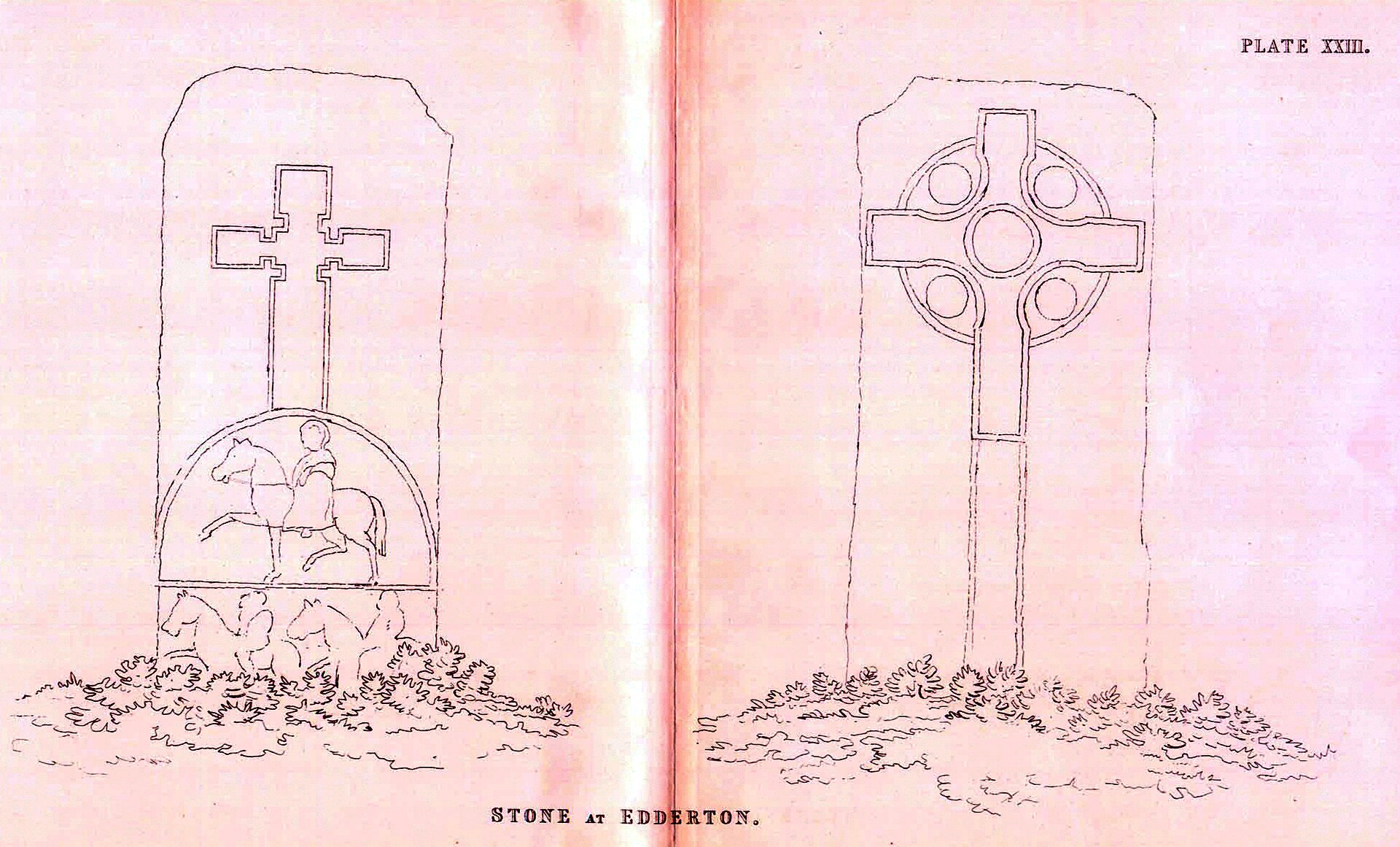
Photo: Charles Carter Petley (1780-1830) / Wikimedia Commons / Public domain A second Pictish monument recorded in the same village of Edderton, placing Clach Biorach within a small local cluster of Pictish carved stones rather than as an isolated example.
-
Celtic art
The stone's incised salmon, double-disc and Z-rod symbols belong to the wider tradition of Celtic art from which Pictish symbol-carving draws its visual vocabulary.
Discovery & excavation
The stone's carvings were first formally documented in 1780, when a recorder noted a circular motif below the main symbols that has since disappeared from the visible surface.
What to look for
-
The Pictish symbol panel
On the stone's north face, a salmon is carved above a double-disc joined by a Z-rod — a classic pairing of Pictish symbols cut into the older sandstone pillar.
-
Scale and proportion
The stone stands 3.13 metres (10 ft 3 in) high, with a base 1.07 metres (3 ft 6 in) wide and 0.46 metres (1 ft 6 in) deep, making it one of the taller standing stones later adapted for Pictish carving.
Plan your visit
- Location
- 57.8369°N · 4.1758°W
- Nearest settlement
- Edderton
- Access
- Open access
- Terrain
- Easy going
- Time needed
- About 15 minutes
- Best time
- Daylight, when the symbol panel is easiest to examine.
- What survives
- The 3.13-metre sandstone pillar survives upright; the circle recorded in 1780 is no longer visible.
- Facilities
- No dedicated visitor facilities are documented at the panel; plan to use facilities in nearby settlements.
Opening & admission
- Standing stone in a field near Edderton; access not established.
Nearby places
Carved stone · Pictish & early medieval
Edderton Cross Slab
Highland
One slab, two scenes: a plain ringed cross on one face, three processing horsemen beneath a cross on the other, recently raised to reveal riders bu…
- Near Edderton
- Easy path

Carved stone · Pictish & early medieval
Ardjachie Stone
Highland
A single red sandstone boulder carries two carving traditions centuries apart: Bronze Age (roughly 2500–800 BC) cup-and-ring marks beneath a Pictis…
- Near Tain
- Easy path

Sacred place · Medieval
Dornoch Cathedral
Highland
Burned by feuding clansmen in 1570 and rebuilt on a narrower plan in the 1830s, it still holds the graves of earls, dukes and the bishop-saint who…
- Near Dornoch

Carved stone · Pictish & early medieval
Clach a' Mheirlich
Highland
A single monolith carries two separate ages of use: raised in the Bronze Age (roughly 2500–800 BC), then marked centuries later with Pictish (of th…
- Near Rosskeen
- Easy path
The setting
Near Clach Biorach, about 53 metres away.
Photo: Richard Webb / Wikimedia Commons / CC BY-SA 2.0
Near Clach Biorach, about 93 metres away.
Photo: Rab McMurdo / Wikimedia Commons / CC BY-SA 2.0
Questions people ask
- What does the name Clach Biorach mean?
- It is Scots Gaelic for 'the Pointed Stone', describing the monument's tapering shape. It is also recorded as Clach Chairidh.
- How old is Clach Biorach?
- The stone was likely erected between 4000 and 1500 BC, then carved with Pictish symbols centuries later, between about 500 and 700 AD.
- What symbols are carved on the stone?
- A salmon above a double-disc joined by a Z-rod, incised on the stone's north face, identifying it as a Class I Pictish stone.
- Where is Clach Biorach located?
- It stands in a field near the village of Edderton in Easter Ross, in the Highland council area.
- How big is the stone?
- It is 3.13 metres (10 ft 3 in) tall, with a base 1.07 metres wide and 0.46 metres deep.
Sources
The Ancient Codex, in your pocket
Get the Pocket Codex app
Carry the directory with you — Clach Biorach and thousands of ancient places across Britain and Ireland, offline, wherever you roam.