
Invereen’s accidental discovery saved a precisely carved Pictish stone — of the Picts, the people of northern and eastern Scotland from about AD 300 to 900 — whose layered symbols connect a lost field setting with a national collection.
In 1932, working a field near Invereen in Inverness-shire, a man named A. Dunbar felt his plough catch on something solid beneath the soil. What came up was a slab of light red sandstone, just over a metre tall, carved with symbols that had lain hidden in the earth for well over a thousand years.
The stone carries two of the most recognisable Pictish symbols: a crescent crossed by a broken arrow known as a v-rod, and a pair of linked discs crossed by a z-rod. A third mark, a plain circle with a line through it, may have been added later than the other two. Because the stone bears symbols alone, with no cross or other Christian imagery, it is classed by archaeologists as a Class I stone — the term used for the earlier, undressed slabs of Pictish carving, as distinct from the shaped, cross-bearing Class II stones that came after.
The stone no longer stands in the ground where Dunbar found it. It was moved to the National Museums of Scotland in Edinburgh, where it remains on public display today, one of many Pictish symbol stones gathered from farmland across the north-east into a single national collection.
What follows is drawn from published sources, with each claim labelled by how firmly it is established.
History
Some time during the Pictish period, most likely between the 6th and 8th centuries, a carver incised a crescent and v-rod and a double disc and z-rod into a slab of local red sandstone. A third symbol, a circle crossed by a line, may have been cut later, suggesting the stone was worked on more than once rather than carved in a single sitting.
In 1932 a man named A. Dunbar uncovered the stone while ploughing a field near Invereen, in Inverness-shire, at the location recorded as grid reference NH797311. The find was accidental rather than the result of any search, which is how many Pictish symbol stones have come to light — turned up by farm work long after their original setting had been forgotten.
Following its discovery, the stone was removed from the farmland at Invereen and transferred into national care. It is now held and displayed by the National Museums of Scotland in Edinburgh, standing alongside other examples of Pictish sculpture gathered from across Scotland rather than remaining at or near its original findspot.
People
-
A. Dunbar
The ploughman who uncovered the stone near Invereen in 1932 while working a field.
Cultural influences
-
Class I Pictish symbol carving
Its crescent-and-V-rod and double-disc-and-Z-rod place the stone within the incised Class I Pictish tradition.
Connections
-
National Museums of Scotland, Edinburgh
Has held and displayed the stone since its removal from Invereen, as part of the national collection of Pictish sculpture.
-
Class I Pictish symbol stones
Belongs to this broader category of undressed stones bearing incised symbols alone, without the crosses added on later Class II stones.
Discovery & excavation
The stone was found by chance in 1932, when A. Dunbar's plough struck it in a field near Invereen. It was subsequently taken into national care rather than left at or marked on the findspot.
Finds now held at: National Museums of Scotland, Edinburgh.
What to look for
-
Crescent and V-rod
A crescent shape crossed by a broken, arrow-like rod — one of the most common symbols found on Pictish stones.
-
Double disc and Z-rod
Two linked circular discs crossed by a broken Z-shaped rod, carved alongside the crescent and v-rod symbol.
-
Circle and line
A simpler third mark, a plain circle crossed by a line, thought to be a possible later addition to the stone.
Plan your visit
- Location
- 57.3545°N · 4.0011°W
- Nearest settlement
- Aviemore
- Access
- Open access
- Terrain
- Easy going
- Time needed
- About 15 minutes
- Best time
- During National Museums of Scotland opening hours.
- What survives
- The red sandstone slab survives in the national collection, with its three incised symbol groups visible.
Opening & admission
- Stone is displayed at the National Museums of Scotland in Edinburgh.
Nearby places

Tomb or burial place · Prehistoric
Clava cairn
Highland
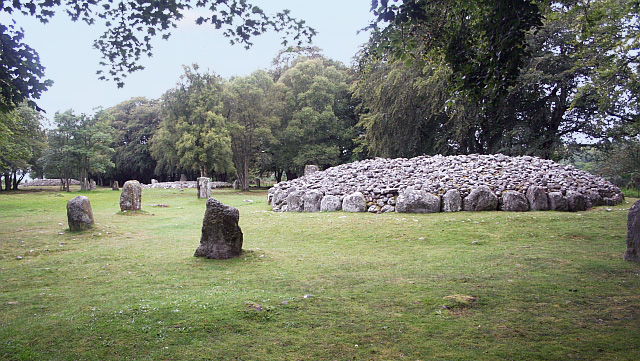
A burial mound of piled stones at Balnuaran of Clava, whose kerb stones were sorted by colour before they were laid.
- Near Inverness
- Some walking
Tomb or burial place · Prehistoric
Clava Cairns
Highland
Clava’s planned arrangement of cairns and standing stones offers rare evidence of a single communal decision about burial and remembrance, rather t…
- Near Inverness
- 149 metres from car park
- Easy path

Tomb or burial place · Prehistoric
Carn Glas
Highland
At 116 metres long, this three-part cairn (a mound of piled stones, often covering a burial) is the longest chambered burial monument yet recorded…
- Near Inverness
- Some walking

Fortified place · Iron Age
Dun Evan
Highland
A double ring of vitrified (burnt so fiercely that the stone melted and set again) and rebuilt walls crowns a rock between two river valleys, with…
- Near Cawdor
- Some walking
Questions people ask
- What is the Invereen Stone?
- A Class I incised Pictish stone of red sandstone, carved with symbols and unearthed near Invereen, Inverness-shire, in 1932.
- Where can the Invereen Stone be seen today?
- It is on display at the National Museums of Scotland in Edinburgh, having been removed from its original findspot.
- How was the Invereen Stone discovered?
- It was found by chance in 1932 when A. Dunbar's plough struck it while working a field near Invereen.
- What symbols are carved on the Invereen Stone?
- A crescent and v-rod, a double disc and z-rod, and a third, possibly later, circle-and-line design.
- Why is it called a Class I stone?
- Class I denotes early Pictish stones carved with symbols only, unlike the shaped, cross-bearing Class II stones that followed.
Sources
The Ancient Codex, in your pocket
Get the Pocket Codex app
Carry the directory with you — Invereen Stone and thousands of ancient places across Britain and Ireland, offline, wherever you roam.