Its rear face still carries an older set of incised symbols beneath a later relief-carved cross — one of only two stones nearby known to have been recarved this way.
In woodland on the northern slope of a low hill south east of Glamis, a slab of stone stands close to five feet tall, its surface marked on both sides by carvings made at different points in its history. It has stood in roughly this spot, by all appearances, since it was first raised, a short walk from the village whose name it shares even though the stone itself sits some distance out among the trees.
What makes it unusual is not simply that it carries Pictish carving, but that it carries two layers of it. One face was cut first, its symbols incised directly into the natural, unshaped stone. Later, the same block was taken up again, its opposite face dressed flat and cut with a cross in relief, so that a plain symbol stone became a sculpted cross-slab without ever leaving the ground it stood on.
That sequence links the stone to only one known neighbour treated the same way, a carved stone at Glamis Manse around 800 metres to the west, and places both within a wider family of related Pictish sculpture found across this part of Angus.
What follows is drawn from published sources, with each claim labelled by how firmly it is established.
History
In the Pictish period, carvers first worked the stone on Hunter's Hill in its plainer form: symbols cut directly into the natural, unshaped surface, a style later classified as Class I. This first phase of carving, confined to what would become the rear face once the stone was reworked, shows the site already held meaning for those who marked it, well before it took on its later, more elaborate form.
At a later date, the same stone was returned to and recarved. Its front face was dressed flat and cut with a cross in relief, turning a Class I symbol stone into a Class II cross-slab that carried both the older incised symbols and a new sculpted cross side by side on opposite faces. Only one other stone in the area, the Glamis Manse Stone roughly 800 metres to the west, is known to have been reused in this same two-stage way, tying the two together in the local sculptural record.
The framework used to describe stones like this one was set out by John Romilly Allen and Joseph Anderson, whose classification divided Pictish symbol stones into Class I, incised carvings on unshaped stone, and Class II, dressed slabs carved in relief and typically bearing a cross. Their system remains the standard reference for describing the Hunter's Hill stone's two distinct phases of carving.
Ross Trench-Jellicoe first proposed grouping a set of related carved stones under the name of the Aberlemno School of Pictish sculpture. That list was later extended by Laing to include the Hunter's Hill stone alongside the Glamis Manse Stone, Aberlemno 2 and Aberlemno 3, Menmuir 1, Kirriemuir 1, Monifieth 2, Eassie, and Rossie Priory, setting it within a wider regional tradition of carved stones rather than treating it as an isolated monument.
People
-
John Romilly Allen
Co-devised, with Joseph Anderson, the Class I and Class II classification system used to describe the stone's two phases of carving.
-
Joseph Anderson
Co-devised, with John Romilly Allen, the classification dividing Pictish symbol stones into incised Class I stones and relief-carved Class II slabs.
-
Ross Trench-Jellicoe
First proposed the grouping of related carved stones that became known as the Aberlemno School of Pictish sculpture.
-
Laing
Extended Ross Trench-Jellicoe's original list to include the Hunter's Hill stone within the Aberlemno School.
Connections
-
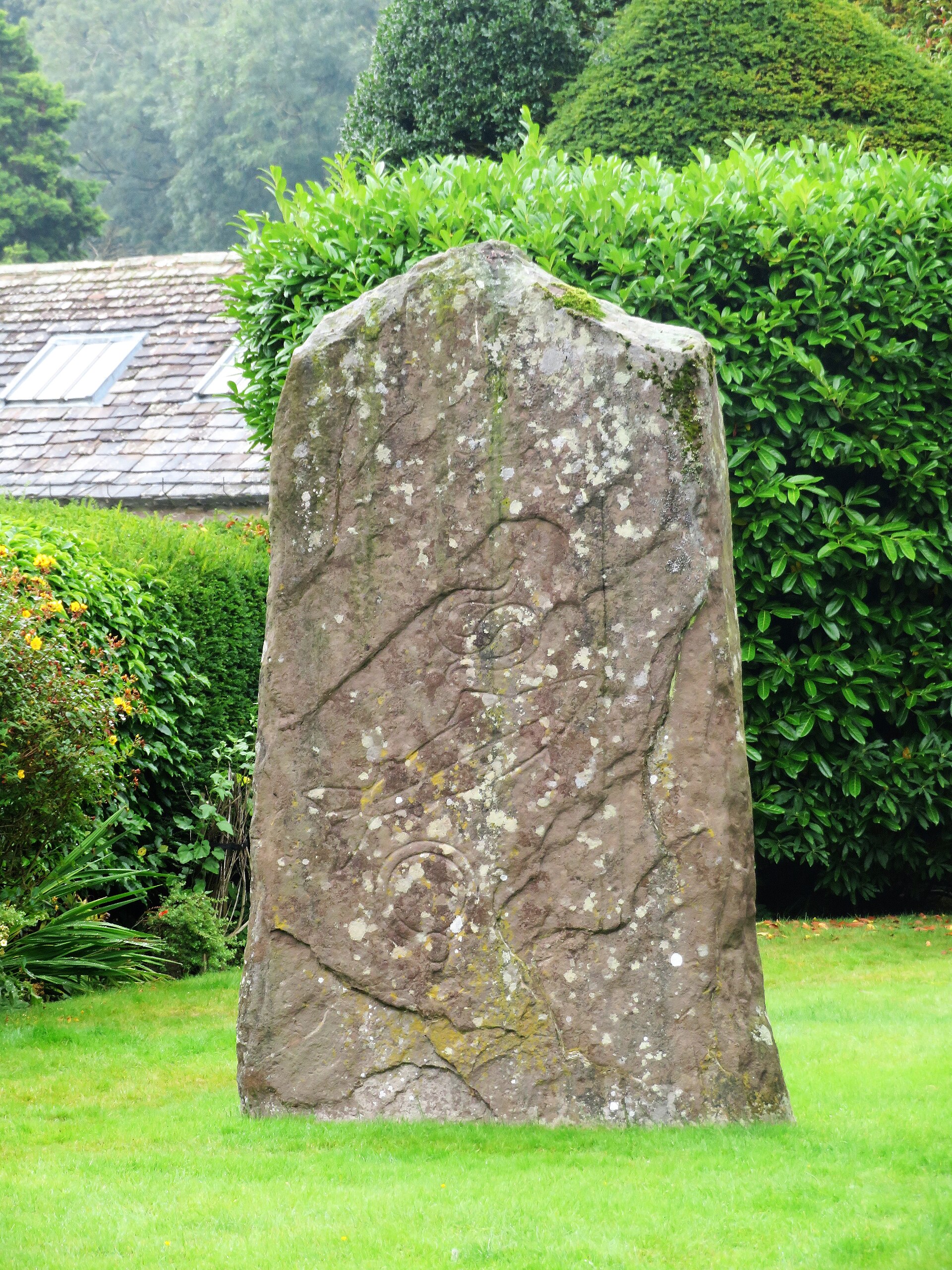
Photo: Gordon Hatton / Wikimedia Commons / CC BY-SA 2.0 Standing about 800 metres to the west, it is the only other stone locally known to have been carved first as a Class I symbol stone and later recarved with a relief, sharing the same two-stage history as the Hunter's Hill stone.
-
Aberlemno 2 (the Kirkyard Stone)
Grouped with the Hunter's Hill stone within the Aberlemno School of Pictish sculpture as extended by Laing.
-
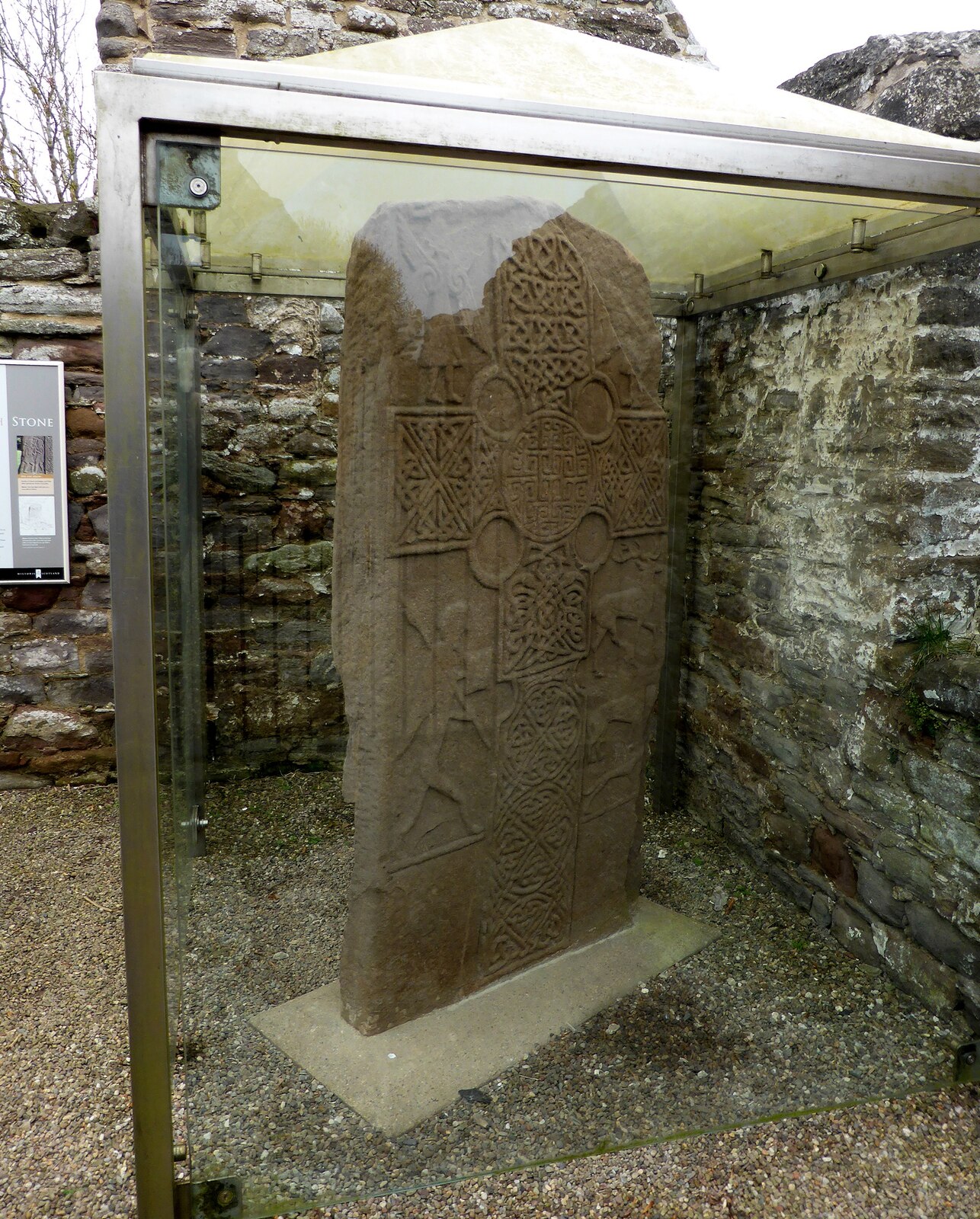
Photo: Sandy Gerrard / Wikimedia Commons / CC BY-SA 2.0 Listed alongside the Hunter's Hill stone as part of the same Aberlemno School grouping of Pictish sculpture.
-
Rossie Priory Stone
Included with the Hunter's Hill stone in the Aberlemno School grouping proposed by Trench-Jellicoe and extended by Laing.
What to look for
-
The cross face
The front of the slab carries a cross cut in relief, standing proud of the surface rather than merely incised — the mark of its later, Class II phase of carving.
-
The incised rear symbols
The rear face bears Pictish symbols cut directly into the stone, the surviving trace of the slab's earlier life as a Class I symbol stone before it was recarved.
-
Scale and setting
Standing 1.52 metres high and 0.71 metres wide, the slab occupies woodland on the north slope of Hunter's Hill, just south of the modern A94 road.
Plan your visit
- Location
- 56.6068°N · 2.9893°W
- Nearest settlement
- Glamis
- Access
- Open access
- Terrain
- Moderate walking
- Time needed
- About 30 minutes
- What survives
- The 1.52-metre slab survives in woodland on Hunter’s Hill, with its later relief cross on one face and earlier incised Pictish symbols on the other.
Opening & admission
No admission is charged; check the managing body's site for any current visitor guidance before travelling.
- Standing in woodland on a hillside slope, so a short uphill walk from the roadside may be required.
Nearby places
Carved stone · Pictish & early medieval
Glamis Manse Stone
Angus
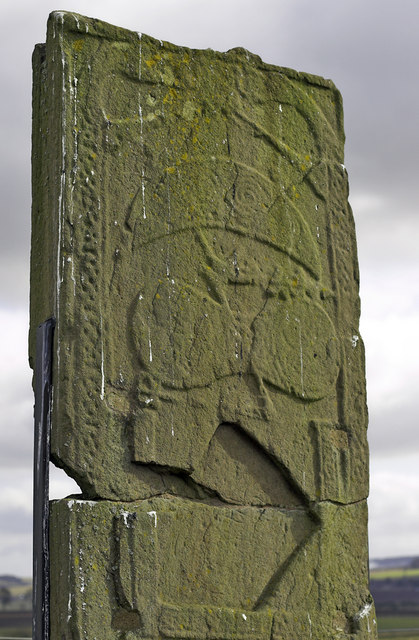
One of the most crowded cross faces in Pictish sculpture: axe-fighters, a cauldron with legs dangling from it, and a centaur share the stone with a…
- Easy path
Fortified place · Medieval
Glamis Castle
Angus
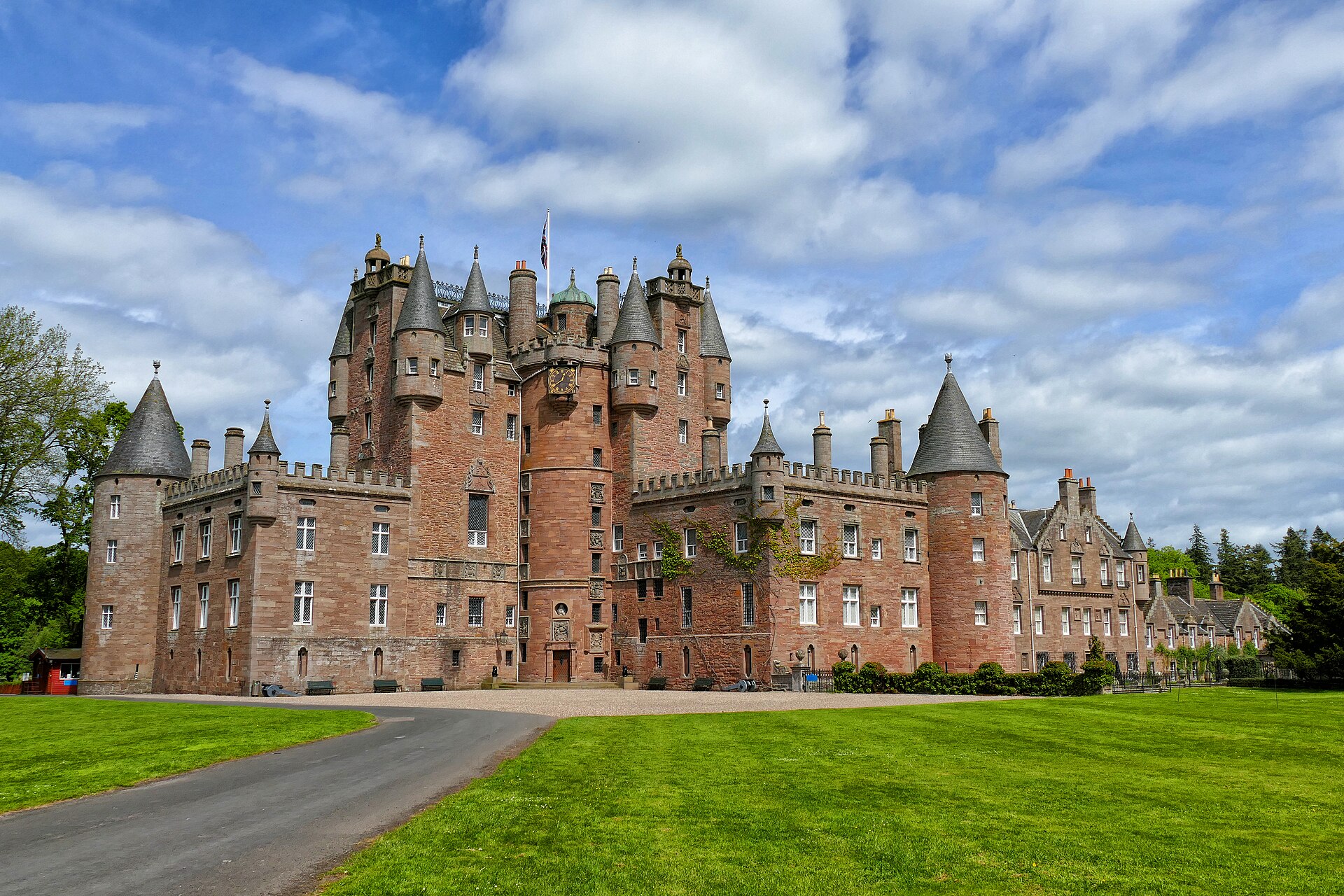
One family, the Lyons, has held this Strathmore estate since the 1370s, and its rooms have hosted a murdered king, a woman burned for witchcraft, a…
- Easy path
Carved stone · Pictish & early medieval
St Orland's Stone
Angus
St Orland’s in-situ cross-slab joins a richly interlaced Christian cross to symbols, hunters, a boat and beasts, preserving a remarkably complex pr…
- Near Glamis
- Some walking
Carved stone · Pictish & early medieval
Eassie Stone
Angus
Carved on both faces with warriors, hunters, angels and a figure entangled with severed heads, it survived only because Georgian antiquarians pulle…
- Near Eassie
- Easy path
The setting
Winter crops in the farmland near Hunter’s Hill Stone; the standing stone is not visible.
Photo: Alan Reid / Wikimedia Commons / CC BY-SA 2.0
View across the landscape near Hunter’s Hill Stone; the standing stone is not visible.
Photo: Scott Cormie / Wikimedia Commons / CC BY-SA 2.0
Glamis kirk and kirkyard in the wider landscape around Hunter’s Hill Stone; the stone is not visible.
Photo: jamesnicoll / Wikimedia Commons / CC BY-SA 2.0
Questions people ask
- What kind of monument is the Hunter's Hill Stone?
- It is a Class II Pictish cross-slab, carved with a cross in relief on one face and older incised symbols on the other.
- Where is the stone located?
- It stands in woodland on the north slope of Hunter's Hill, south east of Glamis village in Angus, just south of the A94.
- Why does the stone have carvings on both faces?
- It was originally a Class I symbol stone carved with incised designs, then later recarved with a relief cross on its front face.
- Is it connected to other Pictish stones nearby?
- It belongs to the Aberlemno School of Pictish sculpture and shares its two-stage carving history with the nearby Glamis Manse Stone.
- How big is the stone?
- It measures about 1.52 metres high and 0.71 metres wide.
Sources
The Ancient Codex, in your pocket
Get the Pocket Codex app
Carry the directory with you — Hunter's Hill Stone and thousands of ancient places across Britain and Ireland, offline, wherever you roam.