
Found in a field-clearance heap in 2001, its incised crescent-and-V-rod and triple disc symbols mark a seventh-century Pictish (of the Picts, the people of northern and eastern Scotland from about AD 300 to 900) carving, not an ordinary field stone.
Among the ordinary stones gathered into a field clearance heap at Cairnton Farm, near Newmachar in Aberdeenshire, one slab stood apart. Kite-shaped and weathered on its carved face, it carried two incised symbols — a crescent crossed by a V-rod, and a triple disc — cut into the surface by a Pictish carver more than a thousand years earlier. When it was recognised in 2001, what had been treated as just another piece of field rubble turned out to be a seventh-century Pictish stone.
The carving places the stone among Scotland’s class I Pictish stones — unshaped natural stones marked only with incised symbols, distinct from the later cross-slabs that combine Christian imagery with the same symbol tradition. The crescent and V-rod and the triple disc are the two symbols recorded on this stone, incised on a single face of the natural kite-shaped slab.
Because the stone was found loose in a clearance heap rather than in its original setting, nothing is known of where it originally stood or what structure, if any, it once marked. It was declared Treasure Trove after its discovery and is now held in the collection of the Marischal Museum in Aberdeen, where it survives as physical evidence of a Pictish presence in the Newmachar area.
What follows is drawn from published sources, with each claim labelled by how firmly it is established.
History
During the seventh century, an unknown carver incised two Pictish symbols — a crescent and V-rod and a triple disc — onto one face of a natural kite-shaped slab of stone. No structure or grave is recorded around it, and nothing else marks why this particular stone, weathered even then, was chosen for the carving. The stone's history between the seventh-century carving and its rediscovery is unrecorded. It was eventually gathered up with other stones cleared from the land, ending as one boulder within a large field clearance heap on farmland near Newmachar, its Pictish carving unnoticed until 2001.
In 2001 the carved slab was recognised for what it was among the stones of a field clearance heap at Cairnton Farm, near Newmachar in Aberdeenshire. Its incised symbols — a crescent and V-rod and a triple disc — identified it as a class I Pictish stone, one carved with symbols alone rather than the crosses of later Pictish sculpture. Following its discovery, the stone was reported and declared Treasure Trove, the legal process by which ownerless antiquities found in Scotland pass into public care rather than remaining with the finder. It was allocated to the Marischal Museum in Aberdeen, where it is now held.
Connections
-
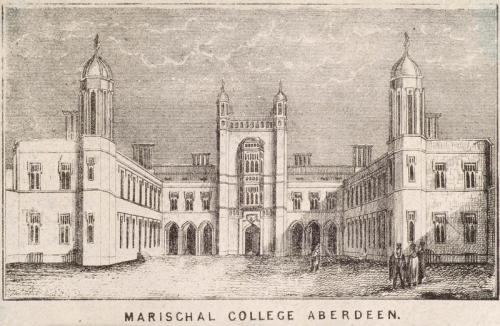
Photo: Unknown / Wikimedia Commons / Public domain Marischal Museum, Aberdeen
Holds the Cairnton stone in its collection following its declaration as Treasure Trove.
-
Cairnton Farm, near Newmachar
The stone was recognised in 2001 among a field-clearance heap at Cairnton Farm near Newmachar. That accidental survival in cleared agricultural stonework explains both its late discovery and why no original setting or associated grave is recorded.
Discovery & excavation
The stone was discovered in 2001 lying within a large field clearance heap at Cairnton Farm, near Newmachar, Aberdeenshire. Its incised symbols identified it as a Pictish carving, and it was declared Treasure Trove — the legal process for ownerless antiquities found in Scotland — before being allocated to the Marischal Museum in Aberdeen, where it remains today.
Finds now held at: Marischal Museum, Aberdeen.
What to look for
-
Crescent and V-rod
One of the two incised symbols on the stone, a crescent shape crossed by a broken V-shaped rod, among the most frequently repeated symbol pairings on Pictish stones; its repetition makes it useful for comparing Cairnton with other Class I carvings in the north-east.
-
Triple disc
The second incised motif is a triple disc: three linked circular forms cut into the same naturally shaped slab as the crescent and V-rod. Read beside that repeated Pictish pairing, it makes the small, weathered stone recognisable as a Class I symbol stone rather than an unmarked fieldstone.
-
Kite-shaped slab
The stone itself is a natural, unshaped slab of kite-shaped outline, weathered on the carved face rather than dressed or trimmed for the carving - a reminder that the monument began as a fieldstone before it became a museum object.
Plan your visit
- Location
- 57.2678°N · 2.2386°W
- Nearest settlement
- Newmachar
- Access
- Open access
- Terrain
- Easy going
- Time needed
- About 30 minutes
- Best time
- Daylight is the most useful time to see the monument and assess the approach.
- What survives
- The 1.3-metre kite-shaped Pictish stone survives in the Marischal Museum collection, with its crescent-and-V-rod and triple-disc carvings on one weathered face.
- Facilities
- The stone is held in the Marischal Museum; use the museum\x27s visitor facilities rather than the discovery site, which is not a public attraction.
Opening & admission
The stone is held in a museum collection, not at its original outdoor location — check the museum's site for current visiting details.
Nearby places
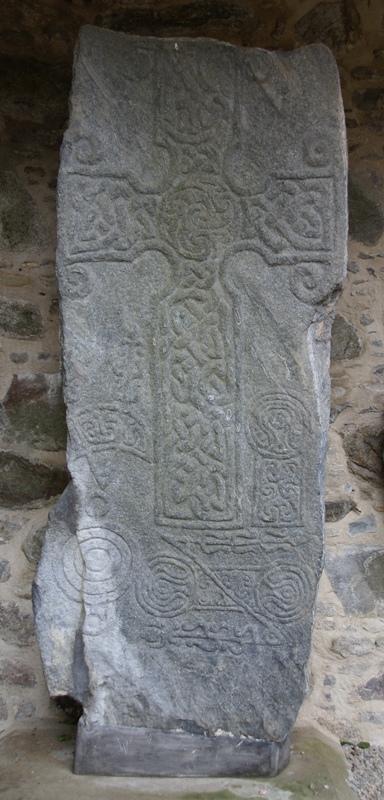
Carved stone · Pictish & early medieval
Dyce Symbol Stones
Aberdeen City
A rare survival: an incised pagan-era stone and a Christian cross-slab stand side by side under one roof, one still carrying an ogham inscription n…
- Near Dyce
- 1 min walk from car park
- Easy path
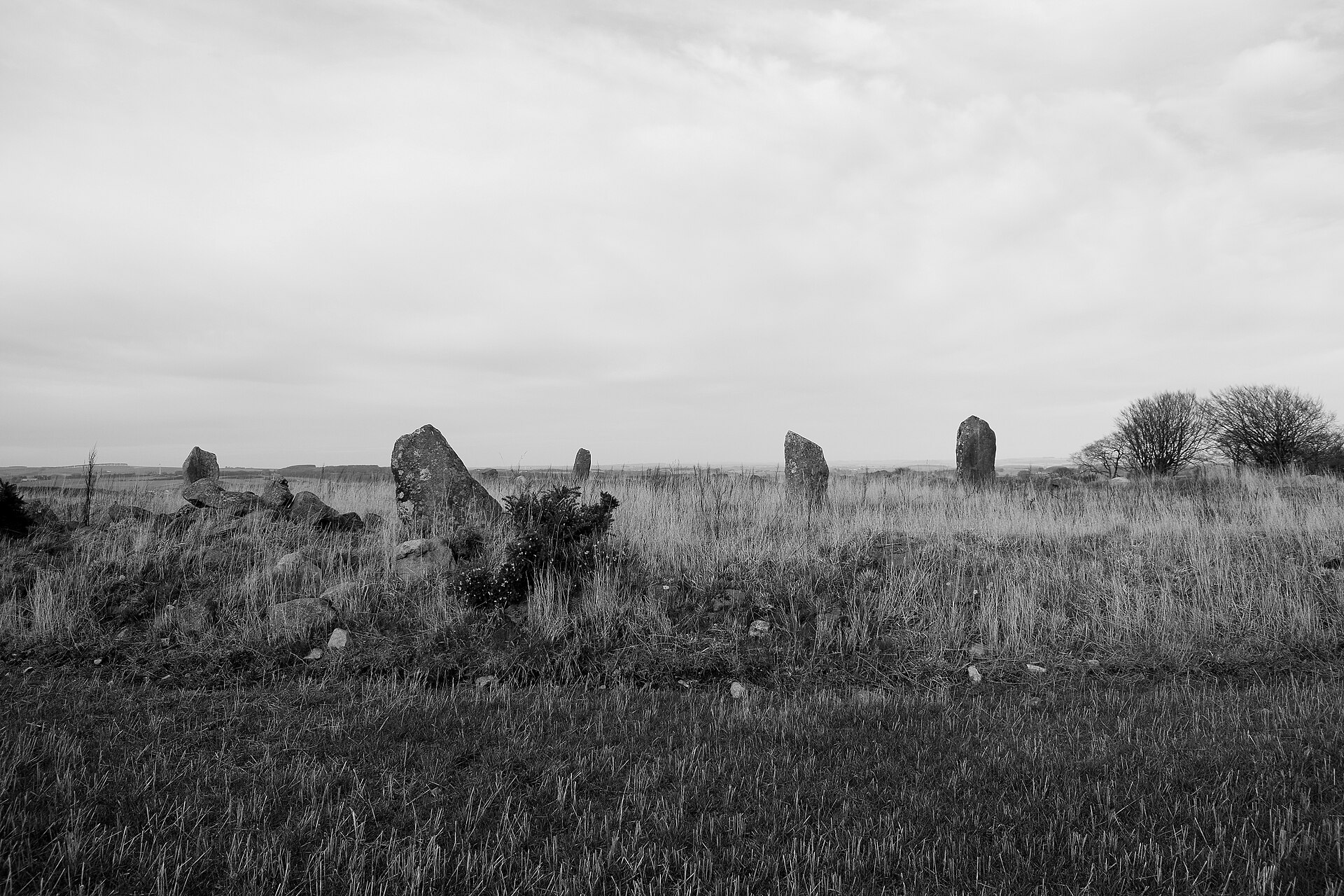
Sacred place · Prehistoric
Sheldon stone circle
Aberdeenshire
Long classified as a recumbent stone circle despite no recumbent stone ever being found here, Sheldon has recently had that identity questioned by…
- Near Oldmeldrum
- Some walking
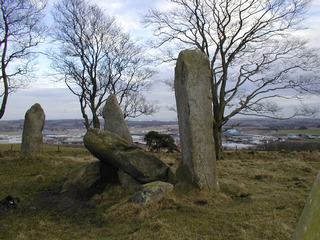
Sacred place · Prehistoric
Tyrebagger stone circle
Aberdeen City
One of only a handful of recumbent stone circles left with all eleven of its original stones still in place: including a 24-ton granite giant laid…
- Near Dyce
- Easy path
Fortified place · Medieval
Caskieben
Aberdeenshire
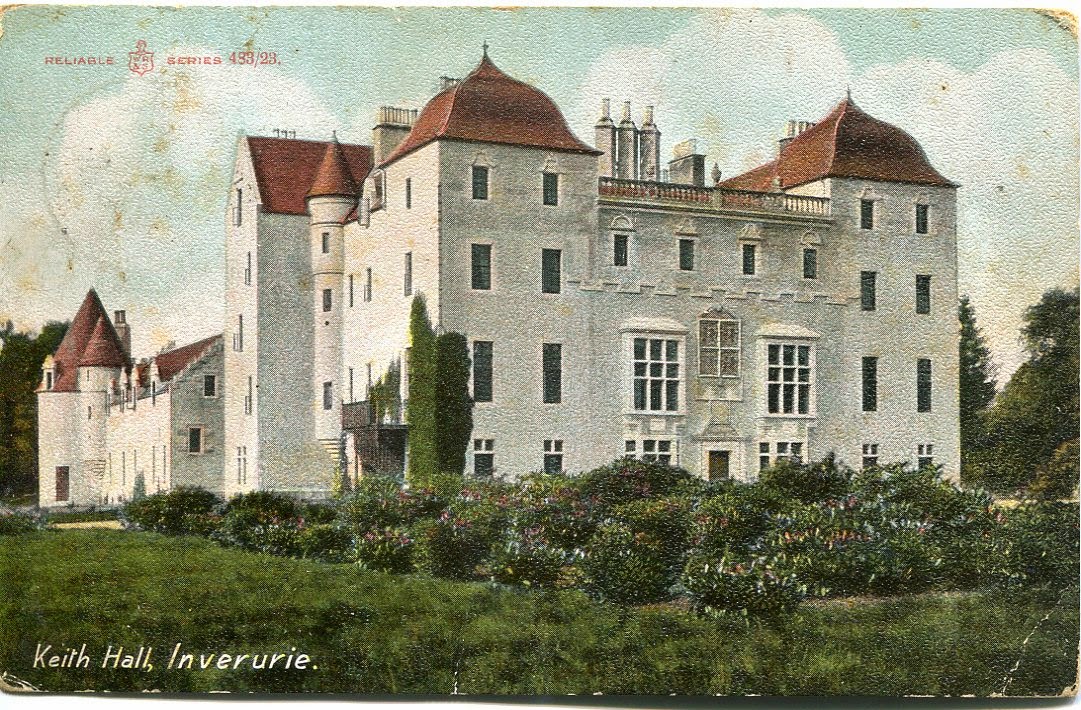
A timber tower's mound and moat still trace the outline beneath Keith Hall, a mansion that grew from Z-plan castle to Georgian seat over seven cent…
- Easy path
The setting
Disblair and rural Aberdeenshire viewed from the air near Cairnton Stone; the stone is not visible.
Photo: Derek Harper / Wikimedia Commons / CC BY-SA 2.0
Road to Cairnton in the landscape around Cairnton Stone; the stone is not visible.
Photo: Richard Webb / Wikimedia Commons / CC BY-SA 2.0
Questions people ask
- What is the Cairnton stone?
- A class I Pictish stone incised with a crescent and V-rod and a triple disc, dating to the seventh century and found near Newmachar, Aberdeenshire.
- Where was the Cairnton stone found?
- It was discovered in 2001 among stones in a large field clearance heap at Cairnton Farm, near Newmachar, Aberdeenshire.
- Where is the stone kept now?
- In the collection of the Marischal Museum, Aberdeen, after it was declared Treasure Trove following its discovery.
- What symbols are carved on the stone?
- A crescent and V-rod and a triple disc, incised on one weathered face of a natural kite-shaped slab.
- What does "class I" mean for a Pictish stone?
- An unshaped stone bearing incised symbols only, without the crosses found on later Pictish cross-slabs.
Sources
The Ancient Codex, in your pocket
Get the Pocket Codex app
Carry the directory with you — Cairnton stone and thousands of ancient places across Britain and Ireland, offline, wherever you roam.