A rare survival: an incised pagan-era stone and a Christian cross-slab stand side by side under one roof, one still carrying an ogham inscription nobody has fully deciphered.
Under a small modern shelter built into the walls of a roofless chapel at Dyce, near Aberdeen, two carved stones stand within a few feet of each other, separated by well over a thousand years of belief. One is scored with the flowing outline of a creature no one can name and a pair of linked discs crossed by a broken rod. The other is dominated by a knotted Celtic cross, its arms filled with interlace, a raised boss at the centre carved with a tight spiral.
Round the foot of the cross on the second stone runs a band of the same symbol vocabulary as the first: a crescent crossed by a v-shaped rod, another double disc and z-rod, and a triple disc paired with a mirror case. Along one edge, cut into the stone’s narrow side, is a line of ogham strokes - an early alphabet built from notches and lines rather than curved letters. Transliterated, it reads EOTTASSARRHETODDEDDOTS MAQQ ROGODDADD, a personal-name formula whose full meaning has not been settled.
Several smaller sculptured stones share the shelter with the two named slabs, all gathered inside the ruins of St Fergus’s Chapel rather than left standing in the open ground where they were originally carved. Together they form one of the more concentrated small collections of Pictish and early medieval carved stone in Aberdeenshire, kept under cover to slow the weathering that has already softened some of the incised lines.
What follows is drawn from published sources, with each claim labelled by how firmly it is established.
History
.jpg?width=1000)
Dyce I was carved as a Class I stone, the term used for Pictish monuments bearing incised symbols alone, without a cross or other Christian imagery cut into the surface. Its face carries two symbols from the standard Pictish repertoire: the so-called Pictish Beast, a stylised creature whose real-world model is still debated, and a double disc joined by a z-shaped rod. No accompanying inscription explains what either symbol meant to the people who cut them.
Dyce II followed as a Class II cross-slab, a later type of Pictish monument that combines the older incised symbols with an explicitly Christian cross carved in relief. Its principal face is dominated by a cross decorated with knotwork and centred on a raised boss carved with spiral ornament, a design that signals the stone was made once Christianity had become established locally alongside older symbolic traditions.
Around the base of the cross on Dyce II, the carvers added a further band of Pictish symbols: a crescent crossed by a v-rod, a second double disc and z-rod, and a triple disc paired with a mirror case. Carving these older symbol forms onto a Christian cross-slab, rather than replacing them, suggests continuity between the two belief systems rather than a clean break from one to the other.
On the narrow side of Dyce II is an ogham inscription, a script built from groups of incised strokes set along a stem line rather than conventional letters. Transliterated, the text reads EOTTASSARRHETODDEDDOTS MAQQ ROGODDADD, which appears to follow the common early medieval formula of one name followed by 'maqq' (son of) and a second name, though a confident full translation has not been agreed.
The two major stones, along with several smaller sculptured fragments, are now kept together in a purpose-built shelter inside the ruined walls of St Fergus's Chapel at Dyce, protecting the carved surfaces from further weathering while keeping the stones close to the site where they were originally set up.
Cultural influences
-
Pictish and Christian carving
Dyce II combines a relief-carved Christian cross with older Pictish symbols, preserving evidence of the period when Christian imagery became established alongside the region’s earlier symbol tradition.
Connections
-
St Fergus’s Chapel, Dyce
The symbol stones are sheltered within the ruined chapel walls, keeping them at the place where they are displayed together.
-
Dyce II cross-slab
Dyce II is the later Class II monument in the chapel shelter: its relief cross, knotwork and Ogham inscription show how Christian imagery was combined with the older Pictish symbols also seen on Dyce I.
What to look for
-
The Pictish Beast
An incised, stylised creature on Dyce I - one of the most common yet least understood figures in Pictish symbol carving, its identity still debated by specialists; compare its abstract outline with the more recognisably Christian imagery on Dyce II.
-
Double disc and z-rod
A recurring Pictish symbol appearing on Dyce I: two linked discs crossed by a broken, zigzag rod.
-
The cross face of Dyce II
A Celtic cross filling most of the stone's front, its surface worked with knotwork interlace and centred on a raised boss carved with spiral ornament.
-
Symbols round the cross base
A crescent and v-rod, a further double disc and z-rod, and a triple disc with mirror case, carved in a band around the foot of the cross on Dyce II.
-
The ogham inscription
A line of incised strokes along the narrow edge of Dyce II, transliterated as EOTTASSARRHETODDEDDOTS MAQQ ROGODDADD.
-
The smaller sculptured stones
Several additional carved fragments housed alongside Dyce I and Dyce II in the same shelter.
-
The shelter within St Fergus's Chapel
A purpose-built cover erected inside the roofless walls of the old chapel, protecting all the stones in one place.
Plan your visit
- Location
- 57.2293°N · 2.2082°W
- Nearest settlement
- Dyce
- Access
- Open access
- Terrain
- Easy going
- Parking
- Parking is available at the site.
- Time needed
- About 30 minutes
- Best time
- The site is open all year round.
- What survives
- Two Pictish stones are displayed in an enclosure within the ruined kirk of St Fergus.
- Facilities
- No visitor facilities are listed for the site.
- Start point
- Dyce Symbol Stones, off Aberdeen Airport ring road — The official visitor page places the stones 0.75 miles north of Kirkton, off the Aberdeen Airport ring road.
Opening & admission
Free to visit and open all year round.
- The stones are housed in a shelter within the ruined St Fergus's Chapel
Nearby places
Sacred place · Prehistoric
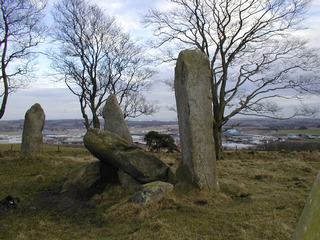
Tyrebagger stone circle
Aberdeen City
One of only a handful of recumbent stone circles left with all eleven of its original stones still in place: including a 24-ton granite giant laid…
- Near Dyce
- Easy path
Carved stone · Pictish & early medieval
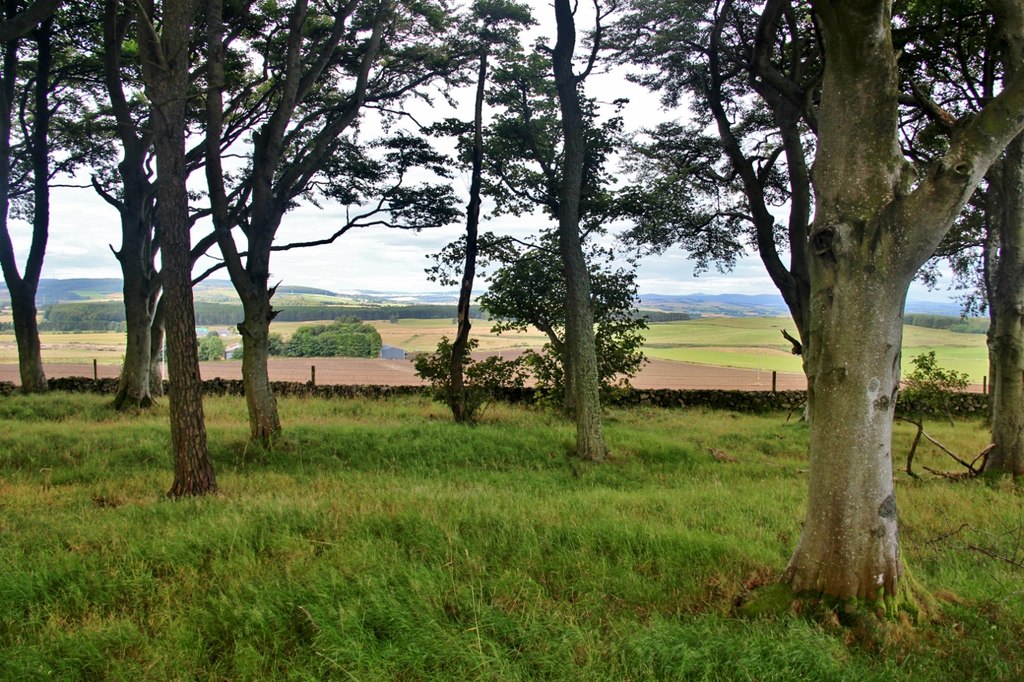
Cairnton stone
Aberdeenshire
Found in a field-clearance heap in 2001, its incised crescent-and-V-rod and triple disc symbols mark a seventh-century Pictish (of the Picts, the p…
- Near Newmachar
- Easy path
Sacred place · Prehistoric
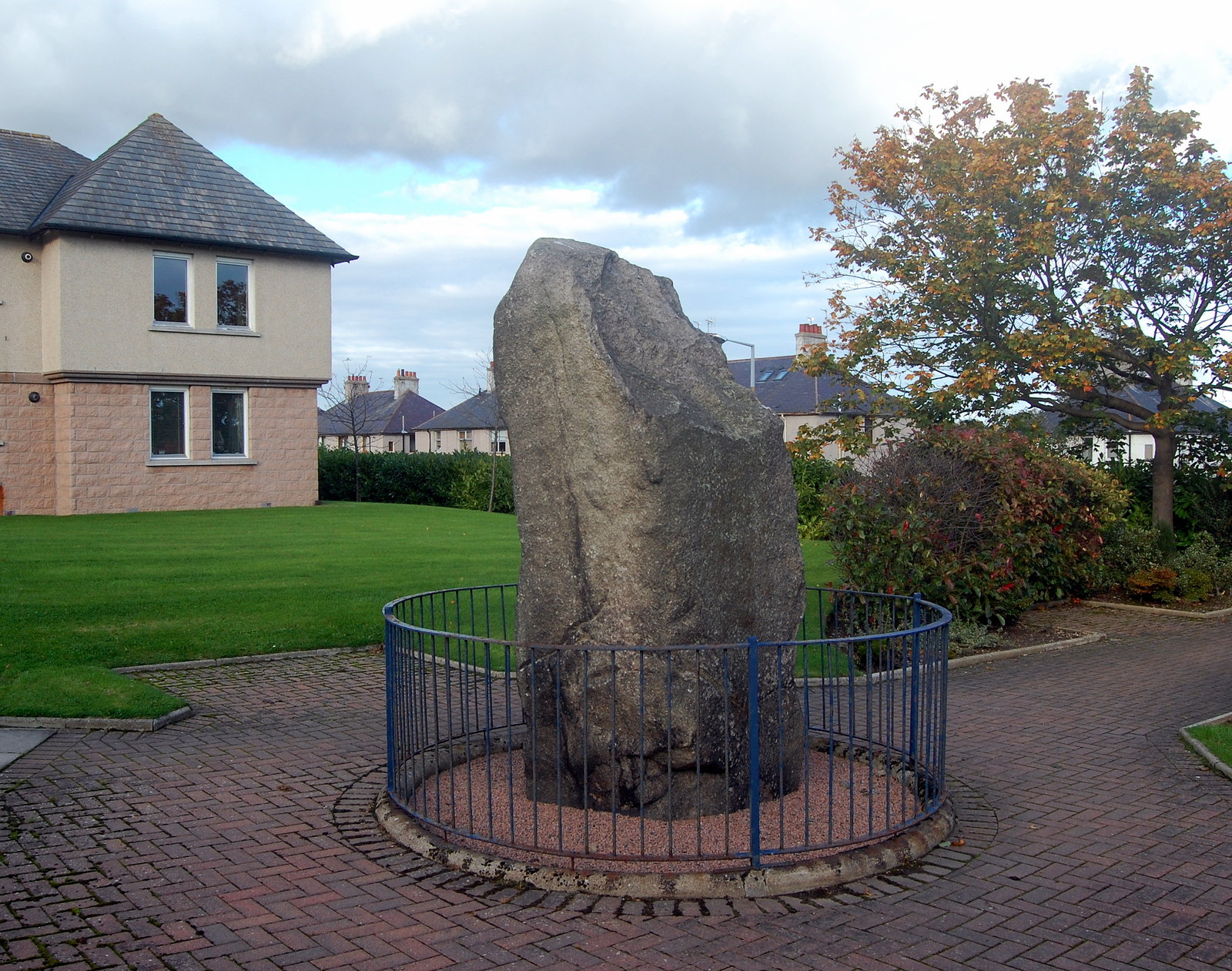
Lang Stane of Hilton
Aberdeen City
A granite monolith nearly three metres tall standing in Hilton, one of several Aberdeen stones sharing the name Lang Stane: Scots for long stone.
- Near Aberdeen
- Easy path
Building or ruin · Medieval
St Machar's Cathedral
Aberdeen City
A working Church of Scotland kirk that still keeps William Wallace's quartered remains in its walls and a ceiling of 48 royal and episcopal coats o…
- Easy path
Questions people ask
- What are the Dyce Symbol Stones?
- Two large Pictish carved stones, Dyce I and Dyce II, along with several smaller sculptured stones, sheltered inside the ruined St Fergus's Chapel at Dyce, Aberdeen.
- What symbols appear on Dyce I?
- Dyce I is a Class I stone incised with the Pictish Beast and a double disc and z-rod, carrying no cross or other Christian imagery.
- What does the ogham inscription on Dyce II say?
- It transliterates as EOTTASSARRHETODDEDDOTS MAQQ ROGODDADD, likely a personal-name formula, though its full meaning remains unresolved.
- How does Dyce II differ from Dyce I?
- Dyce II is a Class II cross-slab, carrying a Celtic cross with knotwork and a spiral boss alongside older Pictish symbols round its base.
- Where can the stones be seen?
- Inside a small shelter built within the ruined walls of St Fergus's Chapel in Dyce, on the outskirts of Aberdeen.
Sources
The Ancient Codex, in your pocket
Get the Pocket Codex app
Carry the directory with you — Dyce Symbol Stones and thousands of ancient places across Britain and Ireland, offline, wherever you roam.