
Carved on a single face of stone left otherwise plain, the Papil Stone rises to a large, long-stemmed cross shaped like a fan, its shaft crowded beneath by robed clerics, a crouching quadruped, and a lower scene of axe-wielding bird-headed figures flanking a disembodied human head. The cross-slab dates from the 8th century and was raised at a religious site at Papil, on the island of West Burra in Shetland.
Carved on a single face of stone left otherwise plain, the Papil Stone rises to a large, long-stemmed cross shaped like a fan, its shaft crowded beneath by robed clerics, a crouching quadruped, and a lower scene of axe-wielding bird-headed figures flanking a disembodied human head. The cross-slab dates from the 8th century and was raised at a religious site at Papil, on the island of West Burra in Shetland.
The remains of a church and burials have been found alongside other Pictish stones at Papil, including a second carved slab known as the Papil shrine, which shows five robed pilgrims carrying croziers and book satchels on foot and horseback towards a cross. Taken together, the finds have led archaeologists to suggest that Papil was once the site of a monastic settlement rather than a single isolated monument.
The stone lay undiscovered for over a millennium until 1887, when the antiquarian and amateur archaeologist Gilbert Goudie found it in the grounds of St Laurence’s Church, Papil. It is held and shown in Edinburgh, at the National Museum of Scotland.
What follows is drawn from published sources, with each claim labelled by how firmly it is established.
History
In the 8th century (c. AD 700), the Papil Stone was carved as part of a religious site at Papil on West Burra, Shetland. The presence of a church, burials and other Pictish carved stones at the same location, including the related Papil shrine, has led archaeologists to conclude that the site may once have functioned as a monastery.
The lower section of the cross-slab, showing two bird-headed hybrid figures wielding axes around a disembodied human head, is carved in a noticeably different manner from the rest of the monument and is not aligned with the surrounding composition. This has led scholars to suggest that the panel was a later addition to the stone, carved around an existing area of damage rather than as part of the original scheme. In 1887, the stone was rediscovered in the grounds of St Laurence's Church, Papil, by the antiquarian and amateur archaeologist Gilbert Goudie. The Papil Stone is now held at the National Museum of Scotland in Edinburgh, and is shown there still.
People
-
Gilbert Goudie
Antiquarian and amateur archaeologist who discovered the Papil Stone in 1887 in the grounds of St Laurence's Church, Papil.
-
Isabel and George Henderson
Art historians who read the cross-slab within a vertical framework running from Heaven at the top of the cross to Hell at its base, and suggested the carved quadruped might represent Cerberus guarding the gates of Hell.
-
Carola Hicks
Art historian who identified stylistic similarities between the Papil quadruped and the animal evangelist symbols of the Book of Durrow.
Cultural influences
-
Book of Durrow
Carola Hicks noted similarities between the Papil quadruped and the animal evangelist symbols in the Book of Durrow, finding the creature stylistically close to the lobate scrolls and spirals of St Luke's calf and anatomically comparable to the lion of St Mark, sharing protruding tongues, almond-shaped eyes and raised curly tails.
Connections
-
Papil shrine
A related Pictish carved stone found at the same site in Papil, thought to have once served as a reliquary; it depicts five robed pilgrim figures carrying croziers and book satchels towards a cross.
-
Conan Stone
Another Pictish stone bearing hybrid figures comparable to those on the Papil Stone.
Discovery & excavation
The Papil Stone was discovered in 1887 in the grounds of St Laurence's Church, Papil, by the antiquarian and amateur archaeologist Gilbert Goudie. It was found alongside other evidence of a religious site, including the remains of a church, burials and further Pictish carved stones, which together suggest the location once served as a monastic site.
Finds now held at: St Laurence's Church, Papil, West Burra, Shetland.
What to look for
-
The fan-shaped cross
A large, long-stemmed cross shaped like a fan dominates the top of the stone, carved on a single face while the reverse is left plain.
-
The four clerics
At the foot of the cross stand two pairs of robed human figures identified as clerics by their cowled robes, croziers, and the book satchels or shrines they carry.
-
The quadruped
A large four-legged creature is carved beneath the clerics and cross. Isabel and George Henderson read the slab as a vertical scheme running from Heaven to Hell and suggested the beast might represent Cerberus guarding the gates of Hell; Carola Hicks compared it stylistically to the animal evangelist symbols of the Book of Durrow.
-
The bird-headed hybrids and the human head
Towards the base of the cross, two humanoid figures with thin legs, prominent knees, possibly clawed feet and large bird-like beaks wield axes on either side of a small disembodied human head. Interpretations vary: the figures have been read as demons tormenting St Anthony during his Temptation, as a Christianised survival of the pre-Christian Celtic cult of the head, or as characters from a now-lost strand of Pictish mythology. The panel is carved in a different style from the rest of the slab and is thought to be a later addition, carved around the already-damaged stone.
Plan your visit
- Location
- 60.0664°N · 1.3371°W
- Access
- Open access
- Terrain
- Easy going
- Time needed
- About 60 minutes
Nearby places
Tomb or burial place · Prehistoric
Catpund
Shetland Islands
Along the bank of a burn on Shetland Mainland, the rock face at Catpund still carries the scars of centuries of quarrying, row upon row of hollows…
- Easy path

Fortified place · Medieval
Scalloway Castle
Shetland Islands
Built by unpaid workers summoned from the parishes of Shetland, for an earl who was executed for misrule eight years after it was finished.

Sacred place · Prehistoric
St Ninian's Isle
Shetland Islands
St Ninian's Isle sits off the south-western coast of Shetland Mainland, joined to it by a 500-metre tombolo, the largest in the United Kingdom. Loc…
- Easy path
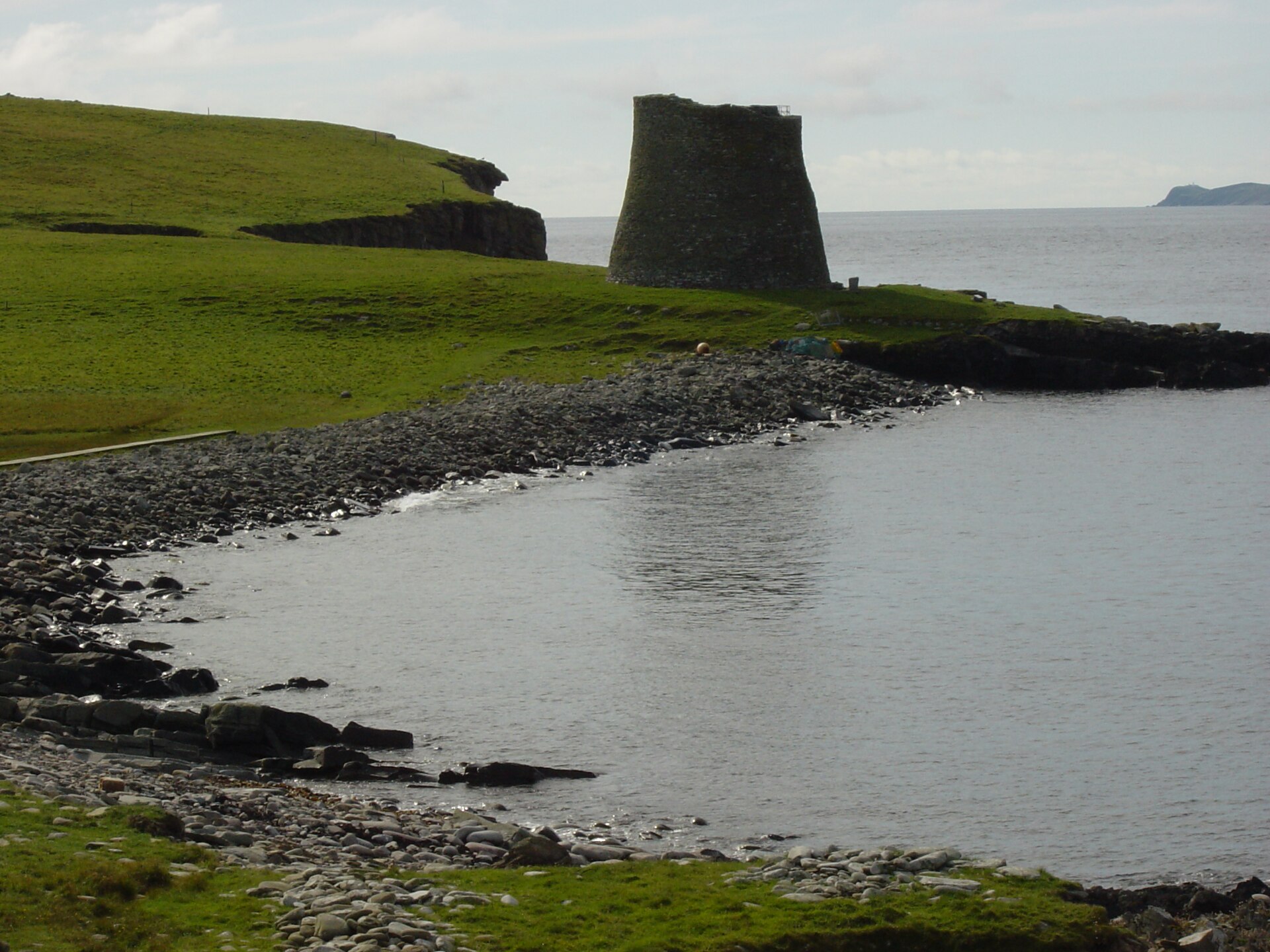
Fortified place · Iron Age
Broch of Mousa
Shetland Islands
The only broch - a drystone tower, round and hollow-walled, built in the Iron Age, from about 800 BC until the Romans came - still standing nearly…
- Near Sandwick
- 3.2 km from car park
- Some walking
The setting
Near Papil Stone, about 113 metres away.
Photo: John Lucas / Wikimedia Commons / CC BY-SA 2.0
Near Papil Stone, about 123 metres away.
Photo: John Lucas / Wikimedia Commons / CC BY-SA 2.0
Questions people ask
- What is the Papil Stone?
- The Papil Stone is an 8th-century carved Pictish cross-slab from a religious site at Papil, on West Burra, Shetland. It bears a large fan-shaped cross, robed clerics, a quadruped, and a scene of bird-headed hybrid figures flanking a human head.
- When and where was the Papil Stone found?
- It was discovered in 1887 in the grounds of St Laurence's Church, Papil, by the antiquarian and amateur archaeologist Gilbert Goudie.
- Where can the Papil Stone be seen today?
- It is held and shown at the National Museum of Scotland in Edinburgh.
- What do the carvings on the Papil Stone depict?
- The stone shows a large fan-shaped cross, two pairs of robed clerics with croziers and book satchels, a quadruped beneath them, and, near the base, two bird-headed hybrid figures wielding axes around a disembodied human head. Scholars disagree on the meaning of this lower scene, with readings ranging from the Temptation of St Anthony to a Christianised version of the Celtic cult of the head.
- Does the site at Papil have other Pictish remains?
- Yes. Alongside the Papil Stone, the site has produced the remains of a church, burials, and a second carved stone known as the Papil shrine, which together suggest Papil was once a monastic site.
Sources
The Ancient Codex, in your pocket
Get the Pocket Codex app
Carry the directory with you — Papil Stone and thousands of ancient places across Britain and Ireland, offline, wherever you roam.