
St Ninian's Isle sits off the south-western coast of Shetland Mainland, joined to it by a 500-metre tombolo, the largest in the United Kingdom. Locally the sand bar is called an ayre, from the Old Norse for gravel bank, and it behaves differently through the year: in summer it lies above sea level and can be walked across freely, but in winter stronger wave action strips the sand away, leaving the crossing submerged at high tide and sometimes for the whole tidal cycle until the beach rebuilds itself the following spring. Depending on which definition is used, St Ninian's is therefore either an island or a peninsula, covering about 72 hectares within the parish of Dunrossness, with the village of Bigton the nearest settlement on the Mainland side.
St Ninian’s Isle sits off the south-western coast of Shetland Mainland, joined to it by a 500-metre tombolo, the largest in the United Kingdom. Locally the sand bar is called an ayre, from the Old Norse for gravel bank, and it behaves differently through the year: in summer it lies above sea level and can be walked across freely, but in winter stronger wave action strips the sand away, leaving the crossing submerged at high tide and sometimes for the whole tidal cycle until the beach rebuilds itself the following spring. Depending on which definition is used, St Ninian’s is therefore either an island or a peninsula, covering about 72 hectares within the parish of Dunrossness, with the village of Bigton the nearest settlement on the Mainland side.
The isle’s low green profile gives little hint of what lay beneath its chapel floor for over a thousand years. On 4 July 1958 a hoard of early medieval silver, one of the most significant Celtic treasure finds in Britain, was lifted from under a cross-marked slab during an excavation led by Aberdeen University. Long before that treasure was buried, the ground had already been used for burial: Neolithic graves have been found within the walls of the chapel that once stood here, and the site’s ecclesiastical associations may stretch back to the Culdees or papar known from other early Christian settlements across the Northern Isles, Hebrides and Faroes. Seabirds, including nesting puffins, now share the isle with these layered remains of much older human use.
What follows is drawn from published sources, with each claim labelled by how firmly it is established.
The name
The tombolo linking the isle to the Mainland is known locally as an ayre, a word derived from the Old Norse for "gravel bank". The isle itself takes its name from Saint Ninian of Galloway, Shetland's patron saint, to whom the ruined chapel near the end of the tombolo is dedicated; the same saint is also widely venerated on the neighbouring Orkney Islands and may be commemorated in the name of North Ronaldsay.
History
The island's use long predates its Christian associations. Neolithic graves have been found within the walls of the chapel, formerly beneath its floor, showing the site was already significant burial ground many centuries before any church stood there.
As its name suggests, the isle carries ecclesiastical connections that, like similar sites elsewhere in the Northern Isles, Hebrides and Faroes, may trace back to the Culdees or papar, early Christian hermits and clergy of the pre-Norse period. Excavation on the isle uncovered the remains of a pre-Norse chapel beneath the later structure, hinting at just such a Culdee presence before Norse settlement of Shetland.
The silver bowls, jewellery and other pieces that make up the St Ninian's Isle Treasure are believed to date from around 750 to 825 AD, though not all of the objects were necessarily new when they were deposited. It is suspected the hoard was buried to hide it from, or that it was stolen during, a Viking raid, placing its concealment within the turbulent period when Norse raiders and settlers were first reaching Shetland. The ruins of the chapel visible today near the end of the tombolo date from the 12th century, built on the same ground that had already served religious and burial purposes for centuries.
The island's last resident family departed in 1796, when Henry Leask, who had married twice and had 13 children, left St Ninian's Isle for good, ending its history of permanent habitation. On 4 July 1958, a local schoolboy named Douglas Coutts, helping a team of visiting archaeologists led by Professor A. C. O'Dell of Aberdeen University, discovered the St Ninian's Isle Treasure under a cross-marked slab in the floor of the early church. The find prompted a renewed wave of archaeological interest in the isle that continued in the years that followed.
People
-
Douglas Coutts
Local schoolboy who discovered the St Ninian's Isle Treasure on 4 July 1958 while assisting the excavation team.
-
Professor A. C. O'Dell
Aberdeen University archaeologist who led the 1958 excavation on St Ninian's Isle during which the treasure was found.
-
Henry Leask
Head of the last family to live permanently on St Ninian's Isle, departing in 1796; married twice and had 13 children.
Connections
-
Bigton
Nearest settlement to St Ninian's Isle, on the South Mainland side of the tombolo.
-
Orkney Islands
Saint Ninian, to whom the isle's chapel is dedicated, is also widely venerated there.
-
North Ronaldsay
Its name may commemorate Saint Ninian, the same saint venerated at the chapel on the isle.
-
Aberdeen University
Conducted the 1958 excavation, led by Professor A. C. O'Dell, that uncovered the St Ninian's Isle Treasure.
Discovery & excavation
The St Ninian's Isle Treasure was found on 4 July 1958 under a cross-marked slab in the floor of the early St Ninian's church, discovered by local schoolboy Douglas Coutts while he was assisting archaeologists led by Professor A. C. O'Dell of Aberdeen University during a dig on the isle. The silver bowls, jewellery and other pieces, not all of which were necessarily new when deposited, are believed to date from around 750 to 825 AD, and are thought to have been buried either to hide them from, or because they were stolen during, a Viking raid. The excavation that uncovered the hoard also revealed the remains of a pre-Norse chapel beneath the later church, along with Neolithic graves within the chapel walls, and it triggered a renewed period of archaeological interest in the site.
Finds now held at: Under a cross-marked slab in the floor of the early church, St Ninian's Isle.
What to look for
-
The tombolo (ayre)
The 500-metre sand tombolo connecting the isle to South Mainland is the largest in the UK; it lies above sea level and is walkable in summer but is often covered at high tide in winter.
-
12th-century chapel ruins
The ruins of a chapel dating from the 12th century stand near the end of the tombolo, on the site of an earlier pre-Norse chapel and Neolithic graves.
-
Nesting seabirds
The isle is visited by many seabirds, including puffins, with several species nesting there.
Plan your visit
- Location
- 59.9723°N · 1.3480°W
- Access
- Open access
- Terrain
- Easy going
- Time needed
- About 45 minutes
Nearby places

Fortified place · Iron Age
Clumlie Broch
Shetland Islands
Clumlie Broch stands on a low rise amid flat arable ground in Dunrossness, on southern Shetland Mainland, roughly eight kilometres north of Sumburg…
- Some walking
Tomb or burial place · Prehistoric
Catpund
Shetland Islands
Along the bank of a burn on Shetland Mainland, the rock face at Catpund still carries the scars of centuries of quarrying, row upon row of hollows…
- Easy path
Fortified place · Iron Age
Broch of Mousa
Shetland Islands
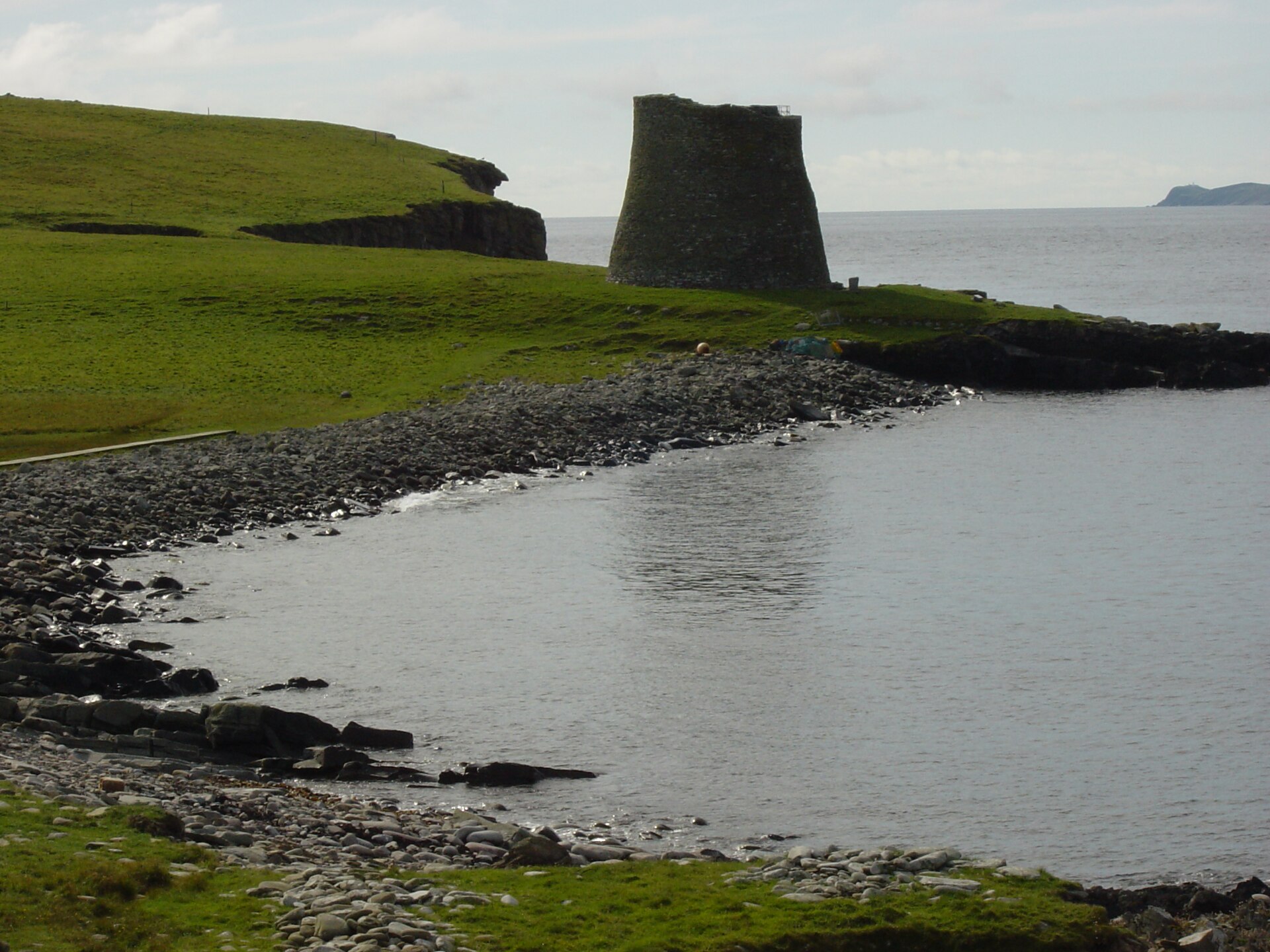
The only broch - a drystone tower, round and hollow-walled, built in the Iron Age, from about 800 BC until the Romans came - still standing nearly…
- Near Sandwick
- 3.2 km from car park
- Some walking

Carved stone · Pictish & early medieval
Papil Stone
Shetland Islands
Carved on a single face of stone left otherwise plain, the Papil Stone rises to a large, long-stemmed cross shaped like a fan, its shaft crowded be…
- Easy path
The setting
St Ninian’s Isle and its tombolo at sunset, seen from the Shetland Mainland.
Photo: Ronnie Robertson / Wikimedia Commons / CC BY-SA 2.0
Sunset over St Ninian’s Isle and the tombolo that joins it to Mainland Shetland.
Photo: Ronnie Robertson / Wikimedia Commons / CC BY-SA 2.0
St Ninian’s Isle at sunset, with its long sand tombolo visible to the right.
Photo: Ronnie Robertson / Wikimedia Commons / CC BY-SA 2.0
Questions people ask
- What is St Ninian's Isle connected to Shetland Mainland by?
- It is joined by a 500-metre tombolo, known locally as an ayre, which is the largest tombolo in the United Kingdom. It lies above sea level in summer but is often submerged at high tide in winter until the sand returns the following spring.
- What was found on St Ninian's Isle in 1958?
- A hoard of early medieval silver, the St Ninian's Isle Treasure, was discovered under a cross-marked slab in the floor of the isle's early church on 4 July 1958 by local schoolboy Douglas Coutts, who was assisting an Aberdeen University excavation led by Professor A. C. O'Dell.
- How old is the St Ninian's Isle Treasure?
- The silver bowls, jewellery and other pieces are believed to date from around 750 to 825 AD, and are thought to have been buried to hide them from, or because they were stolen during, a Viking raid.
- Who was the last person to live on the island?
- Henry Leask headed the last family to live permanently on St Ninian's Isle. He had married twice and had 13 children before the family left in 1796.
- Is the island's history older than its chapel?
- Yes. Neolithic graves have been found within the walls of the chapel, and excavation also uncovered a pre-Norse chapel beneath the visible 12th-century ruins, showing the site was used for burial and worship long before the medieval church was built.
Sources
- St Ninian's Isle - Wikipedia
- St Ninian's Isle - Wikidata
- O'Dell, A. St. Ninian's Isle Treasure. A Silver Hoard Discovered on St. Ninian's Isle, Zetland on 4th July, 1958, Aberdeen University Studies No. 141
- Nicolson, James R., Shetland, Newton Abbott: David & Charles, 1972
- Youngs, Susan (ed.), The Work of Angels: Masterpieces of Celtic Metalwork, 6th-9th centuries AD, British Museum Press, 1989, ISBN 978-0-7141-0554-3
- Webster, Leslie, Anglo-Saxon Art, British Museum Press, 2012, ISBN 9780714128092
Explore more: Sacred places · Prehistoric · Shetland Islands
The Ancient Codex, in your pocket
Get the Pocket Codex app
Carry the directory with you — St Ninian's Isle and thousands of ancient places across Britain and Ireland, offline, wherever you roam.