
Clumlie Broch stands on a low rise amid flat arable ground in Dunrossness, on southern Shetland Mainland, roughly eight kilometres north of Sumburgh Airport. Its outer wall traces a circle 21 metres across, enclosing an interior space of about eight metres; an abandoned croft now encroaches on the ruins and a stone dyke hides much of the western side.
Clumlie Broch stands on a low rise amid flat arable ground in Dunrossness, on southern Shetland Mainland, roughly eight kilometres north of Sumburgh Airport. Its outer wall traces a circle 21 metres across, enclosing an interior space of about eight metres. An abandoned croft now encroaches on the ruins, and a stone dyke hides much of the western side.
What remains visible is the entrance passage and a guard cell set into the thickness of the wall, with sections of walling still standing to a height of around 2 metres. Beneath the floor, a stone cist found 75 centimetres above ground level points to a second life for the structure long after its builders had gone: not as a dwelling, but as a place to bury the dead.
What follows is drawn from published sources, with each claim labelled by how firmly it is established.
History
Clumlie Broch was raised during the Iron Age on a low rise of arable ground in Dunrossness, its drystone wall enclosing a diameter of 21 metres on the outside and around 8 metres within -- a scale typical of the defended roundhouses built across Shetland in this period. At some point after the broch went out of use as a dwelling, it was pressed into service as a burial site. A stone cist set 75 centimetres above the original floor level shows people returning to the ruin generations later to inter their dead within its fallen walls.
In 1887 the antiquarian Gilbert Goudie carried out a partial excavation of the broch, restoring part of the walling as he worked. It was Goudie who uncovered the cist and drew the conclusion that the structure had been repurposed for burial once it had fallen into disuse. Goudie's dig also recovered a substantial haul of everyday material from the site: stone implements, quern stones, whetstones, spindle whorls, and hammer stones, alongside numerous pottery fragments, animal bones, and shells. Among the finds was a fragment of a painted Roman bowl, a rare item to surface this far north.
In the centuries since, an arable croft has grown up around the site and now encroaches on the ruins themselves, while a stone dyke has come to obscure much of the broch's western side.
People
-
Gilbert Goudie
Antiquarian who partially excavated Clumlie Broch in 1887, restored part of its walling, and uncovered the burial cist and associated finds.
Discovery & excavation
Gilbert Goudie's 1887 excavation was partial rather than complete, and included restoration of part of the walling as the dig progressed. Beneath the broch floor he found a stone cist set 75 centimetres above floor level, leading him to conclude the site had been reused for burial after its original occupation ended. The excavation also yielded stone implements, quern stones, whetstones, spindle whorls, hammer stones, pottery fragments, animal bones, shells, and a fragment of a painted Roman bowl.
What to look for
-
Entrance passage and guard cell
Visible on the eastern side of the ruin, the entrance passage and an adjoining guard cell are among the clearest surviving structural features of the broch.
-
Standing walling
Sections of the broch wall still stand to around 2 metres in height, giving a sense of the original structure's massive drystone construction.
-
The stone dyke
A later stone dyke runs across much of the western side of the site, obscuring that part of the broch from view.
Plan your visit
- Location
- 59.9460°N · 1.2777°W
- Access
- Open access
- Terrain
- Moderate walking
- Time needed
- About 30 minutes
Nearby places

Sacred place · Prehistoric
St Ninian's Isle
Shetland Islands
St Ninian's Isle sits off the south-western coast of Shetland Mainland, joined to it by a 500-metre tombolo, the largest in the United Kingdom. Loc…
- Easy path

Fortified place · Iron Age
Old Scatness
Shetland Islands
Construction of a perimeter road for Sumburgh Airport in the late 1970s sliced into a grassy mound at the southern tip of Shetland Mainland, exposi…
- Some walking
Fortified place · Iron Age
Broch of Mousa
Shetland Islands
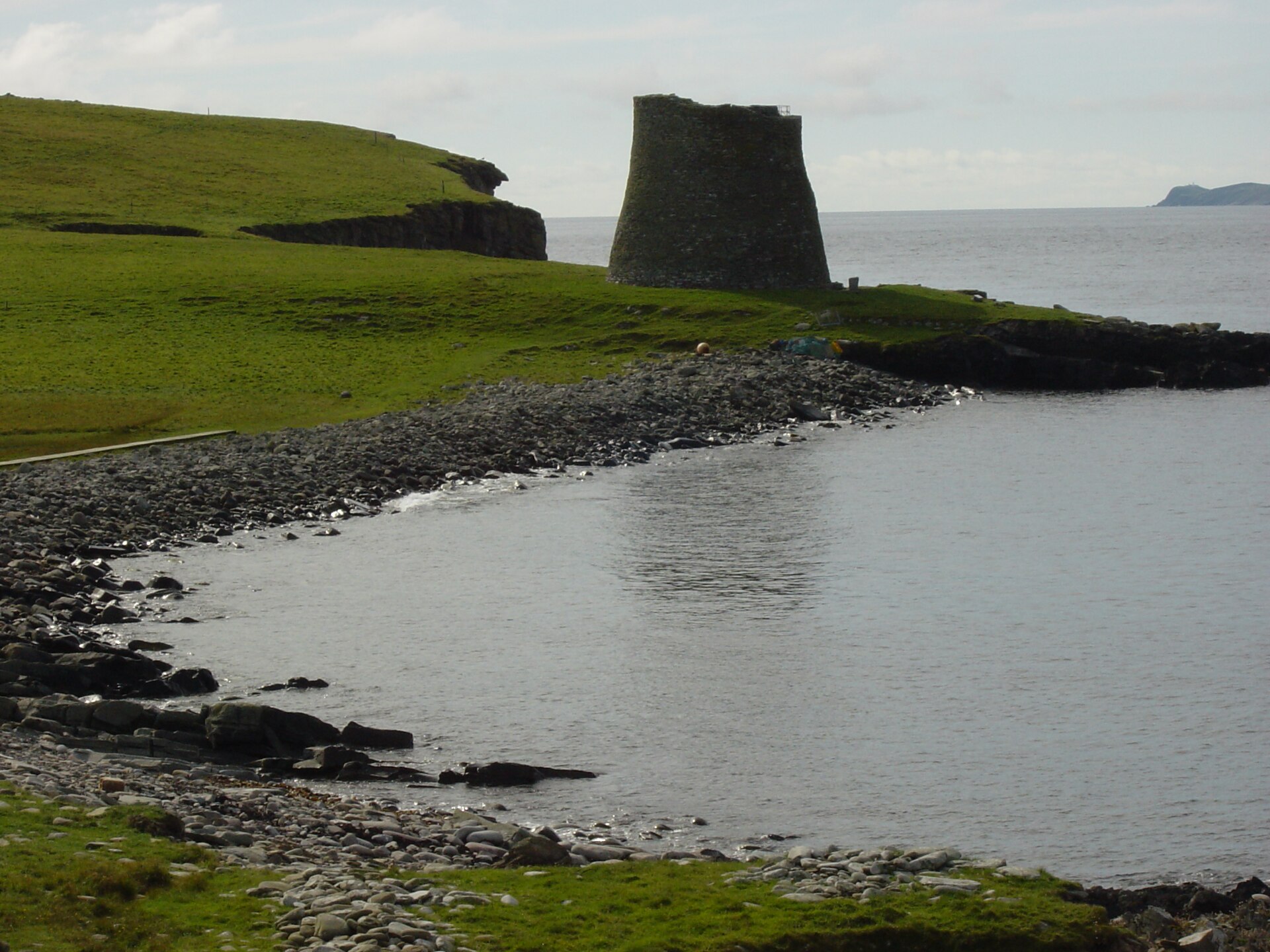
The only broch - a drystone tower, round and hollow-walled, built in the Iron Age, from about 800 BC until the Romans came - still standing nearly…
- Near Sandwick
- 3.2 km from car park
- Some walking
Settlement · Prehistoric
Jarlshof
Shetland Islands
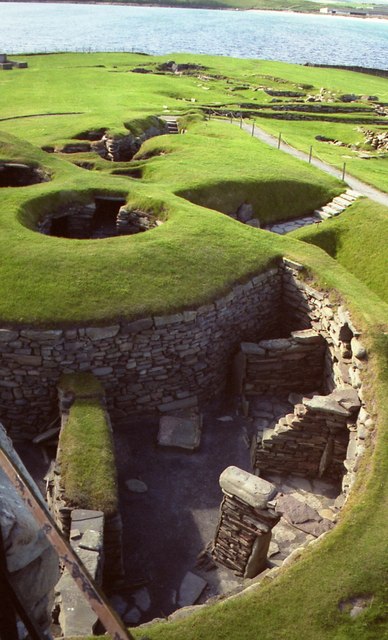
Jarlshof preserves an unusually complete sequence of human occupation, with remains dating from about 2500 BC to the seventeenth century AD.
- Near Sumburgh
- 3 min walk from car park
- Some walking
The setting
Near Clumlie Broch, about 145 metres away.
Photo: Mike Pennington / Wikimedia Commons / CC BY-SA 2.0
Near Clumlie Broch, about 771 metres away.
Photo: Mike Pennington / Wikimedia Commons / CC BY-SA 2.0
Near Clumlie Broch, about 786 metres away.
Photo: Mike Pennington / Wikimedia Commons / CC BY-SA 2.0
Questions people ask
- How big is Clumlie Broch?
- The broch has an external diameter of 21 metres and an internal diameter of about 8 metres, with sections of wall still standing around 2 metres high.
- Where is Clumlie Broch located?
- It stands on a low rise of flat arable ground in Dunrossness, on the southern part of Mainland, Shetland, about 8 kilometres north of Sumburgh Airport (grid reference HU40451811).
- Who excavated Clumlie Broch, and when?
- The antiquarian Gilbert Goudie partially excavated the broch in 1887, restoring part of the walling and uncovering a stone cist and a range of artefacts.
- What was found during the excavation?
- Finds included stone implements, quern stones, whetstones, spindle whorls, hammer stones, pottery fragments, animal bones, shells, and a fragment of a painted Roman bowl.
- Was the broch reused after it went out of use as a dwelling?
- Yes. Goudie found a stone cist 75 centimetres above the original floor level and concluded the broch had been used for burials after falling into disuse.
Sources
Explore more: Fortified places · Iron Age · Shetland Islands
The Ancient Codex, in your pocket
Get the Pocket Codex app
Carry the directory with you — Clumlie Broch and thousands of ancient places across Britain and Ireland, offline, wherever you roam.