
Construction of a perimeter road for Sumburgh Airport in the late 1970s sliced into a grassy mound at the southern tip of Shetland Mainland, exposing a section of broch (a tall circular tower of unmortared stone, found only in Scotland) wall that had lain hidden for more than two thousand years. What excavation later revealed beneath that mound was not a single structure but a settlement built up in layers over millennia, each generation adding new buildings and levelling off the old rather than starting afresh on new ground.
Construction of a perimeter road for Sumburgh Airport in the late 1970s cut into a grassy mound at the southern tip of Shetland Mainland and exposed a section of broch wall that had lain hidden for more than two thousand years. What excavation later revealed beneath that mound was not a single structure but a settlement built up in layers over millennia, each generation adding new buildings and levelling off the old rather than starting afresh on new ground.
At the centre of the site stands the broch itself, its outer wall still rising several metres with a distinctive battered face, and around it a cluster of roundhouses, wheelhouses and later dwellings spreading west and east. To the west, a large aisled roundhouse roughly ten metres across shares the ground with a smaller oval building and a range of structures that includes one with a set of small wall-recesses likened to cupboards. East of the broch stands the largest roundhouse on the site at around twelve metres internally, alongside a wheelhouse and a semi-subterranean building considered characteristic of Pictish architecture. Long after the Iron Age occupation ended, Norse settlers reused the older structures, farmers built a barn and corn drier among the ruins in the 17th century, and a crofthouse went up on the site’s north side in the mid-19th century.
Old Scatness lies close to two other well-known Shetland monuments, the multi-period settlement at Jarlshof and the Iron Age promontory fort at Ness of Burgi. The site is managed by the Shetland Amenity Trust, and in summer costumed guides lead tours of the excavated remains and replica Iron Age and Pictish buildings, with a visitor centre offering exhibits and demonstrations of ancient crafts.
What follows is drawn from published sources, with each claim labelled by how firmly it is established.
History
The broch at Old Scatness was built more than two thousand years ago, during the Iron Age, and went through at least three major phases of use. The first phase saw the construction of the primary tower; the second involved rebuilding the interior, adding a secondary skin of stone to the south and east of the inner wall along with a set of radial piers to form a new internal structure; and in the third phase, a further building was inserted inside the broch itself, made up of six or more curvilinear cells clustered around a central area with a corridor leading out to the east.
To the west of the broch, the settlement's seaward limits took shape around a large circular aisled roundhouse known as Structure 12, roughly ten metres in diameter with walls still standing over two metres high in places. A second, less well-preserved building stood to its west, while a similarly sized but oval roundhouse, Structure 14, lay to its south. North of Structure 12, a further range of buildings included one with a set of seven or more small wall-recesses, and to its east, closer to the broch, the partially collapsed top of a corbelled cell survived as a ring of inward-tilting stones.
East of the broch, a slightly later roundhouse, Structure 21, proved the largest on the site at around twelve metres internally, its short piers later rebuilt as long thin ones. A wheelhouse, Structure 11, was added to the southeast of the broch, and a multi-cellular semi-subterranean building, Structure 5, was inserted into the fill of Structure 21 — a form of construction regarded as characteristic of Pictish architecture.
After Iron Age occupation of the site ended, its stone walls and grassy mounds remained a visible feature of the landscape rather than disappearing from it, and later communities went on reusing parts of the settlement. Archaeologists have recovered Viking Age artefacts from several of the earlier buildings, showing that Norse settlers occupied and reused structures the Iron Age community had left behind.
By the early modern period the ruins had been absorbed into the surrounding agricultural landscape. Excavation has uncovered the remains of a 17th-century barn and corn drier built among the older structures, part of a wider pattern across the Northern Isles in which prehistoric stone buildings were repurposed by later farmers incorporating existing walls into new agricultural use. By the mid-19th century a crofthouse had been built on the north side of the site, and the broch mound and surrounding ruins went on shaping local patterns of settlement and land use even after their original purpose had faded from memory.
In the late 1970s, construction of the perimeter road for the newly expanding Sumburgh Airport exposed part of the broch wall within a grassy mound, bringing the site to archaeological attention for the first time. Full excavation began in 1995 under the University of Bradford, supported by professional archaeologists, students and local volunteers, and has since uncovered the multi-period settlement of broch, wheelhouses and later dwellings described above, with the site now managed and presented to visitors by the Shetland Amenity Trust.
Connections
-
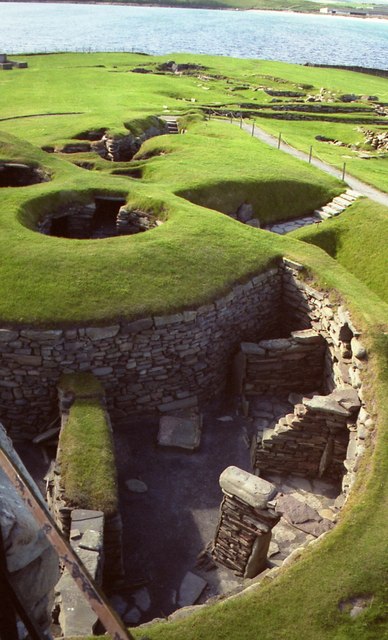
Photo: Nigel Duncan / Wikimedia Commons / CC BY-SA 2.0 A multi-period settlement close to Old Scatness at the southern tip of Mainland, Shetland.
-
Ness of Burgi
An Iron Age promontory fort near Old Scatness, also within the parish of Dunrossness.
Discovery & excavation
Old Scatness was first identified in the late 1970s, when construction of the perimeter road for Sumburgh Airport exposed part of a broch wall within a grassy mound. The structure that emerged had likely been built more than two thousand years earlier, during the Iron Age. Full archaeological excavation did not begin until 1995, led by the University of Bradford and supported by professional archaeologists, students and local volunteers. Over successive seasons the team gradually revealed the full extent of a multi-period settlement — broch, wheelhouses and later dwellings — cataloguing finds as the work progressed. The site is now managed by the Shetland Amenity Trust, which runs a visitor centre with exhibits and craft demonstrations alongside costumed tours of the excavated remains and replica buildings.
Finds now held at: Broch interior; Structure 12; Structure 21.
What to look for
-
The broch
Still standing several metres high with a battered outer wall face, the broch occupies the centre of the settlement and shows at least three distinct phases of internal rebuilding, including a later cluster of six or more curvilinear cells inserted within its walls.
-
Structure 12
A large circular aisled roundhouse to the west of the broch, around ten metres in diameter, with walls surviving over two metres high in places.
-
Structure 14
An oval roundhouse of similar size to Structure 12, standing just to its south.
-
The 'cupboards' building
A structure north of Structure 12 with a set of seven, and possibly originally eight or more, small recesses let into its interior wall.
-
Structure 21
The largest roundhouse on the site, east of the broch, at approximately twelve metres internally, with piers that were rebuilt from short to long thin form over time.
-
Structure 11
A wheelhouse added to the southeast of the broch in a later phase of the settlement's use.
-
Structure 5
A multi-cellular semi-subterranean building inserted into the fill of Structure 21, regarded as characteristic of Pictish architecture.
-
Visitor centre and costumed tours
Run by the Shetland Amenity Trust, the visitor centre holds exhibits and craft demonstrations, and in summer costumed guides lead tours of the site and its replica Iron Age and Pictish buildings.
Plan your visit
- Location
- 59.8790°N · 1.3054°W
- Access
- Open access
- Terrain
- Moderate walking
- Time needed
- About 60 minutes
Nearby places
Settlement · Prehistoric
Jarlshof
Shetland Islands
Jarlshof preserves an unusually complete sequence of human occupation, with remains dating from about 2500 BC to the seventeenth century AD.
- Near Sumburgh
- 3 min walk from car park
- Some walking

Fortified place · Prehistoric
Ness of Burgi fort
Shetland Islands
A narrow finger of land reaches south from Scat Ness into the sea at the southern extremity of Shetland Mainland, and near its end, on a rocky spur…
- Easy path

Fortified place · Iron Age
Clumlie Broch
Shetland Islands
Clumlie Broch stands on a low rise amid flat arable ground in Dunrossness, on southern Shetland Mainland, roughly eight kilometres north of Sumburg…
- Some walking

Sacred place · Prehistoric
St Ninian's Isle
Shetland Islands
St Ninian's Isle sits off the south-western coast of Shetland Mainland, joined to it by a 500-metre tombolo, the largest in the United Kingdom. Loc…
- Easy path
Questions people ask
- What is Old Scatness?
- Old Scatness is an archaeological site on Scat Ness, near the village of Scatness in the parish of Dunrossness on the south end of Mainland, Shetland, close to Sumburgh Airport. It preserves medieval, Viking, Pictish and Iron Age remains, including a broch, built up over thousands of years as successive generations added buildings and levelled off older ones.
- How was Old Scatness discovered?
- The site was first identified in the late 1970s, when construction of the perimeter road for the nearby Sumburgh Airport exposed part of the broch wall within a grassy mound.
- Who excavated Old Scatness?
- Full excavation began in 1995, led by the University of Bradford with support from professional archaeologists, students and local volunteers.
- What periods of occupation does the site span?
- The settlement spans the Iron Age broch and roundhouses, a later Pictish-era building, Viking Age reuse of the earlier structures, a 17th-century barn and corn drier, and a mid-19th-century crofthouse.
- Can Old Scatness be visited today?
- Yes. The site is managed by the Shetland Amenity Trust, which runs a visitor centre with exhibits and craft demonstrations, and in summer offers costumed guided tours of the excavated remains and replica Iron Age and Pictish buildings.
Sources
- Old Scatness — Wikipedia
- Old Scatness — Wikidata
- Old Scatness at Shetland Heritage
- Old Scatness, Shetland Amenity Trust
- Historic Environment Scotland, "Old Scatness, broch and settlement SE of the Cletts (SM3813)"
Explore more: Fortified places · Iron Age · Shetland Islands
The Ancient Codex, in your pocket
Get the Pocket Codex app
Carry the directory with you — Old Scatness and thousands of ancient places across Britain and Ireland, offline, wherever you roam.