
A narrow finger of land reaches south from Scat Ness into the sea at the southern extremity of Shetland Mainland, and near its end, on a rocky spur along the headland's eastern side, stands the Ness of Burgi fort. The blockhouse at its centre was probably built around 100 BC, forming part of the wider Old Scatness archaeological landscape, and is reached today by a grass path leading out along the Ness of Burgi from the village of Scatness, about a mile to the north in the parish of Dunrossness.
A narrow finger of land reaches south from Scat Ness into the sea at the southern extremity of Shetland Mainland, and near its end, on a rocky spur along the headland’s eastern side, stands the Ness of Burgi fort. The blockhouse at its centre was probably built around 100 BC, forming part of the wider Old Scatness archaeological landscape, and is reached today by a grass path leading out along the Ness of Burgi from the village of Scatness, about a mile to the north in the parish of Dunrossness.
What marks the fort out is its apparent mismatch between scale and purpose. The blockhouse seems excessively large for the small area of ground it actually protects, and it was built as an integral part of the defensive wall rather than added later. That wall stops short of the cliffs on both sides, and the ends are properly finished rather than broken or eroded, which suggests the gaps were left deliberately rather than lost to time. Other points along the same promontory would have offered equally good natural defensive positions, reinforcing the sense that whoever built this blockhouse was as concerned with impressing an audience as with keeping anyone out.
That ambiguity places Ness of Burgi within a wider architectural story. Its incomplete defensive wall has been compared to the forework at the Broch of Clickimin, the Huxter Fort and the Crosskirk Broch, structures that may represent an early, experimental stage in a building tradition that went on to produce the broch towers raised across Shetland and the wider Scottish and Irish mainlands.
What follows is drawn from published sources, with each claim labelled by how firmly it is established.
History
Around 100 BC, a blockhouse was raised on the rocky promontory on the east side of the Ness of Burgi, built as an integral part of the defensive wall that closes off the headland rather than as a later addition to it. From the outset the structure sat oddly with its setting: the blockhouse was larger than the ground it defended seemed to warrant, and the flanking wall was left short of the cliffs on either side, its ends properly finished rather than broken away. Since the promontory offered other, equally defensible points, the deliberate gaps suggest the builders valued the impression the fort made as much as any practical defence.
In the centuries that followed, this kind of incomplete defensive forework appeared at other Shetland sites, including the Broch of Clickimin, the Huxter Fort and the Crosskirk Broch, part of a broader development that saw such promontory defences evolve into the broch towers later built across the islands and on the Scottish and Irish mainlands.
Cultural influences
-
A distinctive Shetland blockhouse
Ness of Burgi is a rare, heavily built Iron Age blockhouse: a low rectangular stone structure defended by the narrow neck of its coastal promontory rather than a round broch tower.
Connections
-

Photo: Van de Beek / Wikimedia Commons / CC BY-SA 3.0 The Ness of Burgi fort lies within the Old Scatness archaeological site.
-
.jpg?width=320)
Photo: David Stanley / Wikimedia Commons / CC BY 2.0 Shares similarities in its incomplete defensive forework with the wall at Ness of Burgi.
Discovery & excavation
The stone blockhouse and its surrounding ditches have been recorded through archaeological survey and excavation, which established the layered defensive layout still visible on the promontory.
What to look for
-
The blockhouse
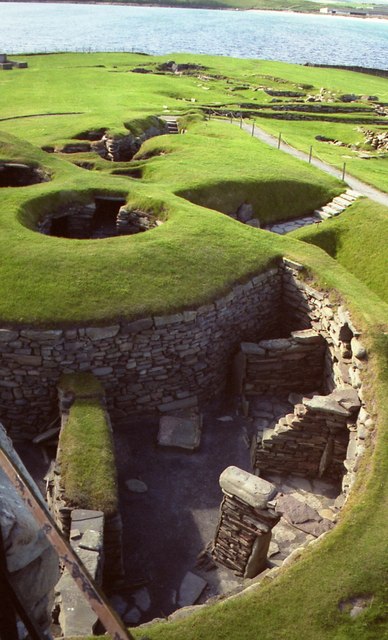
A blockhouse, probably built around 100 BC, built as an integral part of the defensive wall and disproportionately large for the small area of headland it encloses.
-
The unfinished wall ends
The defensive wall stops short of the cliffs on either side, with properly finished ends rather than broken or eroded edges, indicating the gaps were left deliberately.
-
The promontory setting
The fort occupies a rocky promontory on the east side of the Ness of Burgi, a narrow finger of land reaching south from Scat Ness at the southern tip of Shetland Mainland.
-
The approach path
A grass path leads from near Scatness village, about a mile to the north, out to the headland where the fort stands; the site is open to the public at all times.
Plan your visit
- Location
- 59.8589°N · 1.3095°W
- Access
- Open access
- Terrain
- Easy going
- Time needed
- About 45 minutes
Nearby places
Settlement · Prehistoric
Jarlshof
Shetland Islands
Jarlshof preserves an unusually complete sequence of human occupation, with remains dating from about 2500 BC to the seventeenth century AD.
- Near Sumburgh
- 3 min walk from car park
- Some walking

Fortified place · Iron Age
Old Scatness
Shetland Islands
Construction of a perimeter road for Sumburgh Airport in the late 1970s sliced into a grassy mound at the southern tip of Shetland Mainland, exposi…
- Some walking

Fortified place · Iron Age
Clumlie Broch
Shetland Islands
Clumlie Broch stands on a low rise amid flat arable ground in Dunrossness, on southern Shetland Mainland, roughly eight kilometres north of Sumburg…
- Some walking

Sacred place · Prehistoric
St Ninian's Isle
Shetland Islands
St Ninian's Isle sits off the south-western coast of Shetland Mainland, joined to it by a 500-metre tombolo, the largest in the United Kingdom. Loc…
- Easy path
Questions people ask
- What is the Ness of Burgi fort?
- It is an Iron Age promontory fort on the Ness of Burgi in the far south of Mainland, Shetland, centred on a blockhouse probably built around 100 BC and forming part of the Old Scatness archaeological site.
- When was the fort built?
- The blockhouse was probably built around 100 BC.
- Was Ness of Burgi built purely for defence?
- Probably not primarily. The blockhouse is larger than the area it protects seems to require, and the flanking wall stops short of the cliffs at each end with properly finished edges, suggesting the gaps were deliberate. Other points on the promontory offered equally good natural defensive positions, so the fort may have been designed more to impress than to withstand attack.
- How is the site reached and can it be visited?
- The fort is about a mile south of the village of Scatness, in the parish of Dunrossness, reached on foot along a grass path to the headland. It is open to the public at all times.
- How does Ness of Burgi relate to other Shetland sites?
- Its incomplete defensive wall has been compared to the forework at the Broch of Clickimin, the Huxter Fort and the Crosskirk Broch. Structures of this kind are seen as possible prototypes for the broch towers later built across the islands and the Scottish and Irish mainlands.
Sources
The Ancient Codex, in your pocket
Get the Pocket Codex app
Carry the directory with you — Ness of Burgi fort and thousands of ancient places across Britain and Ireland, offline, wherever you roam.