
Tomb or burial place · Prehistoric · Shetland Islands
Catpund
Along the bank of a burn on Shetland Mainland, the rock face at Catpund still carries the scars of centuries of quarrying, row upon row of hollows chiselled out where soapstone vessels were cut directly from the living stone. The material being worked was steatite, known locally as "diales", "kleber", "klever" or "clammel", words rooted in Old Norse and still remembered in Shetland dialect. Its appeal was practical rather than decorative: the high talc content makes it soft enough to carve, it hardens once exposed to air or heat, and it withstands repeated heating and cooling without cracking, properties that made it valuable for cooking vessels long before metal or fired pottery were common on the islands.
Along the bank of a burn on Shetland Mainland, the rock face at Catpund still carries the scars of centuries of quarrying, row upon row of hollows chiselled out where soapstone vessels were cut directly from the living stone. The material being worked was steatite, known locally as “diales”, “kleber”, “klever” or “clammel”, words rooted in Old Norse and still remembered in Shetland dialect. Its appeal was practical rather than decorative: the high talc content makes it soft enough to carve, it hardens once exposed to air or heat, and it withstands repeated heating and cooling without cracking, properties that made it valuable for cooking vessels long before metal or fired pottery were common on the islands.
What survives at Catpund is not a single moment of use but a long working landscape, quarried across different periods for different reasons, with the clearest evidence pointing to intensive activity during the Viking Age. Excavation has shown the quarry floor pitted with the hollows of more than a hundred vessels removed piece by piece, alongside blocks, part-shaped blanks and finished pieces left where they fell, a rare survival of an entire extraction sequence rather than just its finished products.
What follows is drawn from published sources, with each claim labelled by how firmly it is established.
The name
The material quarried at Catpund is known in Shetland dialect by several names — "diales", "kleber", "klever" and "clammel" — all of which trace back to Old Norse, a linguistic echo of the Norse quarrying that dominated the site's later use.
History
The earliest secure evidence for activity at Catpund comes from a prehistoric house excavated on the site, whose contents point to domestic occupation and use during the middle to late Bronze Age, long before the quarry took on the industrial character seen in its later phases. The bulk of the quarrying visible today appears to date to the Viking periods, when workers cut soapstone directly from the rock face using blunt or pointed chisels; no actual tools survive at the site, but the pattern of tool marks left in the stone points clearly to this technique.
The connection to Norse activity is reinforced by finds elsewhere on Shetland: vessels closely similar to those quarried at Catpund have been recovered from the later Norse levels at Jarlshof, where they date to the 12th and 13th centuries AD, suggesting the Catpund quarry supplied vessels used across a wide span of the Norse period. By the 1940s at the latest, the quarrying scars at Catpund had been recognised and recorded, marking the site's entry into the archaeological record even before formal excavation began.
In 1988, excavation at Catpund exposed part of the quarry floor, revealing the hollows left by the removal of over one hundred soapstone vessels; in advance of industrial quarrying that same year, archaeologists also excavated the prehistoric house that established the site's Bronze Age occupation. Through the 1980s and into the early 1990s, further excavations were carried out ahead of mineral extraction by the Shetland Talc company, during which archaeologists recorded over ten tonnes of steatite material spanning every stage of vessel production, from raw blocks and rough blanks to part-finished pieces and completed vessels.
Cultural influences
-
Norse soapstone working
The form of the quarry scars and the vessels found at related Norse sites show Catpund’s place in Shetland’s long tradition of working local steatite. The quarry supplied shaped stone vessels rather than merely raw material.
Connections
-
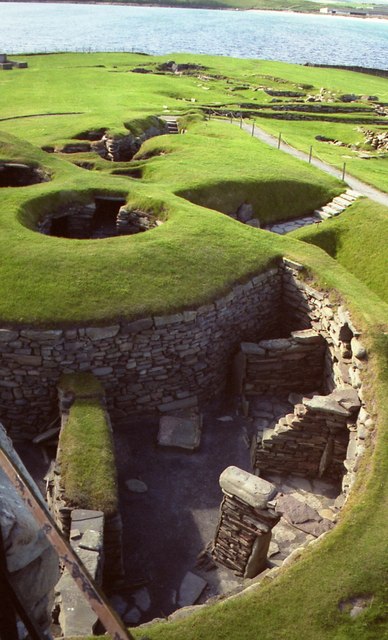
Photo: Nigel Duncan / Wikimedia Commons / CC BY-SA 2.0 Soapstone vessels closely similar to those quarried at Catpund were found in Jarlshof's later Norse levels, dated to the 12th and 13th centuries AD, linking the two sites through the Norse steatite trade.
-
Clibberswick, Unst
Of twenty-three recorded steatite sources on Shetland, only Catpund and Clibberswick on Unst have been excavated, making the two the primary excavated evidence for Shetland's soapstone quarrying industry.
Discovery & excavation
The quarrying scars at Catpund were recognised by at least the 1940s, but detailed understanding of the site came only through excavation: a 1988 dig exposed part of the quarry floor and its hollows from over a hundred removed vessels, and further work through the 1980s and early 1990s, undertaken ahead of mineral extraction by the Shetland Talc company, recorded more than ten tonnes of steatite material at every stage of production. Fragments of steatite vessels recovered from the site are now held in the Shetland Museum and the National Museum of Scotland.
Finds now held at: Shetland Museum; National Museum of Scotland.
What to look for
-
Quarrying scars
Chiselled hollows and scars are visible along the bank of the burn at Catpund, marking the positions from which soapstone vessels were cut directly from the rock.
-
Tool marks
Marks left in the steatite indicate the use of blunt or pointed chisels, even though no actual tools have been recovered from the site.
Plan your visit
- Location
- 60.0264°N · 1.2384°W
- Access
- Open access
- Terrain
- Easy going
- Time needed
- About 90 minutes
Nearby places
Fortified place · Iron Age
Broch of Mousa
Shetland Islands
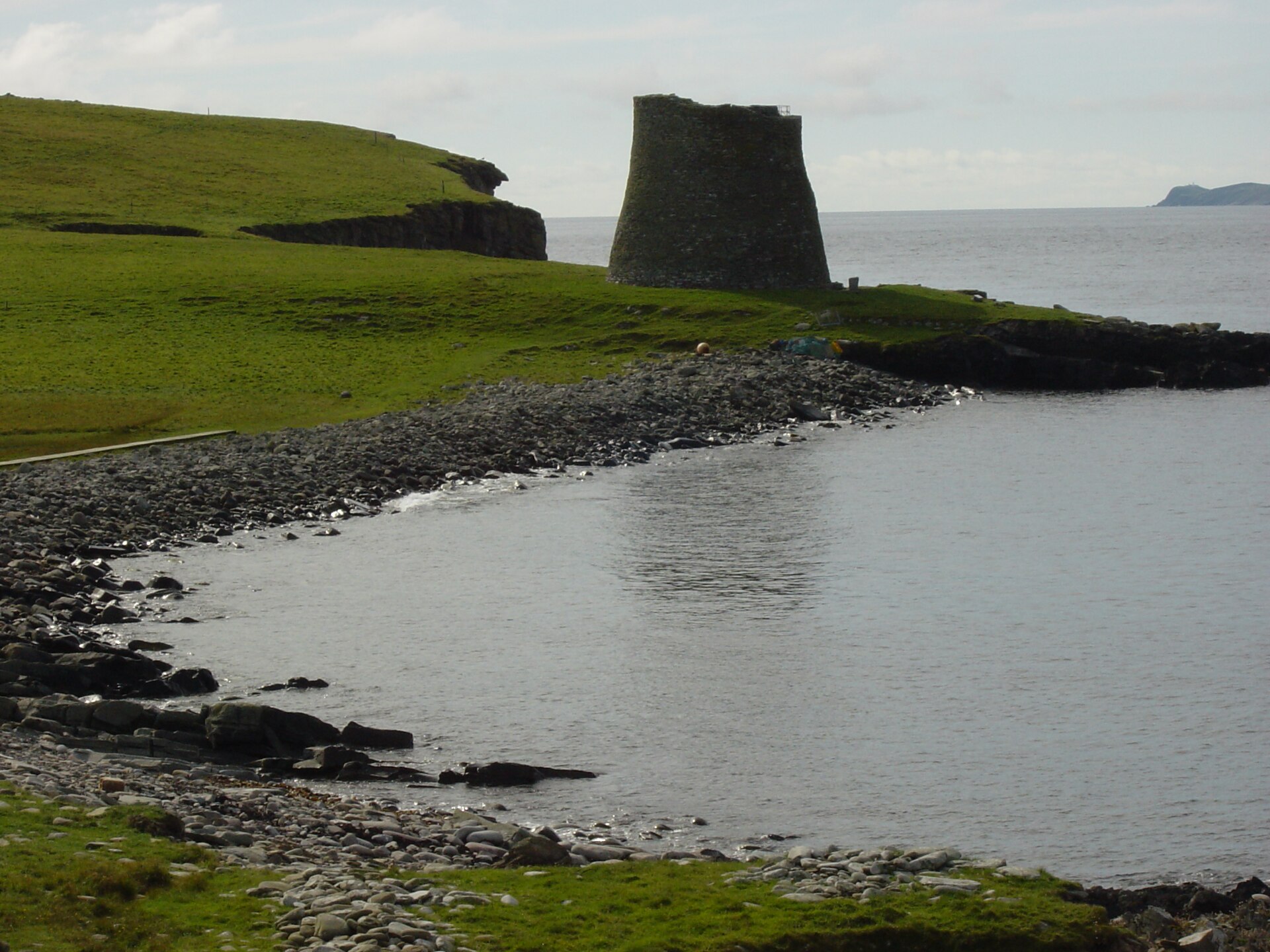
The only broch - a drystone tower, round and hollow-walled, built in the Iron Age, from about 800 BC until the Romans came - still standing nearly…
- Near Sandwick
- 3.2 km from car park
- Some walking

Carved stone · Pictish & early medieval
Papil Stone
Shetland Islands
Carved on a single face of stone left otherwise plain, the Papil Stone rises to a large, long-stemmed cross shaped like a fan, its shaft crowded be…
- Easy path

Sacred place · Prehistoric
St Ninian's Isle
Shetland Islands
St Ninian's Isle sits off the south-western coast of Shetland Mainland, joined to it by a 500-metre tombolo, the largest in the United Kingdom. Loc…
- Easy path

Fortified place · Iron Age
Clumlie Broch
Shetland Islands
Clumlie Broch stands on a low rise amid flat arable ground in Dunrossness, on southern Shetland Mainland, roughly eight kilometres north of Sumburg…
- Some walking
The setting
The A970 running through the hillside near White Stane, close to Catpund’s soapstone quarry.
Photo: David Dixon / Wikimedia Commons / CC BY-SA 2.0
The southern tip of Mousa seen from the coast near Catpund, across Mousa Sound.
Photo: David Dixon / Wikimedia Commons / CC BY-SA 2.0
Questions people ask
- What was quarried at Catpund?
- Catpund is a quarry site where steatite, also known as soapstone and locally as "diales", "kleber", "klever" or "clammel", was cut from the rock to make vessels from prehistory onwards.
- Why was steatite valued as a material?
- Its high talc content makes it soft and easy to carve, it hardens on exposure to air or heat, and it can be heated and cooled repeatedly without shattering, useful properties for vessels used in cooking and storage.
- When was Catpund quarried?
- Occupation nearby dates back to the Bronze Age, evidenced by a prehistoric house on the site, but the majority of the quarrying visible today appears to date to the Viking periods, with vessels similar to Catpund's found in 12th- and 13th-century Norse levels at Jarlshof.
- What did excavations at Catpund find?
- A 1988 excavation exposed part of the quarry floor with hollows from over a hundred removed vessels, and further digs through the 1980s and early 1990s, carried out ahead of mineral extraction by the Shetland Talc company, recorded over ten tonnes of steatite material including blocks, blanks and finished vessels.
- How does Catpund compare to other Shetland steatite sources?
- There are twenty-three recorded sources of steatite on Shetland, but only two have been excavated: Catpund and Clibberswick on Unst, making Catpund one of the best-understood examples of the industry.
Sources
The Ancient Codex, in your pocket
Get the Pocket Codex app
Carry the directory with you — Catpund and thousands of ancient places across Britain and Ireland, offline, wherever you roam.