The most northerly fortified house in the British Isles — burnt by privateers in 1627 after less than thirty years of use, and its top floor later built into the garden wall.
Muness Castle served as a working house for under thirty years, and has stood ruined for four hundred.
It was built in 1598 for Laurence Bruce of Cultmalindie, half-brother to Robert Stewart, 1st Earl of Orkney, on Unst — the most northerly inhabited island in Scotland — three kilometres east of Uyeasound. That position makes it the most northerly fortalice, or small fortified house, anywhere in the British Isles, and the claim is exact — there is nothing of the kind further north.
Its construction may connect it to the great buildings of the Stewart earldom. The castle was possibly put up under the direction of Andrew Crawford, master of works to Earl Patrick, who also oversaw Scalloway Castle and the Earl’s Palace at Kirkwall in Orkney. Earl Robert had died in 1593 and been succeeded by Patrick, so Muness belongs to the first years of the younger earl’s rule, when the Stewarts were building on a scale the Northern Isles had not seen.
Bruce gave the castle to his son Andrew in 1617. Ten years later it was over. In August 1627 foreign privateers burnt Muness, and it may never have been fully repaired. Before the end of that century it had been abandoned altogether, and in 1718 it was sold out of the family.
What happened afterwards is the detail that stays with a visitor. The castle is now roofless, and it is missing its upper storey — because the top floor was taken down and its stone used to build the boundary wall around the site. Anyone walking up to Muness passes through a wall made from the part of the building they have come to look at.
It was designated a Scheduled Monument in 1953 and is run as a museum by Historic Environment Scotland.
Its history is unusually compressed. Most Scottish castles accumulate centuries of alteration, siege and rebuilding; Muness has one building campaign, one owner’s gift to his son, one fire, and then four hundred years of nothing. What a visitor sees is very nearly what Laurence Bruce built, minus a roof, a storey and everything that was portable.
What is missing from Muness is as informative as what stands. There is no later wing, no Georgian refronting, no Victorian restoration — the ordinary accretions of a house that stayed in use. The castle stopped in 1627 and the record stops with it.
What follows is drawn from published sources, with each claim labelled by how firmly it is established.
History
Muness Castle stands on Unst, Scotland's most northerly inhabited island, three kilometres east of the village of Uyeasound. It is the most northerly fortalice — a small fortified house — anywhere in the British Isles, and no fortified house of any kind stands further north. The castle was built in 1598 for Laurence Bruce of Cultmalindie, half-brother to Robert Stewart, 1st Earl of Orkney. Earl Robert had been succeeded by his son Patrick in 1593, so the building belongs to the first years of the younger earl's rule over the Northern Isles.
It may have been constructed under the direction of Andrew Crawford, Earl Patrick's master of works, who also oversaw Scalloway Castle and the Earl's Palace at Kirkwall in Orkney. If that attribution holds, three of the principal buildings of the Stewart earldom are the work of a single man. Bruce gave the castle to his son Andrew in 1617, ten years before the event that effectively ended the building's life as a residence and left it in more or less the condition it has been in ever since. Andrew therefore had the place at its best for barely a decade.
Foreign privateers burnt Muness in August 1627, and it may never have been fully repaired afterwards. It was abandoned before the end of the century, which means the castle was a working house for less than thirty years and has been a ruin for the following four hundred. The building was sold out of the Bruce family in 1718. It is now roofless and missing its upper storey, which was removed so that its stone could be used to build the boundary wall around the site.
Muness was designated a Scheduled Monument in 1953 and is run as a museum by Historic Environment Scotland. It stands on an island at the northern limit of inhabited Scotland, and the castle is among the principal reasons anyone makes the journey to see it.
People
-
Laurence Bruce
Half-brother of Robert Stewart, Earl of Orkney, who built Muness Castle in 1598 as the seat of his lordship of Unst.
Cultural influences
-
A Scottish tower house on Unst
Muness combines a rectangular tower-house plan with round corner towers and gunloops, showing how late sixteenth-century Scottish lordship adapted older defensive forms to firearms.
Connections
-
Unst
Muness Castle is on Unst, one of the Shetland Islands.
-
Uyeasound
Muness Castle is three kilometres east of Uyeasound.
-

Photo: Tom Pennington / Wikimedia Commons / CC BY-SA 2.0 Andrew Crawford may have directed the construction of Muness Castle and Scalloway Castle.
What to look for
-
The missing upper storey
The castle's top floor was taken down and its stone used to build the boundary wall around the site. The wall a visitor passes through is made of the building they have come to see.
-
The 1598 date
Built in a single campaign for Laurence Bruce of Cultmalindie, and possibly by Andrew Crawford, the master of works behind Scalloway Castle and the Earl's Palace at Kirkwall.
-
The most northerly fortalice in the British Isles
On Unst, Scotland's most northerly inhabited island. There is no fortified house further north anywhere in these islands.
-
Traces of the 1627 fire
Foreign privateers burnt the castle in August 1627, and it may never have been fully repaired afterwards.
Plan your visit
- Location
- 60.6895°N · 0.8492°W
- Time needed
- About 45 minutes
Nearby places

Fortified place · Iron Age
Snabrough broch
Shetland Islands
Snabrough Broch sits on a short, low promontory on the shore of Snabrough Loch, on the island of Unst in Shetland, its ruined wall now measuring ar…
- Some walking
Fortified place · Prehistoric
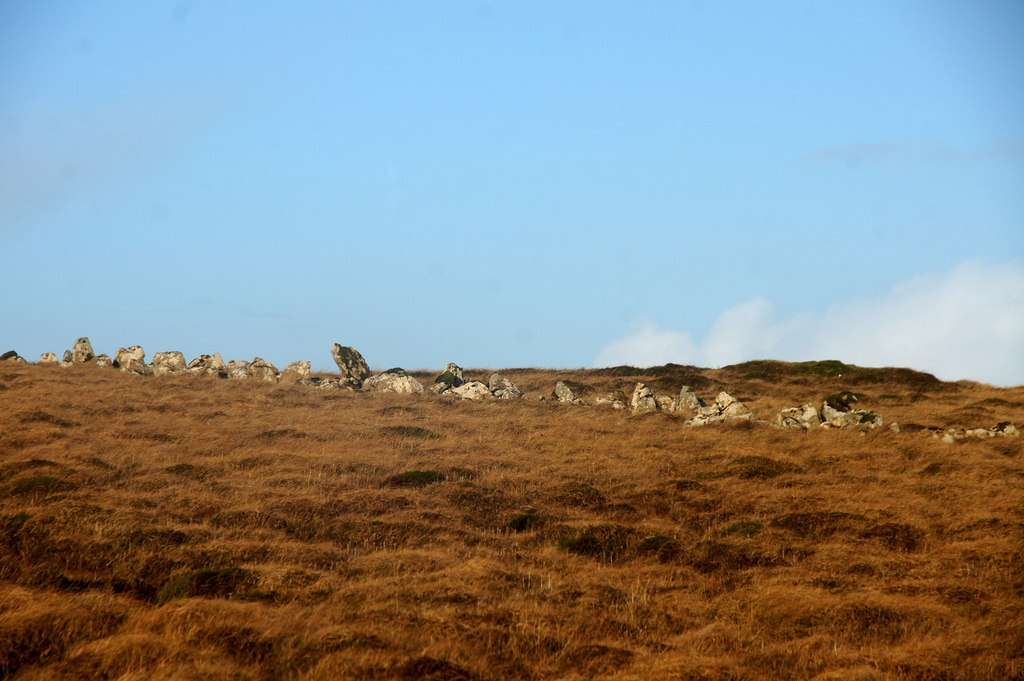
Funzie Girt
Shetland Islands
A stone wall over four kilometres long once ran the full north-south length of Fetlar, splitting the Shetland island into two almost equal halves.…
- Easy path
Sacred place · Prehistoric
Haltadans
Shetland Islands
Thirty-eight stones once ringed this patch of ground on Fetlar, Shetland; twenty-two of them still stand fixed in the soil, describing a circle ele…
- Easy path
Fortified place · Iron Age
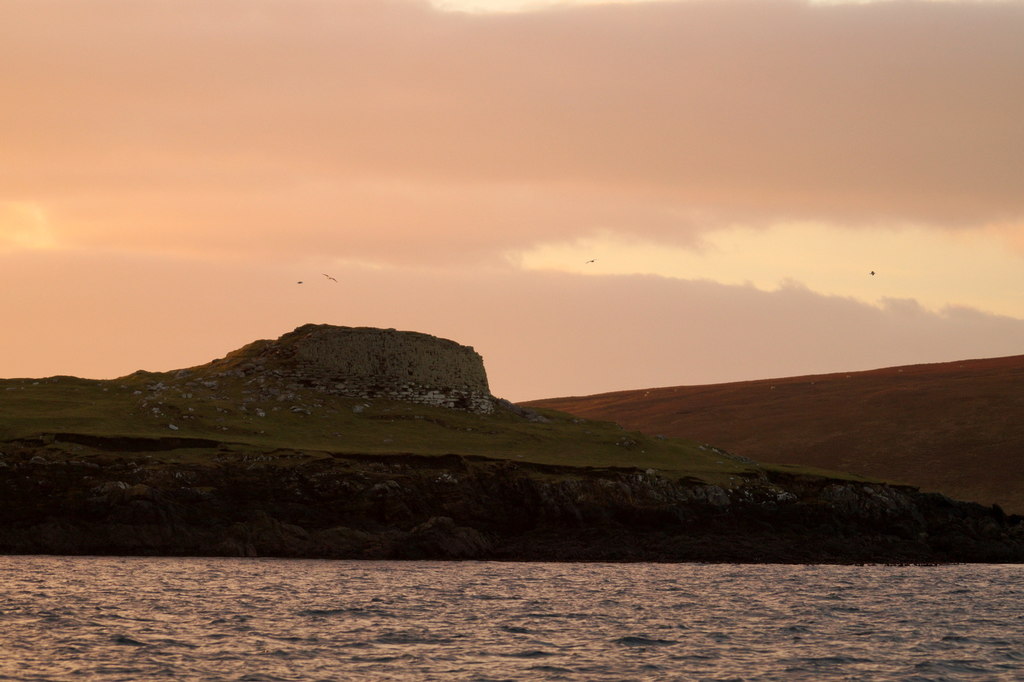
Burra Ness Broch
Shetland Islands
On the tip of the headland of Burra Ness, on the east coast of Yell in Shetland, the drystone wall of a round tower still rises over four metres on…
- Some walking
The setting
Ruined crofthouse at Muness, near the castle.
Photo: Mike Pennington / Wikimedia Commons / CC BY-SA 2.0
Ham Ness coastline seen from Muness Castle.
Photo: Mike Pennington / Wikimedia Commons / CC BY-SA 2.0
Questions people ask
- Who built Muness Castle?
- Laurence Bruce of Cultmalindie, half-brother to Robert Stewart, 1st Earl of Orkney, in 1598. It may have been built under the direction of Andrew Crawford, master of works to Earl Patrick.
- What happened to it?
- Foreign privateers burnt it in August 1627, and it may never have been fully repaired. It was abandoned before the end of the century and sold out of the family in 1718.
- Why is the top floor missing?
- The upper storey was removed and its stone used to build the boundary wall around the castle.
- Can it be visited?
- Yes. It was designated a Scheduled Monument in 1953 and is run as a museum by Historic Environment Scotland.
Sources
The Ancient Codex, in your pocket
Get the Pocket Codex app
Carry the directory with you — Muness Castle and thousands of ancient places across Britain and Ireland, offline, wherever you roam.