
Sacred place · Prehistoric · Shetland Islands
Haltadans
Thirty-eight stones once ringed this patch of ground on Fetlar, Shetland; twenty-two of them still stand fixed in the soil, describing a circle eleven metres across. Within it lies a second, earthen ring 7.9 metres in diameter, broken by a gap of 1.5 metres on its southwest side, and at the very centre stand two rectangular stone pillars, set apart from the surrounding ring of uprights.
Thirty-eight stones once ringed this patch of ground on Fetlar, Shetland; twenty-two of them still stand fixed in the soil, describing a circle eleven metres across. Within it lies a second, earthen ring 7.9 metres in diameter, broken by a gap of 1.5 metres on its southwest side, and at the very centre stand two rectangular stone pillars, set apart from the surrounding ring of uprights.
The site carries two names. It is recorded as Haltadans, and also known as the Fairy Ring or Haltadans stone circle. Its Shaetlan pronunciation is given as HALT-ə-danss, and according to the scholar Jakob Jakobsen the name itself means “lame or limping dance” — a description that ties directly to the legend attached to the stones, in which the outer ring was once a circle of dancing trolls and the two central pillars were a fiddler and his wife, caught by daylight mid-dance.
What follows is drawn from published sources, with each claim labelled by how firmly it is established.
The name
Jakob Jakobsen recorded that Haltadans means "lame or limping dance" in the old Shetland dialect. The name is not merely descriptive of the stones' arrangement but is bound up with the legend told of the site: the limping or halting dance of trolls surprised by sunrise, which gives the monument both its name and its story in a single stroke.
History
As it survives today, Haltadans consists of an outer ring of thirty-eight stones, of which twenty-two remain fixed in the soil, enclosing an inner earthen ring 7.9 metres across with a 1.5 metre gap on its southwest side. Two rectangular pillars stand at the centre, distinct from the ring of stones around them.
The name and the legend attached to the site were recorded by the Faroese-Icelandic philologist Jakob Jakobsen, whose account of the Shaetlan word Haltadans — "lame or limping dance" — preserved the local tradition explaining why the stones stand as they do, linking the monument's name, its layout, and its story into a single piece of oral heritage.
People
-
Jakob Jakobsen
Faroese-Icelandic philologist who recorded the Shaetlan etymology of the name Haltadans and the legend associated with the site.
Connections
-
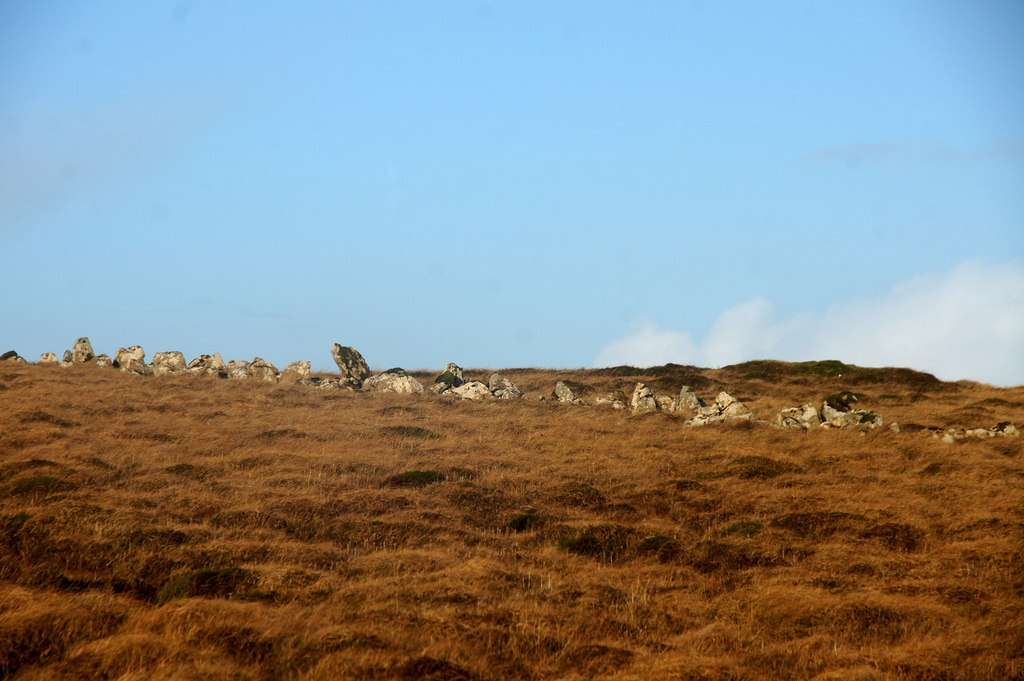
Photo: Mike Pennington / Wikimedia Commons / CC BY-SA 2.0 A prehistoric dyke on Fetlar, forming part of the island’s wider archaeological landscape.
-
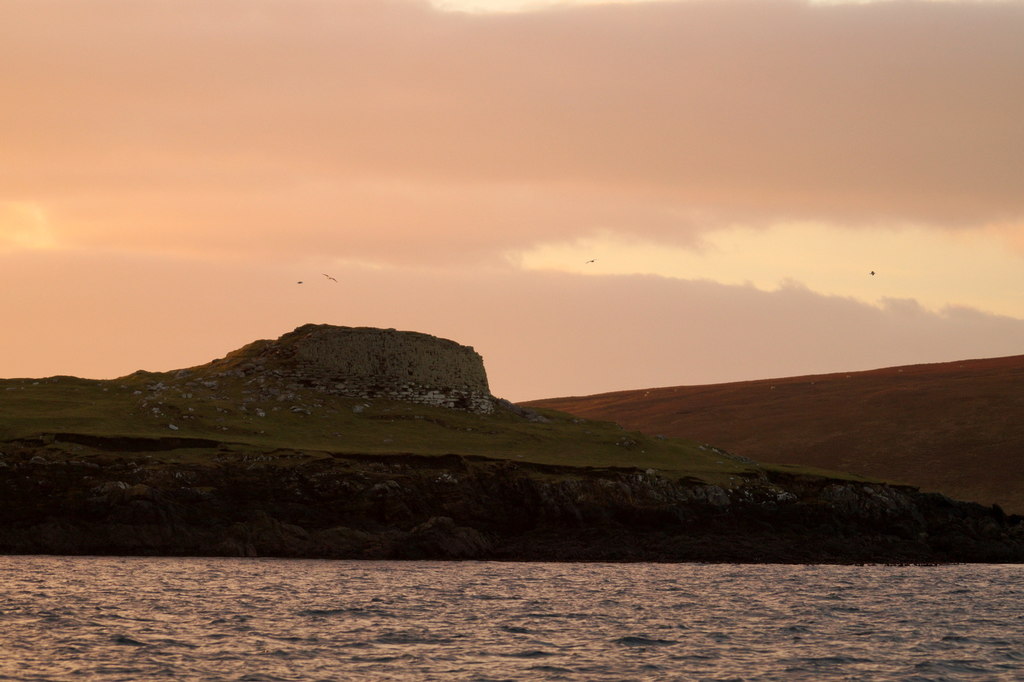
Photo: Mike Pennington / Wikimedia Commons / CC BY-SA 2.0 An Iron Age broch on Shetland, contrasting with Haltadans’s earlier ceremonial stone setting.
-

Photo: Van de Beek / Wikimedia Commons / CC BY-SA 3.0 A later tower house on Shetland, representing a much later phase of settlement and defence.
What to look for
-
The outer stone ring
An eleven-metre circle originally set with thirty-eight stones, of which twenty-two remain fixed in the ground.
-
The inner earthen ring
A 7.9-metre earthen ring inside the stone circle, with a distinct 1.5-metre gap on its southwest side.
-
The two central pillars
A pair of rectangular stone pillars standing at the centre of the rings, identified in local legend as the petrified fiddler and his wife.
What is said
Folklore and tradition, recorded as what is said — not as established fact.
-
The Fiddler and the Dancing Trolls
Local tradition holds that the stone circle was once a ring of trolls dancing through the night, with the two central pillars a fiddler and his wife who played and danced alongside them. Heedless of the passing hours, the trolls were still dancing when the sun rose, and the light turned them all to stone where they stood.
Plan your visit
- Location
- 60.6102°N · 0.8639°W
- Access
- Open access
- Terrain
- Easy going
- Time needed
- About 30 minutes
Nearby places
Fortified place · Prehistoric
Funzie Girt
Shetland Islands
A stone wall over four kilometres long once ran the full north-south length of Fetlar, splitting the Shetland island into two almost equal halves.…
- Easy path
Fortified place · Iron Age
Burra Ness Broch
Shetland Islands
On the tip of the headland of Burra Ness, on the east coast of Yell in Shetland, the drystone wall of a round tower still rises over four metres on…
- Some walking

Fortified place · Medieval
Muness Castle
Shetland Islands
The most northerly fortified house in the British Isles: burnt by privateers in 1627 after less than thirty years of use, and its top floor later b…

Fortified place · Iron Age
Snabrough broch
Shetland Islands
Snabrough Broch sits on a short, low promontory on the shore of Snabrough Loch, on the island of Unst in Shetland, its ruined wall now measuring ar…
- Some walking
The setting
Wet grassland beside Skutes Water at Haltadans, where the stone circle stands.
Photo: Ken Craig / Wikimedia Commons / CC BY-SA 2.0
Moorland at Gravins on Fetlar, close to the Haltadans stone circle.
Photo: Mike Pennington / Wikimedia Commons / CC BY-SA 2.0
The open moorland of Gravins on Fetlar near Haltadans.
Photo: Mike Pennington / Wikimedia Commons / CC BY-SA 2.0
Skutes Water beside the moorland at Haltadans on Fetlar.
Photo: Rude Health / Wikimedia Commons / CC BY-SA 2.0
Questions people ask
- What is Haltadans?
- Haltadans is a stone circle on the island of Fetlar in Shetland, Scotland, also known as the Fairy Ring or Haltadans stone circle. It consists of a ring of stones around an inner earthen ring, with two rectangular pillars at the centre.
- Where is Haltadans located?
- It is located on the island of Fetlar, part of Shetland, Scotland.
- What does the name Haltadans mean?
- According to the scholar Jakob Jakobsen, Haltadans means "lame or limping dance" in the Shaetlan dialect, a name tied to the legend told of the site.
- How many stones make up the circle, and how large is it?
- The outer ring originally comprised 38 stones, of which 22 are still fixed in the soil, forming a circle 11 metres (37 ft) in diameter. Inside it is an earthen ring 7.9 metres (26 ft) across, with a 1.5 metre (5 ft) gap on its southwest side.
- What is the legend behind the two central pillars?
- Local tradition holds that the stone circle was once a ring of dancing trolls, and that the two rectangular pillars at the centre were a fiddler and his wife. They fiddled and danced through the night and, heedless of the time, were still dancing when the sun rose and turned them all to stone.
Sources
- Wikipedia
- Jakob Jakobsen
Explore more: Sacred places · Prehistoric · Shetland Islands
The Ancient Codex, in your pocket
Get the Pocket Codex app
Carry the directory with you — Haltadans and thousands of ancient places across Britain and Ireland, offline, wherever you roam.