
A Neolithic long cairn named after a devil's mittenful of stones — and reduced to less than half its remembered height by shepherds building walls.
The Mutiny Stones have nothing to do with mutiny. The name is a corruption of the Scots phrase mittenfu’ o stones — a mittenful of stones — which arose from a local legend that the devil was passing overhead and dropped a handful of boulders on this spot. Mittenfu’ became the Meeting Stones, and the Meeting Stones became the Mutiny Stones, so the monument’s modern name is three removes from what anyone originally meant by it.
What stands on Byrecleugh Rig is a long cairn, an elongated mound of piled stone, thought to date to the third millennium BC. The form matters: long cairns are Neolithic, and they are a different proposition from the round cairns of the Bronze Age that are commoner across these hills. This is among the older constructions in the Lammermuirs, and it is remote — the nearest centre of habitation is Longformacus, some four miles off.
Its recent history is one of steady subtraction. The cairn has been repeatedly robbed of stone by shepherds, who used the material to build stells — the circular drystone shelters that protect sheep on open hill — and drystone walls. That is entirely comprehensible. A large heap of pre-sorted, weathered building stone sitting in open country, miles from any quarry, was a resource long before anybody thought of it as a monument.
The scale of what has gone is the striking part. The cairn now stands 2.4 metres at its highest point. Within recorded memory it was said to be 5.5 metres. More than half its height has been carried off in a period short enough for people to remember the difference, and it is somewhere in the walls and sheep shelters of the surrounding hill.
What the cairn originally contained is unknown. No excavation is recorded here, and the robbing that removed most of its height will have disturbed whatever lay beneath it long before any archaeologist arrived. What can be said is that somebody in the third millennium BC built something substantial enough on this ridge that, four and a half thousand years later, there was still enough of it left to supply a district’s worth of sheep shelters.
What follows is drawn from published sources, with each claim labelled by how firmly it is established.
The name
Mutiny Stones corrupts the Scots mittenfu’ o stones, ‘a mittenful of stones’; the name passed through ‘Meeting Stones’ and has no connection with mutiny.
History
The Mutiny Stones are a megalithic monument in the Lammermuir Hills, situated on Byrecleugh Rig. The nearest centre of habitation is Longformacus, some four miles away, which makes this one of the more remote monuments of its kind anywhere in the Borders. The monument is constructed as a long cairn — an elongated mound of piled stone — and is thought to date to the third millennium BC. The form places it in the Neolithic rather than among the round cairns of the Bronze Age that are commoner across these hills.
The name is a corruption of the Scots mittenfu' o stones, meaning a mittenful of stones. The phrase arose from a local legend that the devil was passing overhead and dropped a handful of boulders on this spot — an explanation offered for a heap of stone whose real purpose had long been forgotten. That name was later corrupted to the Meeting Stones, and from there to the Mutiny Stones. The monument's modern name is therefore three removes from its original sense, and not one of those removes has anything to do with mutiny.
The cairn has been repeatedly robbed of stone over the years by shepherds, who used the material to build stells — the circular drystone shelters that protect sheep on open hill — and drystone walls. A large heap of weathered building stone in open country was a resource long before it was treated as a monument. It now stands 2.4 metres at its highest point. Within recorded memory it was said to have been 5.5 metres high, so more than half its height has been carried away, within a period short enough for people to remember the difference.
Cultural influences
-
A Neolithic long cairn dispersed into shepherds’ structures
The Mutiny Stones are a third-millennium BC long cairn whose stone was repeatedly taken for sheep stells and drystone walls.
Connections
-
Lammermuir Hills
Mutiny Stones is a megalithic monument in the Lammermuir Hills.
-
Byrecleugh Rig
Mutiny Stones stands on Byrecleugh Rig.
-
Longformacus
Longformacus is the nearest centre of habitation to Mutiny Stones, about four miles away.
What to look for
-
The height that is missing
The cairn stands 2.4 metres at its highest. Within living memory it was reported at 5.5 metres, so what is absent is more than what remains.
-
The stells and walls nearby
Shepherds took stone from the cairn to build sheep shelters and drystone walls. The monument is dispersed into the field boundaries around it.
-
The long cairn form
An elongated mound rather than a round one, which places it in the Neolithic — the third millennium BC — rather than among the Bronze Age round cairns more common in these hills.
What is said
Folklore and tradition, recorded as what is said — not as established fact.
-
The devil’s dropped stones
A local legend says the devil dropped a mittenful of boulders here while passing overhead, giving rise to the earlier Scots name.
Plan your visit
- Location
- 55.8230°N · 2.6041°W
- Access
- Open access
- Terrain
- Rough ground — reasonable boots advised
- Time needed
- About 30 minutes
- What survives
- The robbed long cairn now stands 2.4 metres high, less than half the 5.5 metres recorded within living memory.
Opening & admission
- Remote upland cairn in the Lammermuir Hills; expect rough moorland conditions.
Nearby places
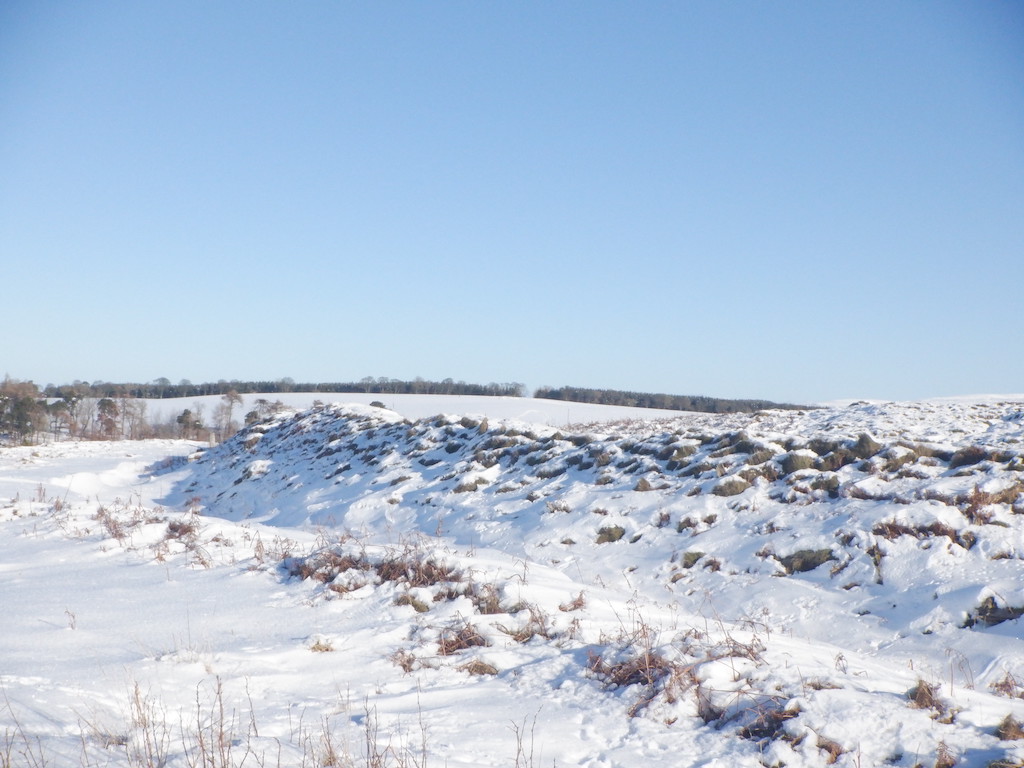
Fortified place · Iron Age
Black Castle, East Lothian
East Lothian
A double ring of earthen ramparts with two carefully placed causewayed entrances, sited between two other named hillforts in a dense East Lothian c…
- Some walking
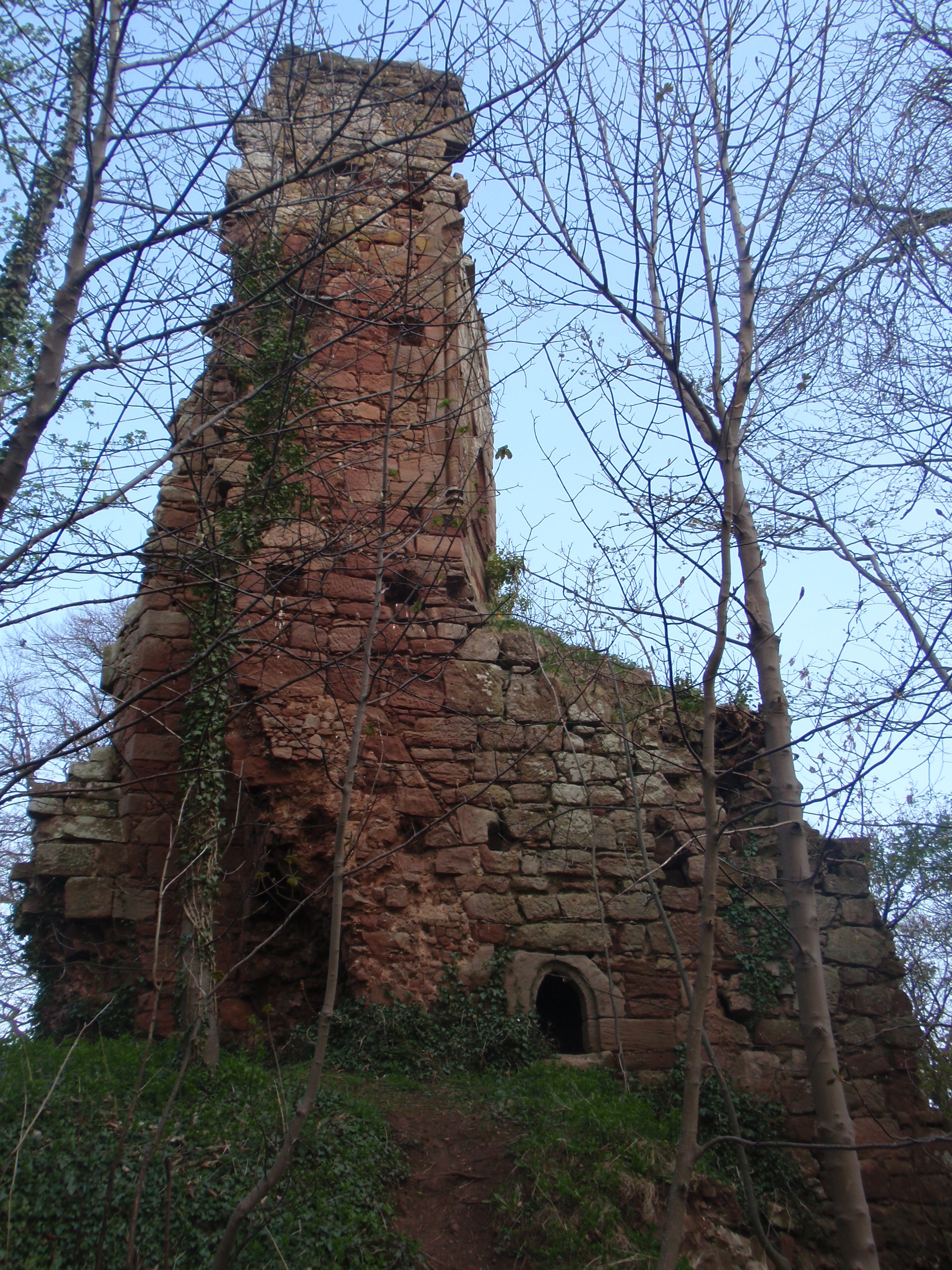
Fortified place · Medieval
Yester Castle
East Lothian
Yester is remembered for its extraordinary underground Goblin Ha’, a surviving medieval hall bound to the enduring folklore of the ‘Wizard of Yester’.
- Near Dunbar
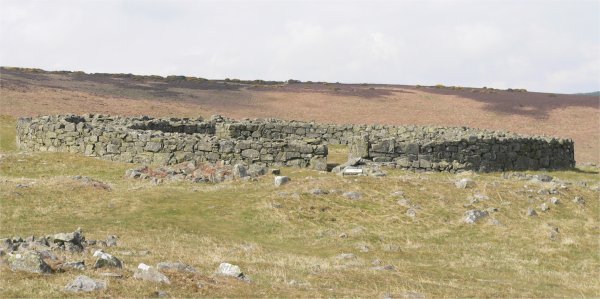
Fortified place · Iron Age
Edin's Hall Broch
Scottish Borders
The hilltop on the northeast slope of Cockburn Law was first fortified in the pre-Roman Iron Age, when double ramparts and ditches enclosed an oval…
- Near Duns
- 1.8 km from car park
- Some walking
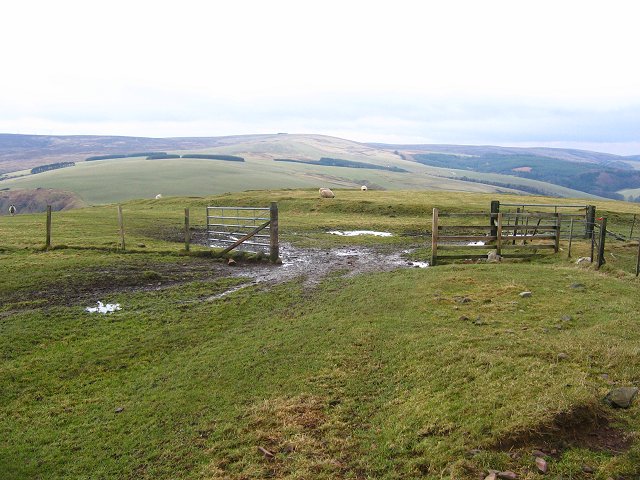
Fortified place · Iron Age
Blackcastle Hill, East Lothian
East Lothian
A single earthen bank, not the layered ramparts of its grander neighbours, rings this Lammermuir summit: a modest, univallate answer to the same Ir…
- Some walking
The setting
The last field at Byrecleugh; retained as a contextual view because the Mutiny Stones are not shown.
Photo: Richard Webb / Wikimedia Commons / CC BY-SA 2.0
The Dye Water valley near Byrecleugh, the setting of the Mutiny Stones.
Photo: Adam Ward / Wikimedia Commons / CC BY-SA 2.0
Dye Water below the moorland near the Mutiny Stones.
Photo: Richard Webb / Wikimedia Commons / CC BY-SA 2.0
Questions people ask
- What does the name mean?
- Nothing to do with mutiny. It is a corruption of the Scots mittenfu' o stones — a mittenful of stones — from a legend that the devil dropped a handful of boulders here while passing overhead. That became the Meeting Stones and then the Mutiny Stones.
- How old is the cairn?
- It is thought to date to the third millennium BC.
- Why is it so much smaller than it was?
- Shepherds robbed it repeatedly for stone to build stells and drystone walls. It stands 2.4 metres now; within recorded memory it was said to be 5.5 metres.
Sources
The Ancient Codex, in your pocket
Get the Pocket Codex app
Carry the directory with you — Mutiny Stones and thousands of ancient places across Britain and Ireland, offline, wherever you roam.