
A yew that has cloned itself into a grove — branches bending to the ground, rooting, and sending up new stems, until the crown reached a hundred metres round.
This yew has reproduced itself sideways. Its branches grow downward rather than up, and where they touch the soil they root and send up new vertical stems — a process called layering. The clones that result are genetically identical to the parent, and as the original trunk hollows and dies back, they carry on. What began as one tree is now a grove whose crown has reached a circumference of about a hundred metres.
It grows beside the River Gryffe, in what were the grounds of the Craigends Estate at Houston in Renfrewshire, at grid reference NS4199566134. Estimates put its age at between 500 and 700 years, which would place its beginning somewhere between about 1300 and 1500, and make it one of the largest and oldest heritage layering yews in Scotland. The Ancient Tree Inventory holds it as tree number 31486. The parent trunk has a girth of 8.86 metres measured 30 centimetres from the ground, and the grove has now thrown out a second row of layered stems beyond the first.
The tree carries a small ecosystem of its own. Ferns, ivy, liverworts, lichens and mosses grow on it, encouraged by the humidity trapped beneath an evergreen canopy and supplemented by occasional flooding from the river. Its condition is what one would expect of a tree of this age and habit: a hollowing trunk, water pockets in the branch angles, holes in the main stem, decaying branches in the crown, rotting wood on the ground. Dormant buds along the horizontal branches are breaking into new vertical growth, so the grove is still extending.
The estate around it has not fared as well. In 1479 the lands of Craigends were granted to William Cuninghame, second son of the first Earl of Glencairn, and this branch of the family held them into the twentieth century. An 1818 account describes the estate as adorned with pleasant orchards and gardens, the seat of the ancient family, and it has been suggested that the yew was among the Cuninghames’ earliest plantings. The last laird, John Charles Cuninghame, died in 1917. His widow held the estate until 1958, a nephew sold it to the developers Taylor Woodrow, the mansion house was demolished in 1971, and by 1973 housing was going up in the grounds.
The grove survived all of that, though not untouched — it suffered a degree of vandalism before a conservation programme in 2018 removed several trees from within it to reduce shading and cleared the surrounding scrub. It now has room to expand on two sides, being hemmed in to the east by a housing estate fence and to the north by the river. It lies just off a public footpath, and can also be seen from the path through the park on the opposite bank. In 2016 it was shortlisted for Scotland’s Tree of the Year by the Woodland Trust.
What follows is drawn from published sources, with each claim labelled by how firmly it is established.
History
The tree is a layering yew, a growth form in which branches hang down, root where they touch the soil, and then send up new vertical stems. The central trunk eventually dies while the rooted clones carry on, so the circumference grows outward and the centre becomes hollow. Every new stem is genetically identical to the parent, because no sexual reproduction is involved.
Estimates put the tree's age at somewhere between 500 and 700 years, which would place its beginning between roughly 1300 and 1500. It is among the largest and oldest heritage layering yews in Scotland, and the Ancient Tree Inventory records it as tree number 31486 at grid reference NS4199566134. The clonal grove has now achieved a second row of branch layering, and the crown has reached a circumference of 328 feet, about 100 metres. The parent trunk has a girth of 27 feet, or 8.86 metres, measured 30 centimetres from the ground.
In 1479 the lands of Craigends were granted to William Cuninghame, who died in 1520, second son of Alexander Cuninghame, first Earl of Glencairn. William built the first fortified manor house, and this cadet branch of the family held Craigends into the twentieth century. An account of 1818 describes the estate as adorned with pleasant orchards and gardens, the seat of the ancient family. It has been suggested that the yew was among the first plantings made by the Cuninghames, who held these lands from at least the time of Alexander Cuninghame, who lived from 1426 to 1488.
John Charles Cuninghame, the seventeenth and last laird, died in 1917, and the estate passed to his widow Alison. She died in 1958, and a nephew who inherited sold the estate to the developers Taylor Woodrow. The mansion house was demolished in 1971, and by 1973 the first of many housing estates was under construction in the grounds.
A conservation programme in 2018 removed several trees from within the grove to reduce shading and cleared much of the surrounding scrub to improve access. The grove had suffered a degree of vandalism before this. It is now in good health, with room to expand on two sides — a housing estate fence confines it to the east and the River Gryffe to the north. In 2016 the Craigends Yew was shortlisted for Scotland's Tree of the Year by the Woodland Trust.
People
-
William Cuninghame
Granted the lands of Craigends in 1479 and built the first fortified manor house there; died 1520.
-
John Charles Cuninghame
The seventeenth and final laird of Craigends, who died in 1917.
Connections
-
Defynnog Yew, Powys
Cited as an example of the typical yew growth form, against which the Craigends Yew's layering habit is contrasted.
-
Clan Fraser tree, Stratherrick
An example of the rarest yew growth form, in which clonal trees are thrown up as suckers from the roots rather than from layered stems.
-
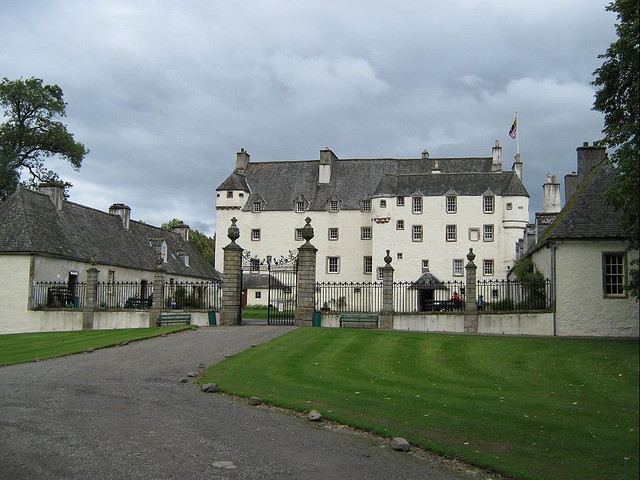
Photo: marsroverdriver / Wikimedia Commons / CC BY-SA 2.0 One of several Scottish sites, with Ormiston, Whittingehame and Broich near Kippen, where other ancient layering yews survive.
-
River Gryffe
The river runs along the north side of the grove, confining its spread and flooding it occasionally, which helps sustain the humidity the tree's epiphytes need.
What to look for
-
The layered stems
Branches that have bent to the ground, rooted, and thrown up new vertical growth. A second row of layering has now formed beyond the first.
-
The hollowing parent trunk
The original trunk has a girth of 8.86 metres and is hollowing, with holes in the main stem and water pockets in the branch angles.
-
The epiphytes
Ferns, ivy, liverworts, lichens and mosses grow on the tree, sustained by the humidity held under the evergreen canopy and topped up by river flooding.
-
The dormant buds
Buds along the horizontal branches are breaking into vertical growth of varying sizes, so the grove is still actively extending itself.
Plan your visit
- Location
- General area near Renfrewshire, Renfrewshire
- Nearest settlement
- Renfrewshire
- Access
- Reached on a public path
- What survives
- Living-tree condition and access should be checked against current local guidance before any visit copy is expanded.
This is a sensitive or fragile site, so we show only its general area. Please check official heritage sources for access before visiting, and take care not to disturb it.
Nearby places

Ancient tree · Medieval
Wallace Oak (Elderslie)
Renfrewshire
By the mid-nineteenth century a Scotsman's snuff box was expected to contain a fragment of this oak. The relic trade is what killed it.
- Near Renfrewshire
Ancient tree · Medieval
Wallace Yew (Elderslie)
Renfrewshire
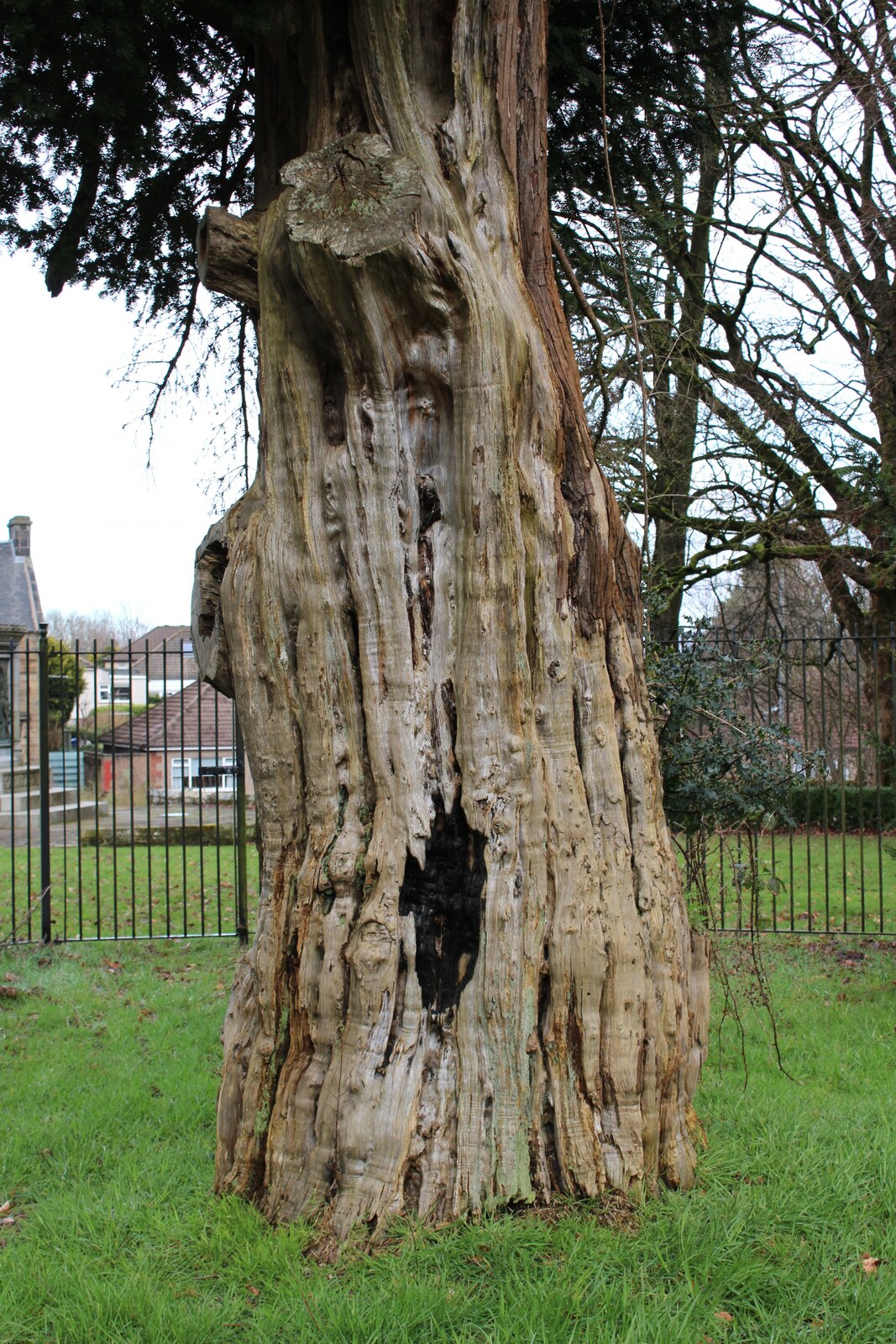
Parish records of the 1700s already call it 'this ancient tree'. Arson in 1978 and storms in 2005 let in a fungus that is now killing it; twelve cu…
- Near Renfrewshire

Sacred place · Medieval
Paisley Abbey
Renfrewshire
Robert II was born here by caesarean section in 1316, after his mother fell from her horse nearby. A stone marker stands where she came off.

Sacred place · Medieval
Castle Semple Collegiate Church
Renfrewshire
A church served by a college of priests, near the eastern end of Castle Semple Loch.
The setting
Path at Craigends; retained as a contextual view because the Craigends Yew is not shown.
Photo: Richard Webb / Wikimedia Commons / CC BY-SA 2.0
Questions people ask
- What is a layering yew?
- One whose branches grow downward, root where they touch the soil, and send up new vertical stems. The clones are genetically identical to the parent, and the original trunk eventually dies while they carry on.
- How old is the Craigends Yew?
- Estimates run between 500 and 700 years, which would place its beginning somewhere between about 1300 and 1500.
- How large is the grove?
- The crown has reached a circumference of about 100 metres, and the parent trunk has a girth of 8.86 metres measured 30 centimetres above the ground.
- Can it be visited?
- It lies just off a public footpath and can also be seen from the path through the park on the far side of the River Gryffe. A path has been cut into the grove itself with only minor damage.
- What condition is the tree in?
- The grove was reported in good health after a 2018 conservation programme, though the parent trunk is hollowing, with decaying branches in the crown and rotting wood on the ground.
Sources
The Ancient Codex, in your pocket
Get the Pocket Codex app
Carry the directory with you — The Craigends Yew and thousands of ancient places across Britain and Ireland, offline, wherever you roam.