Its Bear Gates have stood locked since the eighteenth century under a vow never to reopen them — a promise the family has kept for more than two hundred years.
Two stone bears crouch atop a pair of wrought-iron gates at the entrance to the grounds, sealed shut since the eighteenth century and never opened since. Behind them stands a rambling, harled house with narrow windows and thick walls built in the manner of a fortified mansion rather than a true castle — a building that grew, room by room, out of a remote royal hunting lodge in the forest above the Tweed.
That origin reaches back to the twelfth century, when Scottish kings used the site to hunt, and it hardened into something more defensible after the death of Alexander III in 1286 threw the Borders into two centuries of contested rule between English and Scottish control. Out of that unsettled inheritance came the family who would hold the house for four hundred years, the Stuarts of Traquair, whose fortunes rose and fell with royal favour, marriage, and, in 1513, a death on the battlefield of Flodden.
What survives today is a house that has changed remarkably little since the seventeenth century: a museum room with a mural from 1530, a chapel raised after Catholic emancipation, a library of thousands of volumes, and a working brewery still fermenting ale in oak tuns two centuries old. Traquair is lived in, not preserved behind rope barriers, and it presents its past — royal visits, sealed gates, a film crew, a maze regrown after a hard winter — as a continuous, ordinary inheritance rather than a museum piece.
What follows is drawn from published sources, with each claim labelled by how firmly it is established.
History
From the twelfth century onward Traquair served as a hunting seat for Scottish kings amid dense Border forest, with Alexander I recorded as the first monarch to stay and hunt there. No part of the building standing today can be dated with certainty before the fifteenth century, though the site's long royal association gave it an early claim to prominence in the Tweed valley, then a remote and thickly wooded frontier.
Alexander III's death in 1286 shattered the uneasy peace of the Borders and pulled Traquair into the front line of Anglo-Scottish conflict, as the house became a link in the chain of strongholds guarding the Tweed valley against English incursion. Over the following two centuries ownership passed repeatedly between English and Scottish control, a pattern reflecting the volatility of the frontier the house occupied.
In the 1460s James III granted the estate to Dr William Rogers, a musician and royal favourite, who held it for some nine years before selling it in 1478, for a modest sum, to the Earl of Buchan. The Earl passed Traquair to his illegitimate son James Stuart in 1491, who obtained letters of legitimation and married the Rutherford heiress, bringing the Roxburghshire estates of Rutherford and Wells into the family before he was killed at the Battle of Flodden in 1513.
James Stuart's descendants tied Traquair into the wider web of Border nobility: his daughter Jane Stewart's daughter Janet, born to the Earl of Angus, married Patrick Ruthven, 3rd Lord Ruthven, and the house remained the family seat of the Earls of Traquair for four centuries afterward, passing through successive lairds who reshaped its interiors while leaving its outward form largely untouched.
Mary, Queen of Scots stayed at Traquair in August 1566, and her presence is still marked by a room bearing her name, holding relics said to include her rosary, crucifix and purse; James VI followed in March 1602. Over a century later, in 1738, the fifth Earl Charles Stuart installed the Bear Gates at the entrance to the grounds, with the stone bears added in 1745; the gates were sealed in 1796 on the Countess's death, and the seventh Earl vowed they would remain shut.
In 1875 Traquair passed, via the female line, to Henry Constable Maxwell, a cousin of the Stuarts, carrying the estate beyond the direct male succession while keeping it within the wider family. The National Portrait Gallery later held a 1992 portrait of Catherine Maxwell Stuart, 21st Lady of Traquair, marking the house's continuing line of stewardship into the modern era.
The house's own brewery was revived in 1965 by Peter Maxwell Stuart, the 20th Laird, using eighteenth-century domestic brewing equipment and oak fermenting tuns over 200 years old; five years later, in 1970, the house provided the setting for the horror film Tam-Lin, starring Ava Gardner.
People
-
James Stuart, 1st Laird of Traquair
Received the estate from the Earl of Buchan in 1491, secured letters of legitimation, and was killed at the Battle of Flodden in 1513.
-

Photo: Unidentified painter / Wikimedia Commons / Public domain Mary, Queen of Scots
Stayed at Traquair in August 1566; the room she used still displays relics said to be hers.
-
Charles Stuart, 5th Earl of Traquair
Installed the Bear Gates at the entrance to the grounds in 1738.
-
Peter Maxwell Stuart, 20th Laird of Traquair
Revived the house brewery in 1965 using its original eighteenth-century equipment.
-
Catherine Maxwell Stuart, 21st Lady of Traquair
Subject of a 1992 portrait held by the National Portrait Gallery.
Cultural influences
-
Precursor to Scottish Baronial style
Traquair pre-dates the Scottish Baronial style of architecture and is thought to have been one of its influences, its fortified-mansion form anticipating features later formalised in that later revival style.
Connections
-
National Portrait Gallery, Edinburgh
Holds a 1992 portrait of Catherine Maxwell Stuart, 21st Lady of Traquair.
-
Penicuik
Quarry source for the stone bears added to the Bear Gates in 1745.
-
Rutherford and Wells estates, Roxburghshire
Brought into the Traquair family through James Stuart's 1491 marriage to the Rutherford heiress.
-
Battle of Flodden
Site where James Stuart, 1st Laird of Traquair, was killed in 1513.
-
Earl of Buchan
Bought the estate in 1478 before gifting it to his illegitimate son, James Stuart, in 1491.
In culture
-
Tam-Lin (1970)
The horror film Tam-Lin was shot at Traquair in 1970, starring Ava Gardner alongside Joanna Lumley, Stephanie Beecham and Ian McShane.
What to look for
-
The Bear Gates
Wrought-iron gates topped with stone bears added in 1745, sealed since 1796 and never reopened.
-
The Museum Room mural
A mural dating from 1530, among the oldest surviving in a secular building in Scotland, displayed alongside royal charters bearing the seals and signatures of Scottish kings.
-
The King's Room
The room where Mary, Queen of Scots stayed in 1566, holding relics said to include her rosary, crucifix, purse, a silk quilt and letters bearing her signature.
-
The 18th-century library
A library holding more than 3,000 volumes, largely unchanged since the eighteenth century.
-
The brewery's oak tuns
Original fermenting vessels, some more than 200 years old, still used to brew Jacobite Ale and House Ale.
-
The maze
A maze designed by John Schofield, replanted with beech after severe winter losses to its original Leyland cypress in 1983.
What is said
Folklore and tradition, recorded as what is said — not as established fact.
-
The vow of the Bear Gates
A popular tradition holds that the Bear Gates were closed after Bonnie Prince Charlie passed through them in 1745, with the Earl vowing they would never reopen until a Stuart king returned — a romantic account said to be impossible given the gates' recorded 1796 sealing after the Countess's death.
Plan your visit
- Location
- 55.6083°N · 3.0640°W
- Time needed
- About 120 minutes
Nearby places

Fortified place · Medieval
Elibank Castle
Scottish Borders
A 1511 royal charter tied one family's right to farmland to a promise to build in stone, and the Italianate terraced gardens later raised here rank…
Fortified place · Medieval
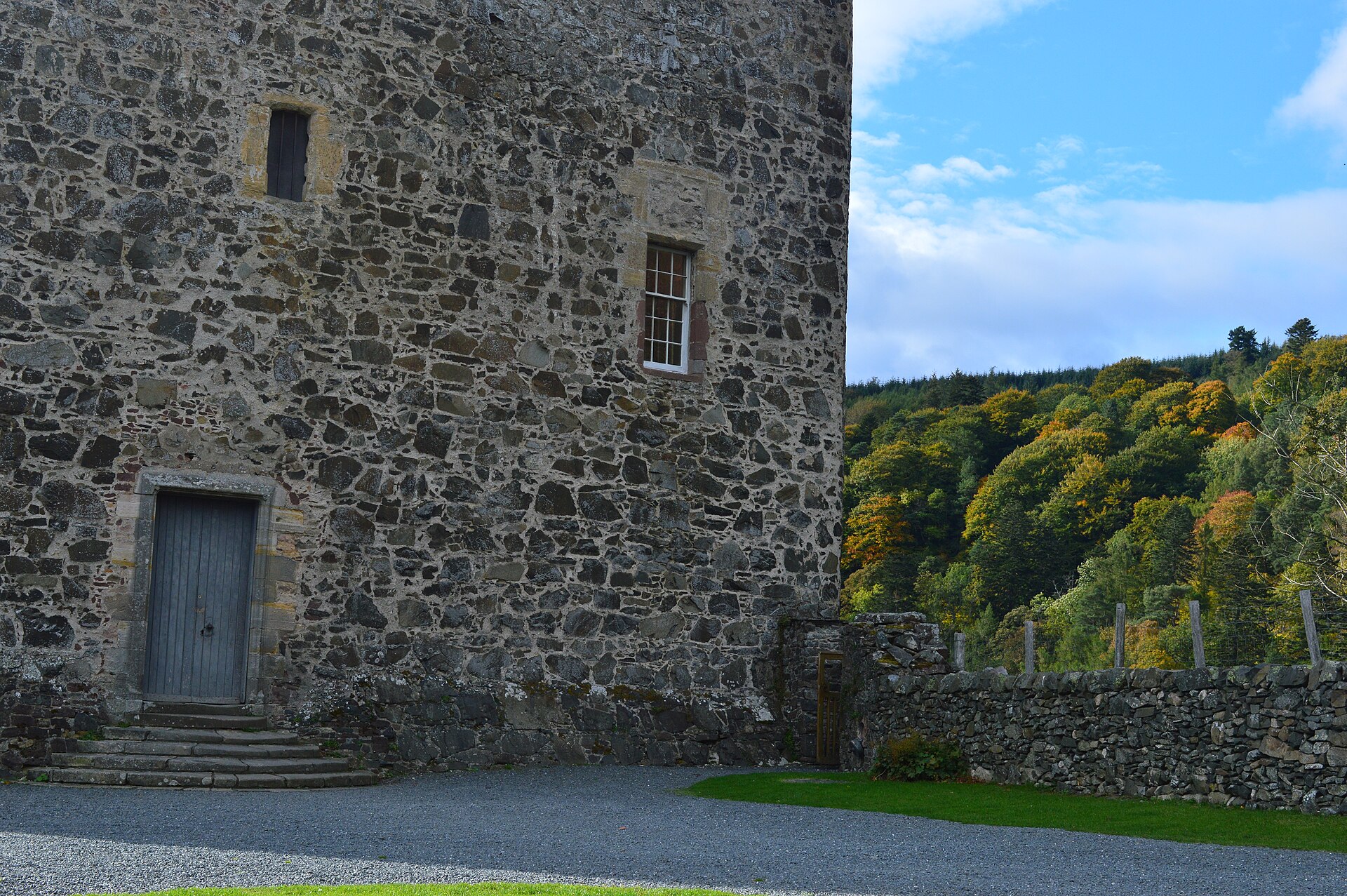
Neidpath Castle
Scottish Borders
A single L-plan tower rebuilt almost nowhere else in its 750-year life, whose carved archway still names both families that shaped it: the Hays' go…
Fortified place · Iron Age
Cademuir Hill Fort
Scottish Borders
Two Iron Age forts crown the Cademuir ridge. The larger, Cademuir I, on the summit, enclosed about 2.25 ha within a single 3 m thick stone wall and…
- Near Peebles
- 4.4 km from car park
- Some walking

Fortified place · Iron Age
Milkieston Rings
Scottish Borders
A small hillfort of the Iron Age, roughly 800 BC until the Roman conquest: a settlement defended by banks and ditches on high ground: with up to si…
- Rough ground
Questions people ask
- Why are the Bear Gates at Traquair House kept closed?
- Official record holds they were sealed in 1796 after the Countess of Traquair's death, with the 7th Earl vowing to keep them shut; a popular but disputed legend links the closure to Bonnie Prince Charlie's 1745 visit.
- Is Traquair House really the oldest inhabited house in Scotland?
- It is claimed to be the oldest continually inhabited house in Scotland, with origins as a royal hunting seat from the 12th century, though no surviving fabric can be firmly dated earlier than the 15th century.
- What links Traquair House to Mary, Queen of Scots?
- Mary stayed at Traquair in August 1566; the room she used, still called the King's Room, displays relics said to be hers, including a rosary, crucifix, purse and signed letters.
- What film was shot at Traquair House?
- The 1970 horror film Tam-Lin was filmed at Traquair, starring Ava Gardner alongside Joanna Lumley, Stephanie Beecham and Ian McShane.
- Does Traquair House still brew its own ale?
- Yes — the house brewery, revived in 1965 by the 20th Laird, still ferments ale in the original oak tuns, some over 200 years old, producing Jacobite Ale and House Ale.
Sources
- Wikipedia: Traquair House
- IMDb: Tam Lin (1970)
- Royal Commission on the Ancient and Historical Monuments of Scotland (RCAHMS)
Explore more: Fortified places · Medieval · Scottish Borders
The Ancient Codex, in your pocket
Get the Pocket Codex app
Carry the directory with you — Traquair House and thousands of ancient places across Britain and Ireland, offline, wherever you roam.