
A 1511 royal charter tied one family's right to farmland to a promise to build in stone, and the Italianate terraced gardens later raised here ranked among the grandest in Scotland.
Broken walls stand on a hillside above the River Tweed, with the faint stepped outline of terraced gardens still traceable on three sides of the ruin. What remains is a fortified house rather than a great castle in the medieval sense — a late 16th-century laird’s residence built for defence and display in roughly equal measure, in the country a few kilometres east of Walkerburn in the Scottish Borders.
The site’s story begins earlier than the visible masonry suggests. A royal grant of land here in the early 16th century made continued possession conditional on construction, and it was a later owner, decades afterwards, who built the stone house whose ruins now stand and gave the place the name it still carries. That owner’s rise at court is written into the grounds as much as the building: the terraces were laid out in the fashion of Continental gardens newly admired in Scotland, transforming a defensive house into a statement of taste and standing.
By the early 18th century the castle had fallen out of use and into disrepair, and it has stood as a ruin ever since. It is now protected as a scheduled monument, recognised for the combined interest of the standing remains and the surviving garden earthworks around them.
What follows is drawn from published sources, with each claim labelled by how firmly it is established.
The name
The estate was originally known as Aleburn or Eliburn, the name attached to the farmland and forests granted here in 1511. When Gideon Murray built his castle on the land around 1595, he renamed the property Elibank, and that name has attached to the site ever since.
History
In 1511 King James IV granted a charter to Catherine Douglas, widow of John Liddale, and her son, also John Liddale, giving the family farmland and forests at Aleburn or Eliburn. The grant came with a condition attached to the land itself: to keep it, the family had to build a stone house, a barn, a doocot (a dovecote, for keeping pigeons) and cattlesheds, turning a legal right into a building obligation written into the property's history from its first appearance in record.
In 1594 the property passed to Gideon Murray of Glenpoit, the neighbouring estate, bringing the land under new ownership after roughly eighty years in the Liddale family. The change in hands set up the building campaign that would follow almost immediately and give the place the form and the name by which it has been known since. Around 1595 Gideon Murray built a castle on the land, naming it Elibank after the older farm name it replaced. The new house replaced or absorbed whatever stone building the 1511 charter had required, and its construction marks the point at which Elibank Castle, as a recognisable structure, first stood on the site.
Following the Union of the Crowns in 1603, a number of Scottish courtiers and administrators reworked their gardens to follow fashionable European models, and Gideon Murray, who held the office of depute-treasurer in Scotland, was among them. He laid out an Italianate series of terraces on three sides of the castle, a garden scheme counted among the grandest of its kind in Scotland and a direct expression of his standing at court.
From Gideon Murray the house descended through a series of holders of the title Lord Elibank, the family name carrying forward from the castle he had built and named. The succession kept the estate within a single lineage for well over a century after its construction. By 1722 the building was recorded as ruinous, and it has remained a ruin from that point onward. The castle's working life as a residence therefore spanned little more than a century, from its construction around 1595 to its abandonment in the early 18th century.
People
-
Catherine Douglas
Widow of John Liddale who, with her son, received the 1511 royal charter to the farmland at Aleburn or Eliburn on condition of building in stone.
-
John Liddale
Son of Catherine Douglas, co-recipient of the 1511 charter that first tied the family's tenure of the land to construction of a stone house.
-
Gideon Murray of Glenpoit
Owner of the neighbouring estate who acquired the land in 1594, built Elibank Castle around 1595, gave it its name, and later laid out its Italianate terraced gardens as depute-treasurer in Scotland.
Cultural influences
-
Continental garden design in a Borders fortified house
The stepped terraces around Elibank introduced a fashionable Continental garden treatment to a late-sixteenth-century defended residence, making landscape design part of its statement of status.
Connections
-
Glenpoit estate
Gideon Murray's neighbouring estate, from which he acquired the Elibank land in 1594 before building the castle there.
-
Lord Elibank (title)
The peerage title that descended from Gideon Murray through a series of later holders after his construction of the castle.
What to look for
-
Ruined fortified house
The standing remains are of a late 16th-century fortified house rather than a medieval castle proper, reflecting its construction around 1595 as a defensible but also fashionable residence.
-
Terraced garden earthworks
Stepped terraces survive on three sides of the ruin, laid out by Gideon Murray after 1603 in an Italianate style then newly fashionable among Scottish courtiers, and counted among the grandest gardens of their kind in Scotland.
Plan your visit
- Location
- 55.6166°N · 2.9590°W
- Time needed
- About 45 minutes
Nearby places
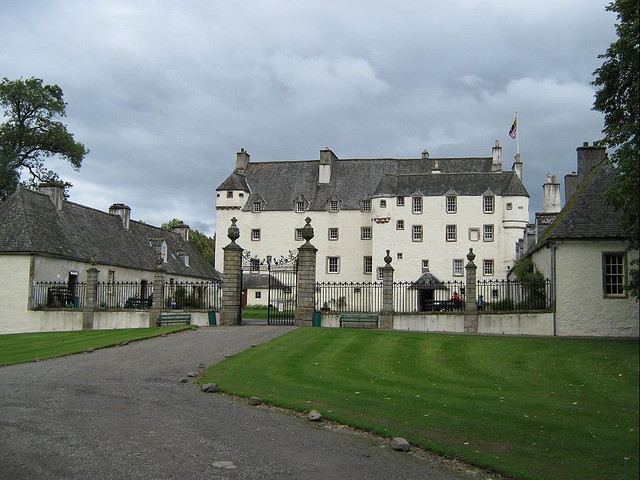
Fortified place · Medieval
Traquair House
Scottish Borders
Its Bear Gates have stood locked since the eighteenth century under a vow never to reopen them: a promise the family has kept for more than two hun…
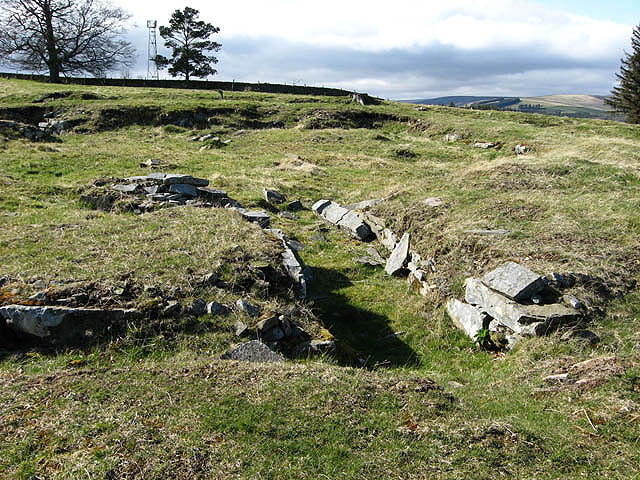
Fortified place · Iron Age
Torwoodlee Broch
Scottish Borders
Roman pottery, glass and a coin found packed inside its walls turn this collapsed tower into rare physical evidence of contact: hostile or looted:…
- Rough ground

Fortified place · Iron Age
Bow Castle Broch
Scottish Borders
One of only three brochs surviving in the Scottish Borders, and the only one to have yielded a Roman cockerel-shaped brooch alongside 2nd-century a…
- Rough ground
Fortified place · Roman
Oakwood Roman Fort and Camp
Scottish Borders
A cohort fort and the builders' camp that put it up, both found from the air in 1949: and abandoned because of a war on the Danube.
- Rough ground
The setting
Near Elibank Castle, about 16 metres away.
Photo: Jim Barton / Wikimedia Commons / CC BY-SA 2.0
Near Elibank Castle, about 16 metres away.
Photo: Jim Barton / Wikimedia Commons / CC BY-SA 2.0
Near Elibank Castle, about 18 metres away.
Photo: Walter Baxter / Wikimedia Commons / CC BY-SA 2.0
Near Elibank Castle, about 35 metres away.
Photo: Jim Barton / Wikimedia Commons / CC BY-SA 2.0
Questions people ask
- What kind of building is Elibank Castle?
- It is a ruined fortified house of the late 16th century, built as a defensible residence rather than a large medieval castle.
- Where is Elibank Castle?
- It stands south of the River Tweed and the A72, around 3km east of Walkerburn in the Scottish Borders.
- Who built Elibank Castle?
- Gideon Murray of Glenpoit built the castle around 1595 after acquiring the land in 1594, and gave it the name Elibank.
- Why are there terraces around the ruin?
- Gideon Murray, depute-treasurer in Scotland, laid out Italianate terraced gardens on three sides of the castle after the 1603 Union of the Crowns, among the grandest in Scotland.
- When did Elibank Castle fall into ruin?
- It was recorded as ruinous by 1722, having stood as a residence for little more than a century.
Sources
- Wikipedia: Elibank Castle
- Historic Environment Scotland — Scheduled Monument record
Explore more: Fortified places · Medieval · Scottish Borders
The Ancient Codex, in your pocket
Get the Pocket Codex app
Carry the directory with you — Elibank Castle and thousands of ancient places across Britain and Ireland, offline, wherever you roam.