Vinquoy is a restored Stone Age burial monument on Eday, built around a central chamber with four small side-cells and overlooking Calf Sound.
Whoever built this tomb chose the highest point on the island. Vinquoy chambered cairn stands on Vinquoy Hill on the north side of Eday, looking out over Calf Sound, and it can be seen from most of the northern half of the island — which is presumably the point.
It is a Maeshowe-type cairn, meaning a central chamber with small cells opening off it rather than the stalled compartments found in the tombs of Rousay. This one has four side-cells reached from a chamber at the end of a five-metre entrance passage, and the chamber was originally roofed by corbelling, courses of stone stepped inward until they closed.
The cairn is about eighteen metres across and three high, built of red sandstone rather than the grey flagstone used on the Orkney Mainland, and it is partly cut into the hill rather than raised entirely on top of it. That colour makes it look quite unlike the tombs most visitors will have seen elsewhere in Orkney.
It was first opened in 1857, when James Farrer and the landowner Robert Fraser Hebden dug down into the chamber through the top of the mound. That was the standard antiquarian method and among the most destructive available: it removes the stratigraphy that would date the tomb. Hebden had bought his Eday estate in 1850, and the Society of Antiquaries of Scotland recorded in 1878 that he made considerable antiquarian researches across the island at his own expense, though little of interest was reported found despite the property abounding in ancient tumuli.
Historic Environment Scotland scheduled the site in 1936. It is open to the public and forms part of the Eday Heritage Trail, which is the reason a small tomb on a remote hill is maintained at all.
What follows is drawn from published sources, with each claim labelled by how firmly it is established.
History
Vinquoy chambered cairn stands on Vinquoy Hill on the north side of Eday in Orkney, on the highest ground on the island, overlooking Calf Sound. It is a Maeshowe-type tomb and probably dates to the early third millennium BC. Height matters for a tomb, and this one is visible from most of the northern half of Eday. It measures about eighteen metres in diameter and three metres high, and it was built of red sandstone — the local rock, which gives the monument a colour quite different from the grey flagstone tombs of the Orkney Mainland. Colour is not a trivial difference when the tomb is the most conspicuous thing on a hillside.
A five-metre entrance passage runs in to a central chamber with four small side-cells opening off it. That plan, a chamber with cells around it, is what defines the Maeshowe type and separates it from the stalled cairns found elsewhere in Orkney. Six spaces inside one small cairn is a great deal of subdivision. The cairn is partly below ground, carved into the hill rather than raised entirely on top of it, and the central chamber originally had a corbelled roof — courses of stone stepped inward until they met. Corbelling is the only roofing technique available to builders without timber long enough to span a chamber.
James Farrer and the landowner Robert Fraser Hebden first excavated it in 1857 by digging into the chamber through the top of the mound, which was the standard antiquarian approach and among the most destructive. Digging in through the roof destroys the stratigraphy that would date the tomb. Hebden had bought his Eday estate in 1850, and according to the journal of the Society of Antiquaries of Scotland for 1878 he made considerable antiquarian researches across the island at his own expense — though the property abounded in ancient tumuli, little of interest was reported found.
Historic Environment Scotland scheduled the site in 1936. It is open to the public and forms part of the Eday Heritage Trail. A heritage trail is a modern imposition on a Neolithic monument, and it is also why the cairn is maintained at all.
People
-
James Farrer
Antiquarian who excavated Vinquoy through the mound’s top in 1857 with landowner Robert Fraser Hebden.
-
Robert Fraser Hebden
Eday landowner who excavated Vinquoy with James Farrer in 1857 and funded wider antiquarian research on the island.
Cultural influences
-
The red-sandstone Maeshowe-type cairn uses a central chamber with four side-cells and a corbelled roof.
Connections
-
Eday
Vinquoy stands on Vinquoy Hill on Eday’s highest ground, making the red-sandstone cairn visible across much of the island’s north.
-
Calf Sound
The tomb overlooks Calf Sound from Vinquoy Hill, a view that explains the prominence of its elevated position.
-
Eday Heritage Trail
Vinquoy is maintained as a stop on the Eday Heritage Trail and is open to the public as a scheduled monument.
Discovery & excavation
James Farrer and Robert Fraser Hebden excavated the cairn in 1857 by entering through the top of the mound.
What to look for
-
Built on the island's highest point
The tomb stands on Vinquoy Hill on the north side of Eday, overlooking Calf Sound — the highest ground on the island.
-
Maeshowe design in red sandstone
It is a Maeshowe-type tomb, 18 metres across and 3 metres high, built of red sandstone, with a 5-metre entrance passage to a central chamber and four side-cells.
-
Cut into the hill
The cairn is partly below ground, carved into the slope, and the central chamber originally had a corbelled roof.
-
Dug through the top in 1857
James Farrer and the landowner Robert Fraser Hebden broke into the chamber through the top of the mound in 1857.
Plan your visit
- Location
- 59.2273°N · 2.7725°W
- Nearest settlement
- Eday
- Access
- Open access
- Terrain
- Moderate walking
- Time needed
- About 30 minutes
- Best time
- Daylight hours
- What survives
- The cairn remains a partly sunken red-sandstone mound with its passage, chamber and side-cells on Vinquoy Hill.
Opening & admission
No managed admission arrangement is published; confirm access locally before travelling.
- The cairn stands on Vinquoy Hill on Eday and is included in the island’s heritage trail. Conditions on the hill can change quickly in poor weather.
Nearby places

Tomb or burial place · Prehistoric
Huntersquoy chambered cairn
Orkney Islands
An exceptionally rare two-storey tomb, its opposed entrances and flooded lower chamber reveal two burial spaces stacked within one small Eday mound.
- Easy path

Sacred place · Prehistoric
Stone of Setter
Orkney Islands
A Late Neolithic standing stone on the island of Eday.
- Near Eday
- Easy path

Tomb or burial place · Prehistoric
Quoyness Chambered Cairn
Orkney Islands
A tomb mistaken for a broch until 1867, holding at least ten adults and possibly four children in a stone-lined cist: a box grave built of slabs: w…
- Near Sanday
- 20 min walk from car park
- Easy path
Ancient place · Prehistoric
Rinyo
Orkney Islands
A settlement of the first farming age on Rousay, discovered in the winter of 1937.
- Near Rousay
- Some walking
The setting
Stone rubble and the trig point on Vinquoy Hill above the chambered cairn.
Photo: Rude Health / Wikimedia Commons / CC BY-SA 2.0
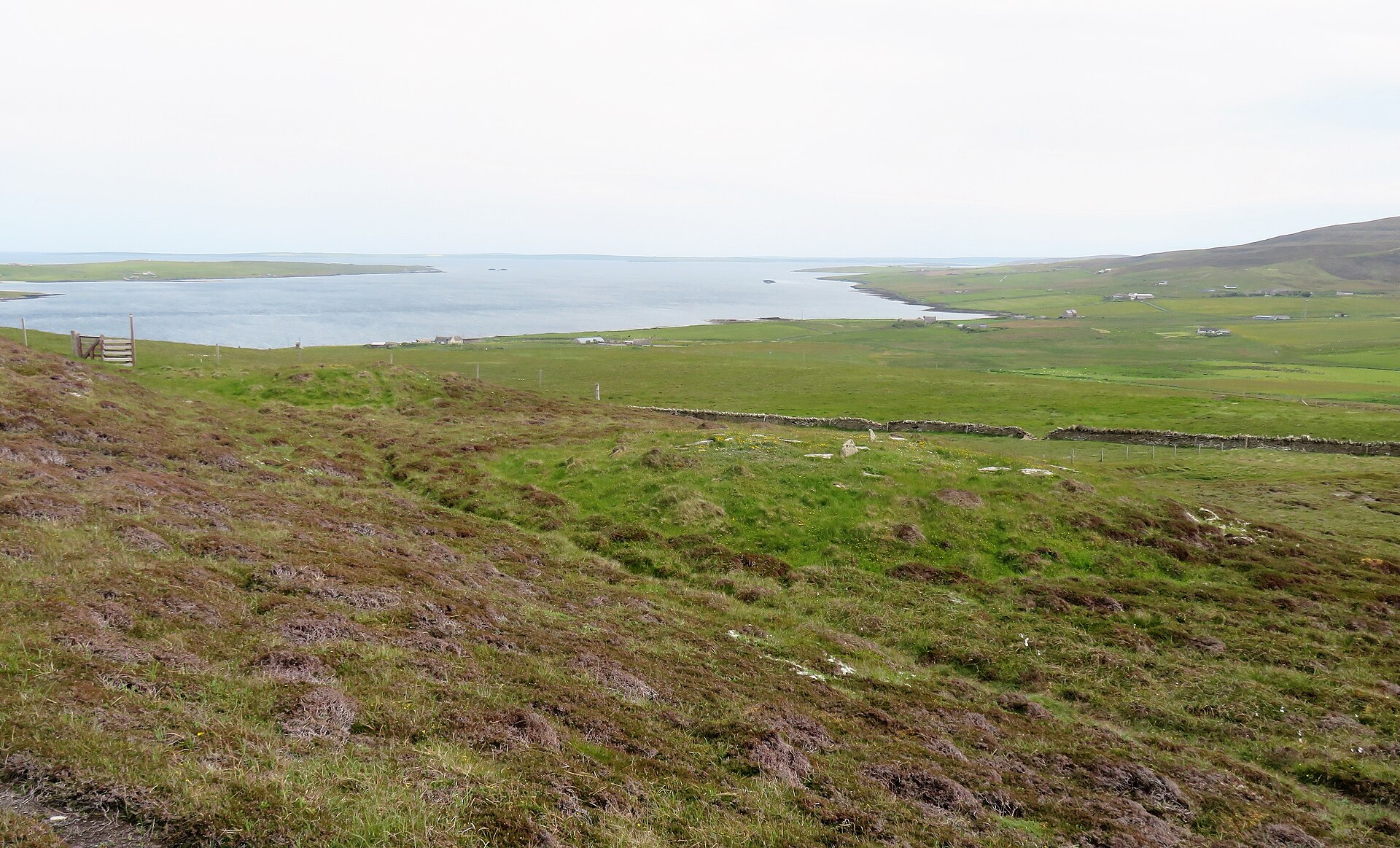
The hillside and sea view north from Vinquoy Hill towards Calf Sound and Red Head.
Photo: Colin Park / Wikimedia Commons / CC BY-SA 2.0
Questions people ask
- Why is Vinquoy chambered cairn significant?
- It is a Maeshowe-type tomb built of local red sandstone, which sets it apart in colour from the grey flagstone cairns of the Orkney Mainland, and it occupies the highest ground on Eday.
- What should a reader focus on?
- The plan inside. A five-metre passage runs to a central chamber with four small side-cells opening off it, which is what distinguishes a Maeshowe-type tomb from the stalled cairns found elsewhere in Orkney.
- How certain is the interpretation?
- The tomb type and the early third-millennium BC date rest on its architecture. The cairn has been restored, so not everything visible is original fabric.
Sources
The Ancient Codex, in your pocket
Get the Pocket Codex app
Carry the directory with you — Vinquoy chambered cairn and thousands of ancient places across Britain and Ireland, offline, wherever you roam.