
A tomb mistaken for a broch until 1867, holding at least ten adults and possibly four children in a stone-lined cist — a box grave built of slabs — with finds echoing Portugal and Spain.
Until 1867 Quoyness was thought to be a broch. James Farrer and George Petrie dug it that year and established that it was a chambered cairn instead — and found, in the south corner of the primary chamber, a stone-lined cist, a grave box built of slabs, holding the remains of at least ten adults and possibly four children. More bone lay in the side cells and in the entrance passage. Farrer left most of it where it was.
The tomb sits on the Elsness peninsula on Sanday, a large oval cairn of the Maeshowe type built probably around 3000 BC. It stands on a wide oval stone platform, kerbed at the south and west, and was raised as a concentric ring of stones — now visible, because the earth and turf that once covered it are gone. A passage nine metres long runs in from the south-east to a rectangular chamber about four metres by two, with six small corbelled cells opening off it. The walls still standing reach almost four metres.
The original roof has gone. Three lintel slabs at the south end make a roof there, though they may not belong to the cairn, and a small trench crosses the clay floor from the entrance to the north wall. A modern roof covers the monument now, and it is open.
The other finds are what widen the picture: animal bone, stone tools, pottery, two spiked slate objects and a large bone pin with a knob on its shank. The stone objects resembled material from western Scotland, Wales, Portugal and Spain — a range reaching down the western coasts rather than a local one.
Gordon Childe supervised a second excavation in 1951 and 1952, and the monument was then partly restored and reconstructed so that its successive stages of building could be seen. Historic Environment Scotland scheduled it in 1994.
What follows is drawn from published sources, with each claim labelled by how firmly it is established.
History
Quoyness chambered cairn is a Neolithic burial monument on the Elsness peninsula on Sanday, in Orkney. It is a large oval cairn of the Maeshowe type, similar in design to Maeshowe itself, and was probably built around 3000 BC. It is in the care of Historic Environment Scotland as a scheduled monument. The cairn stands on a wide oval stone platform and was built of stones, earth and waste material intermixed with horizontal slabs, with a stone kerb round the platform at the south and west ends. It was raised as a concentric ring of stones, now visible, and would originally have been covered with earth and turf.
The entrance passage is nine metres long, on the south-eastern side, and leads into the main chamber. That chamber is rectangular, about four metres by two, with six small corbelled cells opening off it, and the standing walls reach almost four metres. The tomb has lost its original roof. Three lintel slabs at the south end form a roof there, though they may not be original to the cairn, and a small trench runs across the clay floor of the burial chamber from the entrance to the north wall. A modern roof has since been added and the monument is open to the public.
James Farrer and George Petrie excavated the cairn in 1867. The site had been believed to be a broch; the excavation established that it was a chambered cairn instead. In the south corner of the primary chamber they found a stone-lined cist holding the remains of at least ten adults and possibly four children, with further remains in the side cells and the entrance passage. Farrer left most of the human bone in the chamber.
Other finds included animal bones, stone tools, sherds of pottery, two spiked slate objects and a large bone pin with a knob on the shank. The stone objects resembled finds from western Scotland, Wales, Portugal and Spain, which places the tomb in a far wider context than a purely local one. Gordon Childe supervised a second excavation in 1951 and 1952, after which the monument was partially restored and reconstructed to display the different stages in which it had been built. Historic Environment Scotland scheduled it in 1994.
People
-
James Farrer
Antiquarian who excavated Quoyness with George Petrie in 1867, establishing that the supposed broch was a chambered cairn.
-
George Petrie
Antiquarian who excavated Quoyness with James Farrer in 1867 and helped identify its Neolithic chambered-cairn plan.
-
V. Gordon Childe
Archaeologist who supervised the 1951–52 re-excavation and partial reconstruction showing the tomb’s building stages.
Cultural influences
-
Maeshowe-type chambered cairn tradition — a tall, steep-sided central chamber off which open small corbelled cells, the most elaborate Orkney cairn form, here built from a mix of stone, earth and waste material with horizontal slabs.
Connections
-
Maeshowe
Quoyness is a Maeshowe-type cairn: its long entrance passage, central chamber and corbelled side cells closely follow the named monument’s design.
-
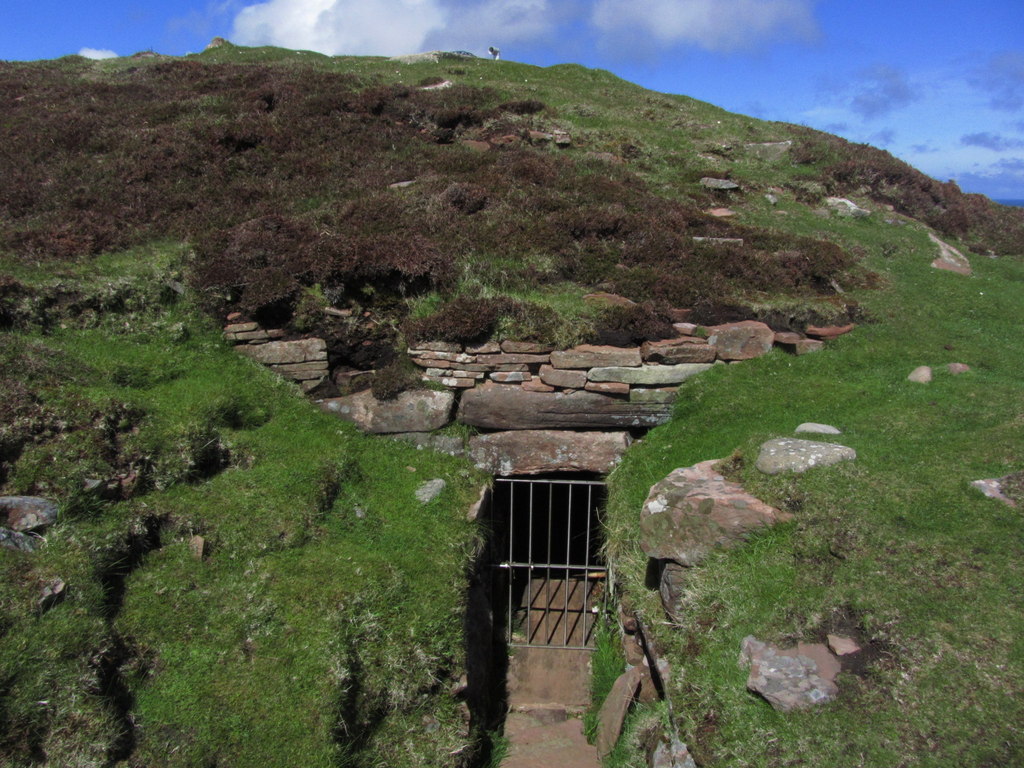
Photo: Colin Park / Wikimedia Commons / CC BY-SA 2.0 Both are Orkney chambered cairns built around a central chamber with side cells, although Vinquoy’s four cells differ from Quoyness’s six.
Discovery & excavation
James Farrer and George Petrie excavated the cairn in 1867, having first taken the site for a broch before identifying it as a chambered cairn. A stone-lined cist in the south corner of the primary chamber held the skeletal remains of at least ten adults and possibly four children, with further remains in the side cells and entrance passage; Farrer left most of the human bones in the chamber. Other finds included animal bones, stone tools, pottery sherds, two spiked slate objects and a large knobbed bone pin — the stone objects resembling finds from western Scotland, Wales, Portugal and Spain. V. Gordon Childe led a second excavation in 1951–1952.
What to look for
-
The nine-metre passage
On the south-eastern side, leading into the main chamber — a long approach for a chamber four metres by two.
-
The six side cells
Corbelled cells opening off the main chamber, several of which held human remains.
-
The standing walls
Almost four metres high, though the original roof is gone; a modern one now covers the tomb.
-
The concentric ring
The cairn was built as a ring of stones, now visible, and was originally covered with earth and turf.
-
The reconstruction
The partial restoration after Childe's excavation was designed to show the tomb's successive stages of construction.
Plan your visit
- Location
- 59.2256°N · 2.5682°W
- Nearest settlement
- Sanday
- Access
- Open access
- Terrain
- Easy going
- Parking
- Parking available nearby — see the official getting-here page.
- Start point
- On the island of Sanday on the southern point of Els Ness, 2.5m from Kettlehoft village. Reached via Orkney Ferries Ltd from Kirkwall, tel: 01856 872044. · Access to the chambers is by crawling and can be wet.
- Time needed
- About 45 minutes
- Best time
- Open year-round.
- What survives
- A roofed chambered cairn with standing walls, a long entrance passage and visible concentric construction rings.
- Facilities
- No dedicated visitor facilities are documented at the cairn; plan to use facilities in nearby settlements.
- Start point
- Parking area north of Quoyayre, Sanday (coastal path to cairn)
Opening & admission
Free entry
- Open year-round.
Nearby places
Tomb or burial place · Prehistoric
Scar boat burial
Orkney Islands
A Viking boat burial on Sanday, dating from between 875 and 950.
- Near Sanday
- Some walking

Sacred place · Prehistoric
Stone of Setter
Orkney Islands
A Late Neolithic standing stone on the island of Eday.
- Near Eday
- Easy path

Tomb or burial place · Prehistoric
Huntersquoy chambered cairn
Orkney Islands
An exceptionally rare two-storey tomb, its opposed entrances and flooded lower chamber reveal two burial spaces stacked within one small Eday mound.
- Easy path

Tomb or burial place · Prehistoric
Vinquoy chambered cairn
Orkney Islands
Vinquoy is a restored Stone Age burial monument on Eday, built around a central chamber with four small side-cells and overlooking Calf Sound.
- Near Eday
- Some walking
Sources
- Canmore site record 3395 (accessed 2026-06-13)
- Trove (HES) record (accessed 2026-06-13)
- Wikipedia: Quoyness chambered cairn (accessed 2026-06-13)
- Wikidata Q7272906 (accessed 2026-06-13)
Explore more: Tomb or burial places · Prehistoric · Orkney Islands
The Ancient Codex, in your pocket
Get the Pocket Codex app
Carry the directory with you — Quoyness Chambered Cairn and thousands of ancient places across Britain and Ireland, offline, wherever you roam.