
An exceptionally rare two-storey tomb, its opposed entrances and flooded lower chamber reveal two burial spaces stacked within one small Eday mound.
Two burial chambers are stacked vertically inside this mound, and they face opposite directions. The lower entrance runs east and downhill; the upper runs west and uphill. A double-storied tomb of this kind is rare enough in Britain that Huntersquoy is worth the trip to Eday on that ground alone.
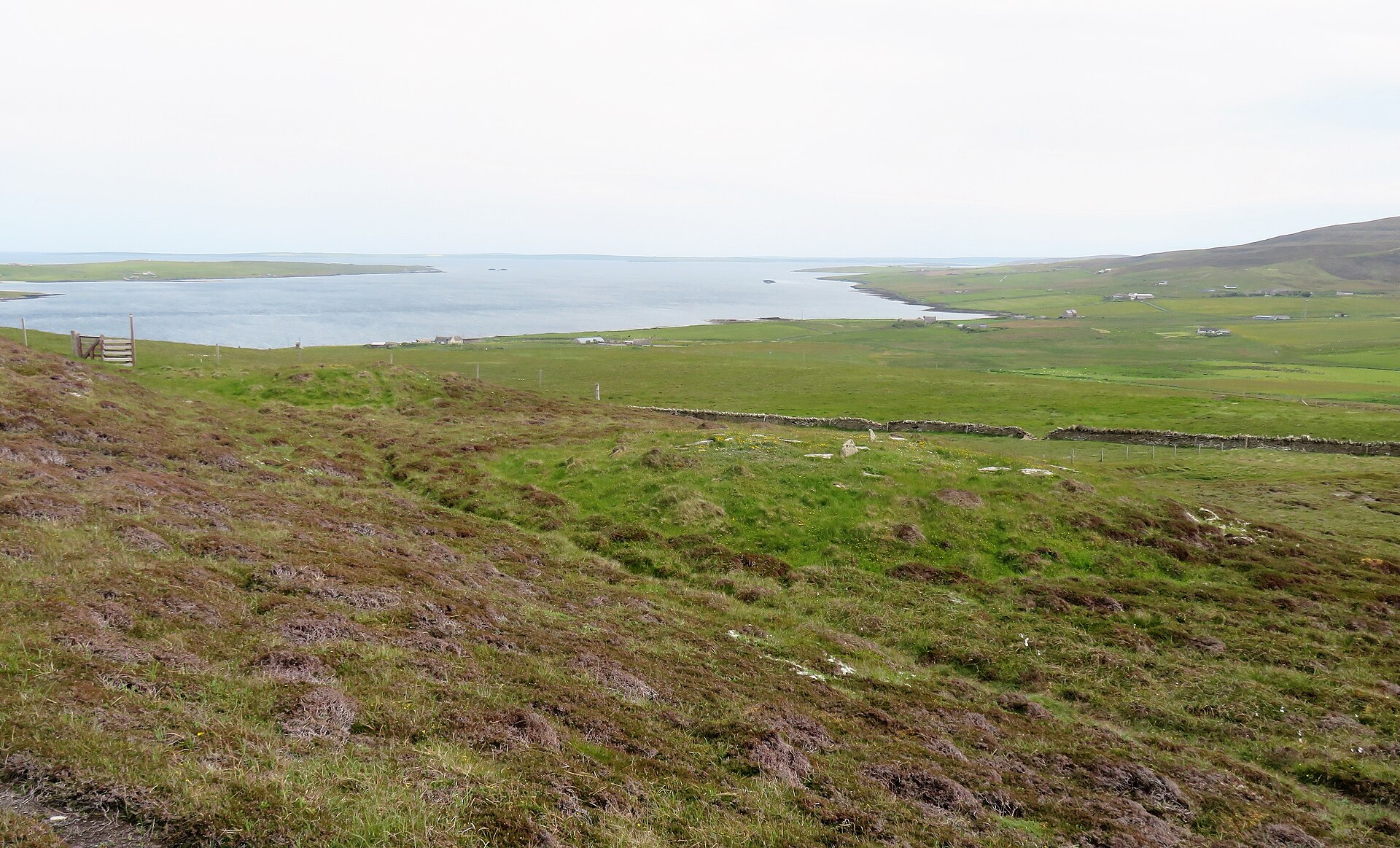
From outside there is very little to see — a small circular mound ten metres across and sixty centimetres high, on a gentle slope above Calf Sound. It is a Neolithic cairn of the Orkney–Cromarty type, from the third millennium BC, and tombs of that class are usually called stalled cairns after the upright stones that divide the central passage into compartments.
The two chambers have fared very differently. The lower one, of Bookan type, is intact and below ground, roofed with enormous flat lintels laid across it. The upper one, at ground level, is in ruins; part of it had been built directly on top of the lower chamber’s roof slabs. It was originally rectangular, aligned west to east, and probably divided into three compartments.
Getting into the lower chamber is possible but not comfortable. The passage is unobstructed and often flooded, and its height of 1.75 metres at the entrance falls away quickly as it runs in.
The cairn was already ruinous when it was first excavated in 1936, the year Historic Environment Scotland scheduled it. Two years later the landowner, Major H. Hebden of Carrick House, gave the finds to the National Museum of Antiquities of Scotland.
What follows is drawn from published sources, with each claim labelled by how firmly it is established.
History
Huntersquoy is a Neolithic chambered cairn on the island of Eday in Orkney, dating from the third millennium BC and of the Orkney–Cromarty type. Those tombs are often called stalled cairns, from the central passage edged with upright stones that divides the space into separate compartments. What makes this one rare is that it has two storeys. The cairn contains two overlying chambers, one above the other, and a double-storied burial monument of this kind is very unusual anywhere in Britain.
The two chambers have fared very differently. The Bookan-type lower chamber is intact and lies below ground; the upper chamber, at ground level, is in ruins, and very little of it survives at all — which is the ordinary fate of anything left exposed on an Orkney hillside. They also face opposite ways. The lower chamber's entrance passage faces east and downhill, and the upper passage faces west and uphill — two separate approaches to a single mound, arranged so that neither interferes with the other.
The lower passage is unobstructed but frequently flooded. At its entrance the height is 1.75 metres, and it drops away rapidly as the passage runs inward, so getting to the chamber means stooping progressively lower into standing water. The lower chamber was roofed with enormous flat lintels laid straight across it, and part of the upper chamber was then built directly on top of those roof slabs. The upper chamber was originally rectangular, aligned west to east, and was most likely divided into three compartments.
From outside it is easy to walk past. The whole monument reads as a small, unobtrusive circular mound, ten metres across and sixty centimetres high, sitting on a gently sloping hill that overlooks Calf Sound. It was first excavated in 1936, by which time the cairn was already in ruins, and Historic Environment Scotland scheduled it in the same year. Finds from the tomb were given to the National Museum of Antiquities of Scotland in 1938 by the landowner, Major H. Hebden of Carrick House on Eday.
People
-
Major H. Hebden
Landowner who donated the 1936 excavation finds to the National Museum of Antiquities of Scotland in 1938.
Cultural influences
-
Huntersquoy is a stalled chambered cairn of the third millennium BC, divided by upright slabs into burial compartments.
Connections
-

Photo: Rob Burke / Wikimedia Commons / CC BY-SA 2.0 Eday
Huntersquoy chambered cairn is located on the island of Eday.
-

Photo: No machine-readable author provided. Ericbobson assumed (based on copyright claims). / Wikimedia Commons / Public domain Calf Sound
Huntersquoy chambered cairn overlooks Calf Sound.
-

Photo: Rob Burke / Wikimedia Commons / CC BY-SA 2.0 Carrick House
Finds from Huntersquoy chambered cairn were donated to the National Museum by Major H. Hebden of Carrick House, Eday.
Discovery & excavation
The cairn was excavated in 1936, when it was already ruinous and its lower chamber was found intact beneath the mound.
What to look for
-
Two-storey tomb
A lower chamber lies below an upper chamber, with entrances facing east downhill and west uphill.
-
Flooded lower passage
The lower entrance passage is often flooded and drops rapidly in height toward the chamber.
-
Lintel roof
Enormous flat slabs roof the intact lower chamber.
Plan your visit
- Location
- 59.2241°N · 2.7680°W
- Access
- Open access
- Terrain
- Easy going
- Time needed
- About 30 minutes
- Best time
- Daylight hours
- What survives
- A low ten-metre mound contains an intact subterranean lower chamber; the upper ground-level chamber is largely ruined.
Opening & admission
No operator-published admission details are currently available; confirm access locally before travelling.
- The scheduled tomb stands on Eday above Calf Sound. Its low entrance passage is frequently flooded and drops sharply in height toward the intact lower chamber.
Nearby places

Tomb or burial place · Prehistoric
Vinquoy chambered cairn
Orkney Islands
Vinquoy is a restored Stone Age burial monument on Eday, built around a central chamber with four small side-cells and overlooking Calf Sound.
- Near Eday
- Some walking

Sacred place · Prehistoric
Stone of Setter
Orkney Islands
A Late Neolithic standing stone on the island of Eday.
- Near Eday
- Easy path

Tomb or burial place · Prehistoric
Quoyness Chambered Cairn
Orkney Islands
A tomb mistaken for a broch until 1867, holding at least ten adults and possibly four children in a stone-lined cist: a box grave built of slabs: w…
- Near Sanday
- 20 min walk from car park
- Easy path
Ancient place · Prehistoric
Rinyo
Orkney Islands
A settlement of the first farming age on Rousay, discovered in the winter of 1937.
- Near Rousay
- Some walking
Questions people ask
- What makes Huntersquoy unusual?
- It is a rare double-storied burial monument — two overlying chambers, one above the other, with separate entrance passages facing opposite ways.
- What condition are the chambers in?
- The lower chamber, of Bookan type, is intact and below ground. The upper chamber, at ground level, is in ruins and very little of it survives.
- Can it be entered?
- The lower passage is unobstructed but often flooded. Its height at the entrance is 1.75 metres and drops rapidly as the passage runs inward.
- How old is it?
- Third millennium BC. It is an Orkney–Cromarty type chambered cairn, first excavated in 1936 and scheduled in the same year.
Sources
The Ancient Codex, in your pocket
Get the Pocket Codex app
Carry the directory with you — Huntersquoy chambered cairn and thousands of ancient places across Britain and Ireland, offline, wherever you roam.