A Viking boat burial on Sanday, dating from between 875 and 950.
A farmer on Sanday found bones sticking out of a beach in 1985 and thought he had come across a drowned sailor. John Dearness also picked up a small lead object, and he died before anyone worked out what either meant.
It took until 1991. Julie Gibson, the Orkney county archaeologist, heard about the bones six years after the event, was shown the lead object and carried it to Kirkwall, where it was identified as a weight for measuring bullion. That single find changed the reading of the site entirely, and Gibson and Raymond Lamb went back to look properly.
What they found was eroding fast. Historic Scotland put together a team under the Norwegian specialist Magnar Dalland and excavated through November and December — a winter dig on an exposed Orkney beach, done at that pace because the sea was taking it.
The boat had rotted away completely. More than three hundred iron rivets marked out a vessel 6.5 metres long and 1.5 wide, laid into a boat-shaped enclosure lined with stone and then packed with more stone. Inside the boat was a further walled enclosure, and inside that lay three people: a man, an elderly woman and a child, buried between 875 and 950 AD with a considerable quantity of grave goods.
What follows is drawn from published sources, with each claim labelled by how firmly it is established.
History
The Scar boat burial is a Viking boat burial on Sanday in Orkney, dating to between 875 and 950 AD. It held the remains of a man, an elderly woman and a child, together with numerous grave goods. Three people in one boat is a rich and unusual burial by any Norse standard. It was found by accident. John Dearness, a farmer on Sanday, came across bones protruding from the ground at The Crook Beach a kilometre north-east of Scar in 1985, along with a small lead object, and supposed he had found the resting place of a drowned sailor.
Dearness died before the significance of what he had found was understood. That is a recurring shape in Orkney archaeology — a farmer notices something, and the identification arrives years later, sometimes too late for the finder. Six years passed between the finding and the identification, and the finder did not live to hear it. The lead object settled it. Julie Gibson, the Orkney county archaeologist, visited the island in 1991 having heard about the bones six years earlier, took the object to Kirkwall, and it was identified as a lead weight for measuring bullion.
Gibson and Dr Raymond Lamb investigated further and found the site exposed and eroding rapidly. Historic Scotland assembled a team under the Norwegian specialist Magnar Dalland, and the excavation was carried out through November and December 1991 — a winter dig against the sea. The boat itself had gone. Its timber had rotted entirely, leaving more than three hundred iron rivets to mark a vessel 6.5 metres long and 1.5 wide, laid in a boat-shaped stone-lined enclosure that had then been packed with further stones. Rivets are all that normally survives a clinker-built boat left in the ground for a thousand years.
Inside the boat was a second walled enclosure of stones, and the three bodies were found within it — a burial deliberately built in layers, boat inside stone, chamber inside boat.
People
-
John Dearness
Sanday farmer who found exposed bones and a lead object at The Crook Beach in 1985, before the burial was identified.
-
Julie Gibson
Orkney county archaeologist who took the lead object to Kirkwall in 1991, where it was recognised as a bullion weight.
-
Magnar Dalland
Norwegian specialist who led the Historic Scotland rescue excavation through November and December 1991.
Cultural influences
-
The stone-lined boat burial held a man, an elderly woman and a child with grave goods, dating from about 875 to 950.
Connections
-

Photo: Callum Black / Wikimedia Commons / CC BY-SA 2.0 The boat burial and chambered cairn represent different funerary traditions in Orkney, spanning prehistoric burial architecture and a later maritime burial.
-
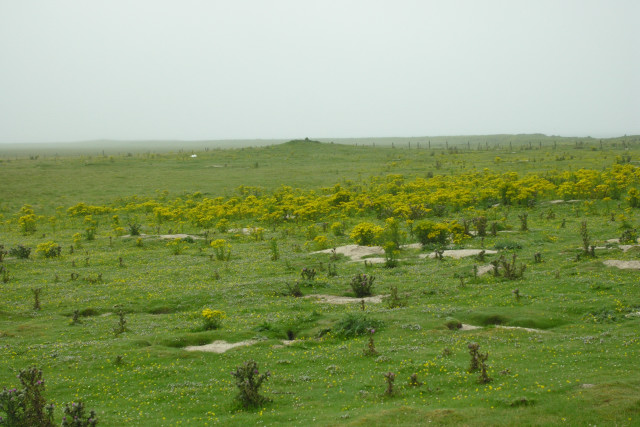
Photo: George Brown / Wikimedia Commons / CC BY-SA 2.0 Both are archaeological sites in Orkney’s coastal landscape, where erosion continues to reveal evidence of past occupation.
-

Photo: Rob Burke / Wikimedia Commons / CC BY-SA 2.0 The burial and broch belong to the wider North Ronaldsay and Orkney island sequence of prehistoric and Iron Age coastal settlement.
Discovery & excavation
John Dearness found bones and a lead object exposed at The Crook Beach in 1985; rapid coastal erosion led to excavation in November and December 1991.
What to look for
-
Three people in one boat
The burial held a man, an elderly woman and a child, laid together with numerous grave goods, and dates to between 875 and 950 AD.
-
The lead weight that identified it
The farmer John Dearness found bones and a small lead object in 1985 and thought he had found a drowned sailor. Six years later it was identified in Kirkwall as a lead weight for measuring bullion, which is what prompted the excavation.
-
An excavation against the sea
The site at The Crook Beach was exposed and eroding fast. A team under the Norwegian archaeologist Magnar Dalland dug it in November and December 1991 because there was no prospect of a second chance.
Plan your visit
- Location
- 59.2978°N · 2.5679°W
- Nearest settlement
- Sanday
- Access
- Open access
- Terrain
- Moderate walking
- Time needed
- About 20 minutes
- Best time
- Daylight hours
- What survives
- No boat timber survived, but more than 300 iron rivets marked a vessel about 6.5 metres long within its stone-lined enclosure.
Opening & admission
No reliable current admission details are recorded; verify before travelling.
Nearby places

Tomb or burial place · Prehistoric
Quoyness Chambered Cairn
Orkney Islands
A tomb mistaken for a broch until 1867, holding at least ten adults and possibly four children in a stone-lined cist: a box grave built of slabs: w…
- Near Sanday
- 20 min walk from car park
- Easy path
Ancient place · Prehistoric
Tofts Ness
Orkney Islands
Tofts Ness is a Sanday peninsula with ancient mounds, cairns, enclosures and structural remains, alongside evidence of later shipwrecks.
- Near Sanday
- Some walking

Fortified place · Iron Age
Broch of Burrian
Orkney Islands
The Broch of Burrian is a tall circular tower of unmortared stone, a type of building found only in Scotland, on the rocky shore of North Ronaldsay.
- Rough ground

Tomb or burial place · Prehistoric
Huntersquoy chambered cairn
Orkney Islands
An exceptionally rare two-storey tomb, its opposed entrances and flooded lower chamber reveal two burial spaces stacked within one small Eday mound.
- Easy path
Questions people ask
- Who was buried at Scar?
- A man, an elderly woman and a child, with numerous grave goods. The burial dates to between 875 and 950 AD.
- How was it found?
- John Dearness, a farmer on Sanday, found bones and a small lead object protruding from The Crook Beach in 1985 and thought he had found a drowned sailor. He died before the site's significance was understood.
- What identified it as a Viking burial?
- The lead object. In 1991 the county archaeologist Julie Gibson took it to Kirkwall, where it was identified as a lead weight for measuring bullion.
- Why was the excavation so rushed?
- The site was exposed and eroding rapidly. Historic Scotland assembled a team under Magnar Dalland and dug it through November and December 1991.
- Is any of the boat left?
- No timber. More than three hundred iron rivets survive, marking a vessel 6.5 metres by 1.5 laid in a boat-shaped stone-lined enclosure packed with further stones.
Sources
The Ancient Codex, in your pocket
Get the Pocket Codex app
Carry the directory with you — Scar boat burial and thousands of ancient places across Britain and Ireland, offline, wherever you roam.