
On 21 June 1919 the interned German High Seas Fleet went to the bottom of Scapa Flow on its own orders. Rear Admiral Ludwig von Reuter believed the British meant to seize his ships that day, the deadline for Germany to sign the Treaty of Versailles; he did not know the deadline had been extended by two days. That morning the British fleet sailed out to conduct training manoeuvres, and at 11:20 Reuter transmitted the order to scuttle. SMS Seydlitz slipped beneath the surface at 13:50.
She was a battlecruiser of the Kaiserliche Marine, built at Hamburg, ordered in 1910 and commissioned in May 1913 — the fourth built for the High Seas Fleet, named after Friedrich Wilhelm von Seydlitz, and the culmination of the first German generation that had begun with Von der Tann in 1906. She carried a redesigned propulsion system and an improved armour layout and displaced 24,988 tonnes, roughly 3,000 more than the Moltke-class ships before her.
Two engagements defined her. At Dogger Bank in January 1915 a 13.5-inch shell from the British battlecruiser Lion struck her rearmost turret and came very close to setting off a magazine explosion that would have destroyed the ship. The German navy responded with new safety measures across the fleet — and at Jutland, on 31 May 1916, those measures saved her. She was hit twenty-one times by heavy shells; one penetrated the working chamber of the aft superfiring turret and the fire destroyed the turret, but not the ship. She was torpedoed in the same action, took in over 5,300 tonnes of water, and lost freeboard to 2.5 metres.
She was not only a target. Early in the same battle, salvos from Seydlitz and Derfflinger destroyed the British battlecruiser Queen Mary in seconds.
Getting her home took three days and very nearly failed. Both gyro-compasses had gone, so the light cruiser Pillau was sent to guide her. By the afternoon of 1 June her bow was almost completely submerged, the only buoyancy left forward being the broadside torpedo room; she was turned about and steamed astern to take pressure off the strained bulkheads in the flooded bow, and preparations were being made to evacuate the wounded when a pair of pump steamers reached her and stabilised the flooding. She limped into the outer Jade on the morning of 2 June, having taken on at most 5,308 tonnes of water.
There had been other damage before that. In August 1915 she went to the Baltic with Moltke and Von der Tann to screen the German attempt on the Gulf of Riga, keeping Russian reinforcements away rather than fighting herself. In April 1916, off Norderney, she struck a mine that tore a fifteen-metre hole in her hull just abaft the starboard broadside torpedo tube; eleven men were killed, 1,400 short tons of water came aboard, and she was out of service for over a month.
After the scuttling she lay on her side on the bottom in 22 metres of water, and was frequently mistaken for a small island. In that condition she was sold as scrap to the salvage firm of Cox and Danks, run by Ernest Cox, along with a battleship and twenty-six destroyers. Raising her proved awkward and then faintly ridiculous. She sank again during the first attempt, wrecking most of the salvage equipment. Cox tried once more, arranging for news cameras to be present when she came up — a plan that nearly backfired when she was accidentally refloated while he was holidaying in Switzerland. Cox told the workers to sink her again and came back to Britain to be there when she was raised for a third time.
She was raised on 2 November 1928 and towed south, still inverted, to be broken up at Rosyth by 1930. Her bell is on display at the Laboe Naval Memorial, and one of her 15 cm guns, taken off in 1916, was mounted aboard the commerce raider Kormoran in the next war.
What follows is drawn from published sources, with each claim labelled by how firmly it is established.
History
SMS Seydlitz was a battlecruiser of the German Kaiserliche Marine, built at Hamburg, ordered in 1910 and commissioned in May 1913 — the fourth battlecruiser built for the High Seas Fleet, named after Friedrich Wilhelm von Seydlitz. She represented the culmination of the first generation of German battlecruisers that had begun with Von der Tann in 1906, with a redesigned propulsion system, an improved armour layout, and a displacement of 24,988 tonnes, some 3,000 tonnes heavier than the Moltke class before her.
She fought at Dogger Bank in January 1915, where a 13.5-inch shell from the British battlecruiser Lion struck her rearmost turret and very nearly caused a magazine explosion that would have destroyed the ship. The safety measures imposed across the German fleet after that near-miss are the reason she survived what happened at Jutland.
At Jutland on 31 May 1916 she was hit twenty-one times by large-calibre shells, one of which penetrated the working chamber of the aft superfiring turret. The resulting fire destroyed the turret; the post-Dogger Bank precautions prevented a catastrophe. She was also torpedoed, taking in over 5,300 tonnes of water and losing freeboard to 2.5 metres, and had to be lightened significantly to cross the Jade Bar. She gave as well as she took. Early in that battle, salvos from Seydlitz and the battlecruiser Derfflinger destroyed the British battlecruiser Queen Mary in seconds.
Getting home took three days. Both gyro-compasses failed and the light cruiser Pillau was sent to guide her; by the afternoon of 1 June her bow was nearly submerged and the only remaining buoyancy forward was the broadside torpedo room. She was turned around and steamed astern to relieve pressure on the strained bulkheads, and two pump steamers arriving alongside stabilised the flooding. She had taken on at most 5,308 tonnes of water.
In August 1915 she had been transferred with Moltke and Von der Tann to the Baltic, screening the German force that attempted to clear the Gulf of Riga. Her role there was to keep Russian reinforcements out of the operation rather than to fight. In April 1916 she struck a mine off Norderney which tore a fifteen-metre hole in her hull just abaft the starboard broadside torpedo tube. Eleven men were killed and 1,400 short tons of water entered the ship, and she was out of service for over a month.
Like the rest of the German battlecruisers that survived the war, she was interned at Scapa Flow in 1918. The fleet remained in captivity through the negotiations that produced the Treaty of Versailles. Rear Admiral Ludwig von Reuter believed the British intended to seize the German ships on 21 June 1919, the deadline for Germany to sign the treaty. He did not know the deadline had been extended by two days. On the morning of 21 June the British fleet left Scapa Flow to conduct training manoeuvres, and at 11:20 Reuter transmitted the order to scuttle. Seydlitz slipped beneath the surface at 13:50.
She came to rest on her side on the bottom in 22 metres of water and was frequently mistaken for a small island. In that condition she was sold as scrap to the salvage firm of Cox and Danks, led by Ernest Cox, along with a battleship and twenty-six destroyers.
Raising her was difficult and became a small piece of theatre. She sank again during the first attempt, wrecking most of the salvage equipment. Cox tried again and arranged for news cameras to be present at the moment of success; the plan nearly failed when she was accidentally refloated while he was on holiday in Switzerland, whereupon he told the workers to sink her again and returned to Britain to be there when she was raised a third time.
She was raised on 2 November 1928 and towed south, still inverted, to be scrapped at Rosyth by 1930. Her bell is on display at the Laboe Naval Memorial, and one of her 15 cm guns, removed in 1916, was later mounted aboard the commerce raider Kormoran during the Second World War.
What to look for
-
The date on the seabed
21 June 1919 — the day Reuter, wrongly believing the treaty deadline had passed, ordered the interned High Seas Fleet scuttled. Seydlitz went under at 13:50.
-
The island that was a battlecruiser
She settled on her side in 22 metres of water and was frequently mistaken for a small island before salvage began.
-
The Cox and Danks salvage
Ernest Cox bought her as scrap along with a battleship and twenty-six destroyers. She sank again on the first attempt, wrecking most of the equipment, and was finally raised on 2 November 1928.
-
What survives ashore
Her bell is at the Laboe Naval Memorial, and one of her 15 cm guns, removed in 1916, was later mounted aboard the commerce raider Kormoran.
Plan your visit
- Location
- General area near Orkney Islands, Orkney Islands
This is a sensitive or fragile site, so we show only its general area. Please check official heritage sources for access before visiting, and take care not to disturb it.
Nearby places

Sacred place · Prehistoric
Orphir Round Church
Orkney Islands
Orphir Round Church preserves the remains of a circular medieval church dedicated to Saint Nicholas.
- Easy path
Tomb or burial place · Prehistoric
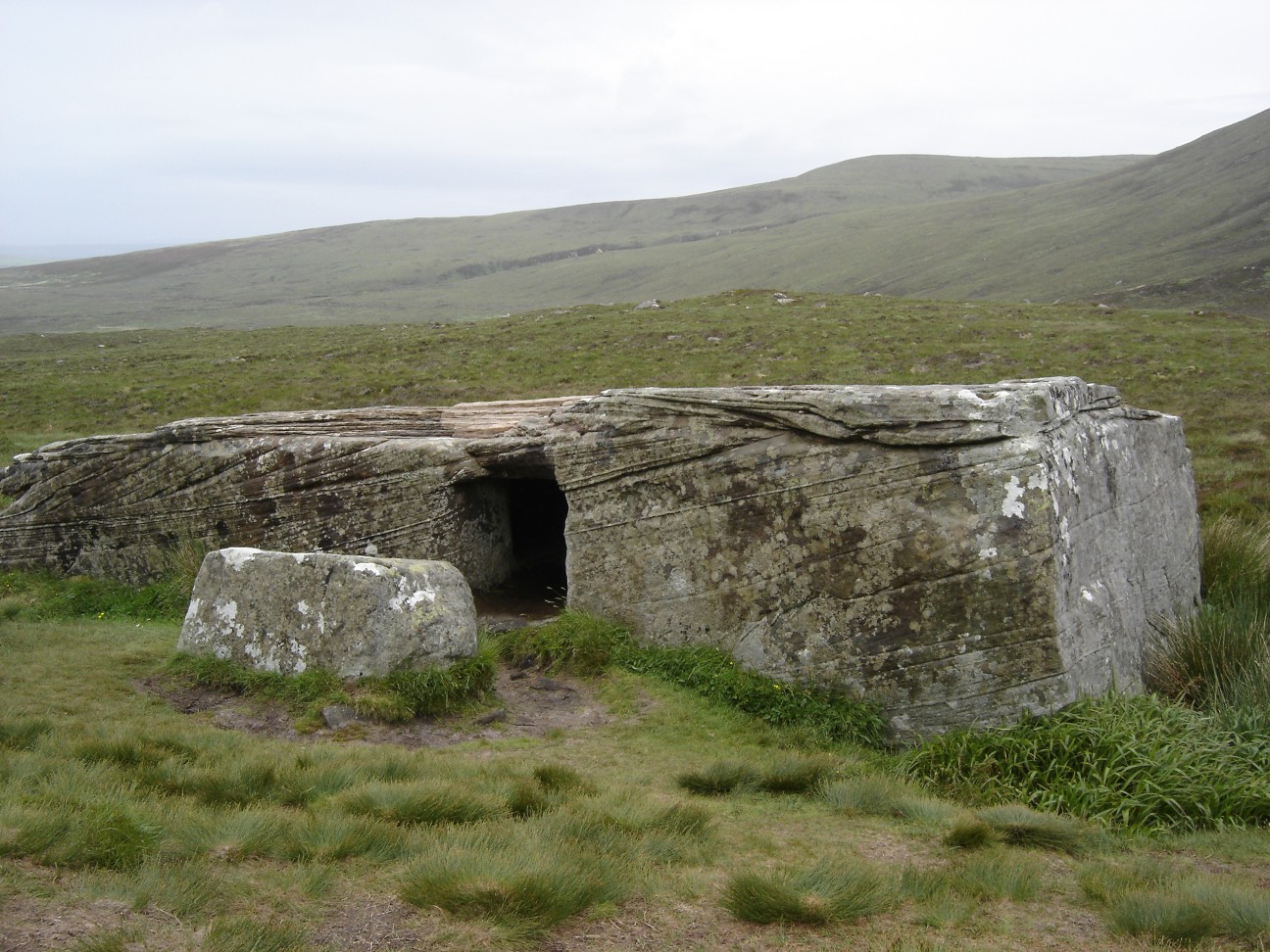
Dwarfie Stane
Orkney Islands
A chamber tomb carved out of a single glacial erratic of Old Red Sandstone, in a steep valley on Hoy.
- Near Rackwick
- 8 min walk from car park
- Easy path

Tomb or burial place · Prehistoric
Unstan Chambered Cairn
Orkney Islands
Twenty to thirty bowls were put in here, most of them already broken and already used: one sherd carried the impression of a barley grain.
- Near Stenness
- 2 min walk from car park
- Easy path
Questions people ask
- What was SMS Seydlitz?
- A battlecruiser of the German Kaiserliche Marine, built at Hamburg, ordered in 1910 and commissioned in May 1913. She was the fourth battlecruiser built for the High Seas Fleet and the culmination of the first German generation, heavier than the Moltke class before her by about 3,000 tonnes.
- What saved her at Jutland?
- Precautions taken after Dogger Bank. In January 1915 a shell from the British battlecruiser Lion had struck her rearmost turret and nearly caused a magazine explosion; the safety measures imposed afterwards meant that when a shell penetrated her aft superfiring turret at Jutland the fire destroyed the turret without destroying the ship.
- Why was the fleet scuttled?
- Rear Admiral Ludwig von Reuter believed the British intended to seize the interned German ships on 21 June 1919, the deadline for Germany to sign the Treaty of Versailles. He was unaware the deadline had been extended by two days. With the British fleet away on training manoeuvres he gave the order at 11:20, and Seydlitz went under at 13:50.
- Was she left on the bottom?
- No. She lay on her side in 22 metres of water, often mistaken for a small island, and was sold as scrap to Cox and Danks. After sinking again on the first salvage attempt she was raised on 2 November 1928 and towed inverted to Rosyth, where she was scrapped by 1930.
The Ancient Codex, in your pocket
Get the Pocket Codex app
Carry the directory with you — SMS Seydlitz / German fleet wrecks and thousands of ancient places across Britain and Ireland, offline, wherever you roam.