Orphir Round Church preserves the remains of a circular medieval church dedicated to Saint Nicholas.
This church was built as a penance for murder, and then rededicated to the man who was murdered.
Jarl Haakon Paulsson, Earl of Orkney from 1103 to 1123, is thought to have raised the round kirk at Orphir after killing his cousin and co-ruler Magnus Erlendsson. The Orkneyinga saga records that Haakon took sole power in 1117 following the killing; Magnus was later canonised, and the church Haakon had built in expiation was rededicated to St Magnus.
Its shape came from Jerusalem. Round churches imitate the Holy Sepulchre, and the form spread through northern Europe with crusaders trying to reproduce what they had seen. Orphir is the oldest surviving example in Scotland — the only other medieval round church in the country is at Roxburgh, on the English border. What was built here was a circular nave about six metres across with a barrel-vaulted semicircular apse on the east side and a window in the middle of it, inside walls a metre thick.
The saga mentions a large drinking-hall with a magnificent church beside it, and the hall is still there: the Earl’s Bu, with an eleventh-century Norse horizontal watermill alongside.
Almost the entire church stood until 1757, when most of it was taken down to build a new parish kirk. That replacement has since been demolished too. What survives is the apse and a fragment of the nave wall, protected as a scheduled monument since 2014 and in the care of Historic Environment Scotland.
What follows is drawn from published sources, with each claim labelled by how firmly it is established.
History
The Orphir Round Church, also called the Round Kirk or St Nicholas's Church, stands in Orphir parish on the Orkney Mainland. It is the oldest surviving round church in Scotland, and the only other medieval one is at Roxburgh near the English border. A round church anywhere in Britain is rare; two in one country is nearly the whole national supply. It consisted of a circular nave about six metres across with a semicircular, barrel-vaulted apse on the eastern side carrying a central window. The walls are a metre thick. Those dimensions make it a small building by any standard, and its interest lies entirely in its shape and its story.
The design was borrowed from Jerusalem. Round churches imitated the Church of the Holy Sepulchre, and the form became popular with returning crusaders attempting to reproduce the building they had seen. Very few of those imitations survive anywhere in northern Europe. It is thought to have been built by Jarl Haakon Paulsson, Earl of Orkney from 1103 to 1123, as penance for murdering his cousin and co-ruler Magnus Erlendsson — later Saint Magnus — in the late eleventh or early twelfth century. Penance on that scale was a normal instrument of twelfth-century politics as well as of conscience.
The Orkneyinga saga records that Haakon took sole power in 1117 after the killing, and the round kirk was afterwards rededicated to St Magnus. A church built in penance for a murder, then rededicated to the murdered man, is an unusually complete circle. The saga is the principal source for all of it, and it is a source with its own interests.
The saga also describes a large drinking-hall with a magnificent church nearby. The remains of that hall, known as the Earl's Bu, can still be seen alongside an eleventh-century Norse horizontal watermill. A hall, a mill and a church together give an unusually complete picture of a Norse earl's establishment.
Almost the whole church survived until 1757, when most of it was pulled down to provide stone for a new parish kirk — which has itself since been demolished. Only the apse and a small segment of the nave wall now remain. Robbing a church for the stone to build its replacement was ordinary practice, and it is why so little medieval fabric survives in Orkney. The site is in the care of Historic Environment Scotland, open to the public, and protected as a scheduled monument, a designation applied to it in 2014. What is left is a fragment, but it is the oldest fragment of its kind in the country.
People
-
Haakon Paulsson
Earl of Orkney from 1103 to 1123, associated with building the church as penance for killing Magnus Erlendsson.
-
Magnus Erlendsson
Haakon’s cousin and co-ruler, later Saint Magnus, to whom the church was rededicated after his killing.
Cultural influences
-
The circular plan imitates the Church of the Holy Sepulchre and reflects a form adopted by crusaders in northern Europe.
Connections
-
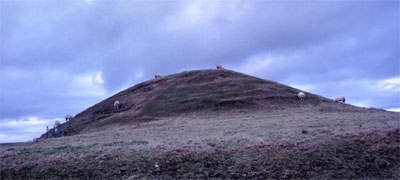
Photo: Otter at Dutch Wikipedia (Original text: Hopmans) / Wikimedia Commons / CC BY-SA 3.0 Maeshowe is a Neolithic chambered tomb in Orkney’s World Heritage landscape; Orphir Round Church is a much later Norse-period Christian monument, together marking the long succession of ceremonial architecture on Mainland Orkney.
-
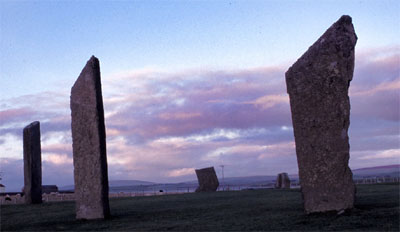
Photo: Otter at Dutch Wikipedia (Original text: Hopmans) / Wikimedia Commons / CC BY-SA 3.0 Stones of Stenness Circle and Henge
The Stones of Stenness represent the Neolithic ceremonial landscape of Mainland Orkney, while Orphir’s round church and Earl’s Bu record the Norse and medieval administration that later occupied the same island.
-

Photo: Otter / Wikimedia Commons / CC BY-SA 3.0 Barnhouse is a Neolithic settlement close to the Stenness monuments. Orphir Round Church provides a medieval counterpart in Orkney’s broader archaeological sequence, linking domestic and sacred sites from different periods.
What to look for
-
Round nave
The surviving curve belongs to a circular nave about six metres across, an exceptionally rare medieval church form in Scotland.
-
Eastern apse
The semicircular eastern apse retains its barrel vault and central window within walls about a metre thick.
-
Earl’s Bu and mill
Beside the church are the Earl’s Bu hall remains and an eleventh-century Norse horizontal watermill.
Plan your visit
- Location
- 58.9220°N · 3.1567°W
- Access
- Open access
- Terrain
- Easy going
- Time needed
- About 20 minutes
- Best time
- Daylight hours
- What survives
- Only the barrel-vaulted apse and a short section of the circular nave wall remain after most of the church was demolished in 1757.
Opening & admission
Free to visit and open year-round.
- Historic Environment Scotland cares for the church and nearby Earl’s Bu. Check its official page for any temporary access restrictions.
Nearby places
Tomb or burial place · Prehistoric
Maeshowe Chambered Cairn
Orkney Islands
The burial mound was built around 2800 BC by farming communities of central Orkney and contains a stone chamber associated with the Grooved Ware po…
- Near Stenness
- 1.6 km from car park
- Easy path
Sacred place · Prehistoric
Stones of Stenness Circle and Henge
Orkney Islands
An ancient monument five miles north-east of Stromness that may be the oldest circular enclosure in the British Isles.
- Near Stenness
- 2 min walk from car park
- Easy path

Settlement · Prehistoric
Barnhouse Settlement
Orkney Islands
A settlement of the first farming age on the shore of the Loch of Harray, close to the Standing Stones of Stenness.
- Easy path
The setting
Sheep pasture beside Orphir Round Church.
Photo: Ymblanter / Wikimedia Commons / CC BY-SA 4.0
Questions people ask
- Why was it built?
- As penance. Jarl Haakon Paulsson, Earl of Orkney from 1103 to 1123, is thought to have raised it after murdering his cousin and co-ruler Magnus Erlendsson, who was later canonised as St Magnus. The church was afterwards rededicated to him.
- Why is it round?
- The design imitates the Church of the Holy Sepulchre in Jerusalem. Round churches became popular with returning crusaders trying to reproduce that building.
- Is it the only one in Scotland?
- It is the oldest surviving round church in Scotland. The only other medieval example is at Roxburgh, near the English border.
- What happened to the rest of it?
- Almost the whole church stood until 1757, when most was demolished to provide stone for a new parish kirk — which has itself since been demolished. Only the apse and a small segment of nave wall survive.
- What else is on the site?
- The Earl's Bu, the remains of the large drinking-hall the Orkneyinga saga describes beside the church, and an eleventh-century Norse horizontal watermill.
Sources
The Ancient Codex, in your pocket
Get the Pocket Codex app
Carry the directory with you — Orphir Round Church and thousands of ancient places across Britain and Ireland, offline, wherever you roam.