
Blackhammer Chambered Cairn preserves a Neolithic, the late Stone Age, burial monument dating from roughly 4000–2500 BC, on Rousay in Orkney.
The masonry either side of the entrance is laid in triangles. It is decoration, on a tomb, and it is a Rousay habit — the Neolithic builders of this one island finished their cairns that way, and it is among the clearest evidence that they were working to a convention they shared with each other rather than inventing each tomb afresh.
Blackhammer was raised around 3000 BC near the base of a hillside above Eynhallow Sound. It is a stalled cairn of the Orkney-Cromarty type: an oblong mound, 22.5 metres by 8.9, enclosing a single long chamber divided into compartments by pairs of upright slabs set like stalls. Seven compartments were built. By the time the tomb was excavated in 1936, four of the dividing slabs had gone.
What came out of it was modest — two adult men, a pottery bowl, a flint knife, a polished stone axe, some animal bones. A chamber 13.5 metres long with seven stalls was built for more than two people, and there is no way now to recover what became of the others.
Higher up the same hill is the Knowe of Yarso, built at the same period, so the slope carried two tombs at once. Blackhammer was scheduled in 1994, and is entered today through a modern concrete roof.
What follows is drawn from published sources, with each claim labelled by how firmly it is established.
History
The cairn was built around 3000 BC on the island of Rousay, near the foot of a hillside looking out over Eynhallow Sound. It belongs to the Orkney-Cromarty group of chambered tombs, whose distinguishing feature is a burial chamber divided into compartments by pairs of upright stone slabs — stalls, hence the term stalled cairn. The tomb is oblong, 22.5 metres by 8.9 externally, enclosing a chamber 13.5 metres long, 2 metres wide and 2 metres high. It was first excavated in 1936, when it was established that there had originally been seven compartments; four of the dividing slabs had already been removed by that time.
The excavation recovered the skeletal remains of two adult men, together with a pottery bowl, a flint knife, a polished stone axe and animal bones. For a tomb of this size and this many compartments, two individuals is a small return, and what happened to the rest is not recoverable. On the outside, to either side of the entrance, the masonry is laid in a decorative triangular pattern. That treatment is characteristic of the Neolithic tombs of Rousay specifically, and it is one of the clearest signs that these builders were working to a shared local convention.
The Knowe of Yarso chambered cairn stands higher up the same hill and was built in the same period, so the two tombs were in use together, one above the other on the same slope. Historic Environment Scotland scheduled Blackhammer in 1994. The tomb is now entered through a modern concrete roof.
Cultural influences
-
Blackhammer is a stalled cairn, divided into burial compartments by pairs of upright slabs.
-
The cairn shares a hillside with the contemporary Knowe of Yarso tomb.
Connections
-

Photo: MichaelMaggs / Wikimedia Commons / CC BY-SA 4.0 Knowe of Yarso chambered cairn
Blackhammer and Knowe of Yarso are Neolithic stalled cairns on Rousay, two of the island’s funerary monuments that served small farming communities over long periods.
-
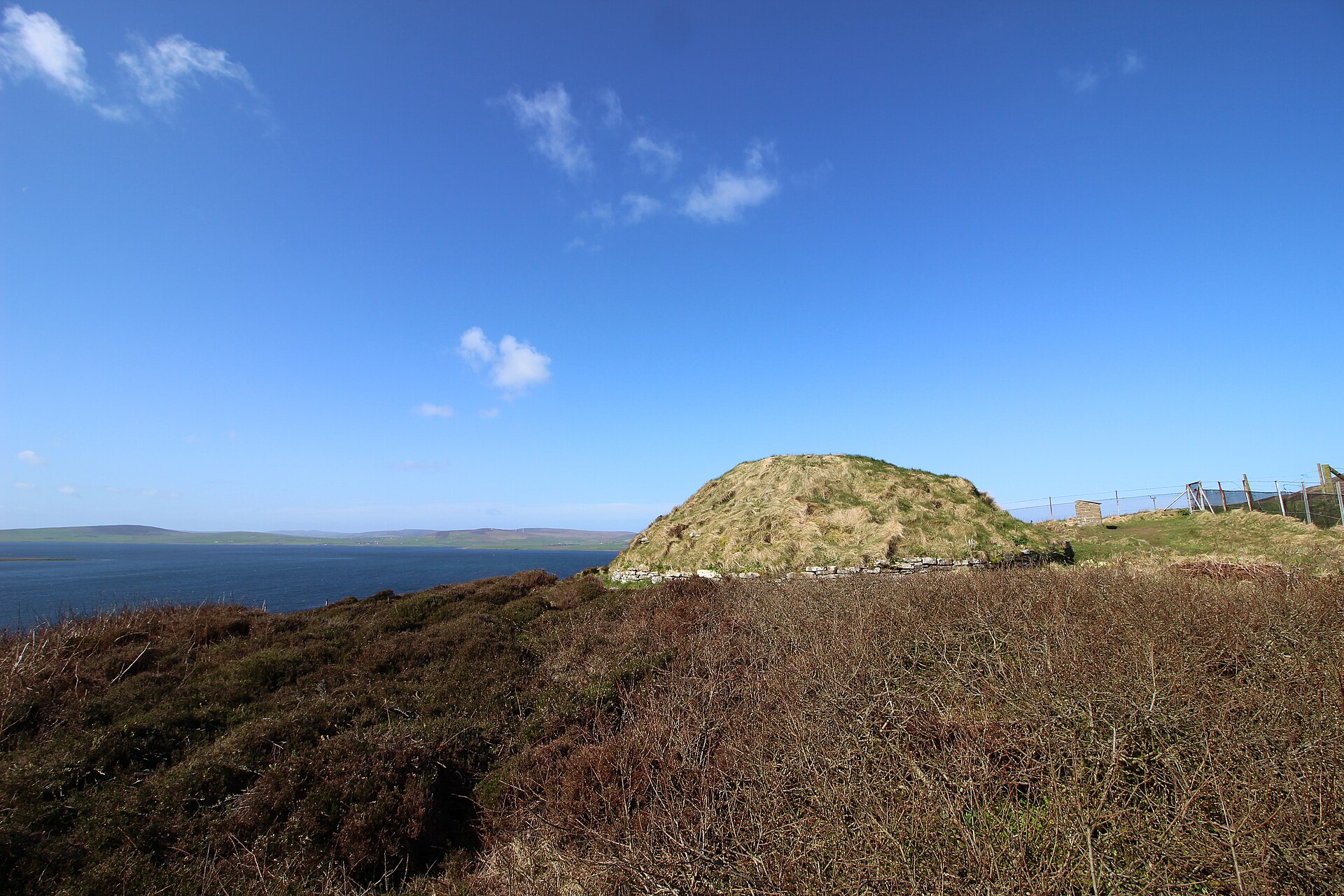
Photo: Beep boop beep / Wikimedia Commons / CC BY-SA 4.0 Another Rousay chambered cairn, just over a kilometre from Blackhammer, linking two monuments within the island’s Neolithic cemetery landscape.
-
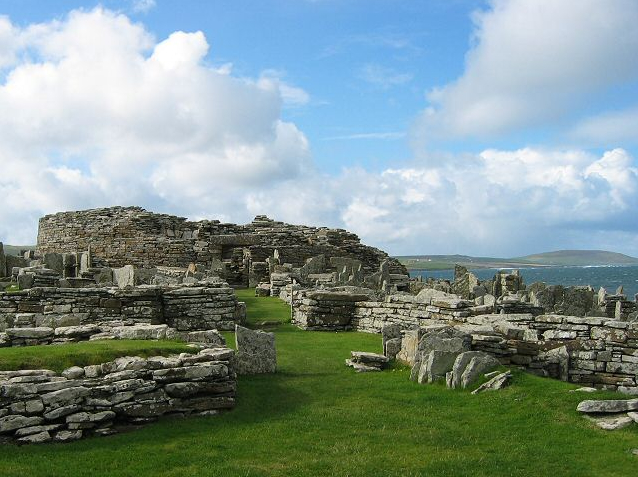
Photo: Rob Burke / Wikimedia Commons / CC BY-SA 2.0 Blackhammer’s Neolithic burial chamber and the Broch of Gurness represent very different prehistoric communities in Orkney: the cairn served collective burial, while the broch belongs to a later defended settlement tradition.
Discovery & excavation
The 1936 excavation found the remains of two adult men, a pottery bowl, flint knife, polished stone axe and animal bones.
What to look for
-
Stalled chamber
The 13.5-metre chamber originally contained seven compartments divided by upright stone slabs, a classic Rousay stalled-cairn arrangement.
-
Triangular entrance masonry
Decorative triangular stonework flanks the entrance, a distinctive Rousay treatment marking the chamber’s carefully built façade.
-
Modern roof
Visitors enter through a modern concrete roof, installed to protect the fragile stalled chamber below.
Plan your visit
- Location
- 59.1313°N · 3.0252°W
- Access
- Open access
- Terrain
- Moderate walking
- Time needed
- About 30 minutes
- Best time
- Daylight hours
- What survives
- The oblong cairn retains its long chamber, entrance decoration and surviving stalls, though four divisional slabs had been removed before excavation.
- Facilities
- No dedicated visitor facilities are documented at the cairn; plan to use facilities in nearby settlements.
Opening & admission
Free.
- Open all year round.
Nearby places

Tomb or burial place · Prehistoric
Knowe of Yarso chambered cairn
Orkney Islands
Knowe of Yarso preserves a burial mound built around a stone chamber, bringing together material remains and documented history that illuminate Ork…
- Rough ground
Tomb or burial place · Prehistoric
Taversöe Tuick
Orkney Islands
A burial mound on Rousay of about 4000–2500 BC, with a rare double-tiered chamber.
- Near Rousay
- Some walking
Settlement · Prehistoric
Broch of Gurness
Orkney Islands
The Broch of Gurness is a stone tower and settlement on the north-east coast of Mainland Orkney, overlooking Eynhallow Sound.
- Near Evie
- 141 metres from car park
- Some walking
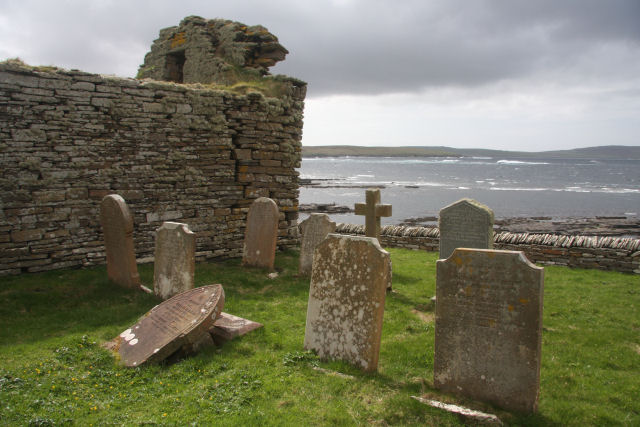
Ancient place · Prehistoric
Rousay
Orkney Islands
A small hilly island north of Mainland, whose density of remains has earned it a reputation of its own.
- Some walking
Questions people ask
- What kind of tomb is this?
- A stalled cairn of the Orkney-Cromarty group, whose distinguishing feature is a burial chamber divided into compartments by pairs of upright stone slabs. It was built around 3000 BC on Rousay, near the foot of a hillside looking over Eynhallow Sound.
- What did the excavation find?
- The 1936 excavation established seven original compartments, four of the dividing slabs having already been removed. It recovered the remains of two adult men with a pottery bowl, a flint knife, a polished stone axe and animal bones — a small return for a tomb of that size.
- What is unusual about the exterior?
- To either side of the entrance the masonry is laid in a decorative triangular pattern, a treatment characteristic of the Neolithic tombs of Rousay specifically and one of the clearest signs that these builders worked to a shared local convention.
Sources
- Canmore site 2645
- Wikipedia: Blackhammer Chambered Cairn
- Wikidata: Q880846
- Historic Environment Scotland scheduled monument SM90035 — Blackhammer,chambered cairn,Rousay (accessed 2026-08-03)
- Historic Environment Scotland — Blackhammer Chambered Cairn (accessed 2026-08-30)
Explore more: Tomb or burial places · Prehistoric · Orkney Islands
The Ancient Codex, in your pocket
Get the Pocket Codex app
Carry the directory with you — Blackhammer Chambered Cairn and thousands of ancient places across Britain and Ireland, offline, wherever you roam.