An incised hammer mark and a hole probably cut for the jougs — the iron collar in which offenders were chained — survive on a cross now standing in a mausoleum's burial ground.
A hole is cut through the shaft of this cross, and the listing’s judgement is that it was probably made for the jougs — the hinged iron collar that was locked round an offender’s neck and chained in a public place so that everyone passing could see who was in it. Beside it, incised into the stone, is a hammer. Neither mark is decorative. Together they place the shaft squarely in the working life of a burgh, where the cross was the point at which markets were licensed, proclamations read and punishments displayed.
The shaft is otherwise plain: tall and rectangular, its angles chamfered and stopped, rising from a simple square plinth to a small star-shaped finial with a hole through its centre.
What surrounds it now has nothing to do with markets. The Michael Kirk beside the cross was built in 1705 by Dame Elizabeth Dunbar as a mausoleum for her husband, Sir Robert Gordon of Gordonstoun, who had died the year before. It is a small three-bay Gothic church in ashlar, with elaborate Y-tracery in the pointed windows of the east and west gables, a south door whose reveals carry half-round and fillet moulding decorated with stars and roses, and a steeply pitched West Highland slate roof over flat moulded skews. The burial ground around it is walled, with low coped gatepiers to east and west; the western pair have seventeenth-century carved stone reused within them.
The parish this church served had already been dissolved. Ogstoun was united with Kineddar in 1669 to form the parish of Drainie, and Drainie built its own churches — one in 1673 and another by Gillespie Graham in 1821. The second was demolished in 1923. The mausoleum has outlasted both.
Its survival owes something to families who kept finding uses for it. Lady Florence Gordon Cumming restored it for her family to use during their summer residences at Gordonstoun, travelling from Altyre near Forres, and the Elgin Courant and Courier reported its re-consecration on 19 February 1901. John Kinross carried out the restoration and refurbished the interior across 1900 and 1901, panelling it throughout, and the altar was shifted to the west end to fit more seats into a small building.
Inside are mural memorials to Sir Robert Gordon — possibly carved by John Faid of Elgin — and to Gordons and Gordon Cummings before and after him. The kirk now serves as the chapel of Gordonstoun School, and remains in use as an ecclesiastical building in the charge of the Scottish Episcopal Church.
What follows is drawn from published sources, with each claim labelled by how firmly it is established.
History
The cross is of market-cross type — a tall rectangular shaft with chamfered and stopped angles, rising from a simple square stone plinth and finished with a small star-shaped finial pierced by a central hole. It is a plain object, its interest lying in the two working marks cut into it rather than in any ornament. An incised hammer mark is cut into the shaft, and there is a hole probably made for the jougs — the hinged iron collar fastened round an offender's neck and chained to a post or wall as a public punishment. Both features tie the stone to the practical business of a burgh rather than to ceremony.
The Michael Kirk beside it is dated 1705 and was built by Dame Elizabeth Dunbar as a mausoleum in memory of her husband, Sir Robert Gordon of Gordonstoun, who died in 1704. It is a small three-bay Gothic church in ashlar, with large pointed windows carrying elaborate Y-tracery in the east and west gables. The south door is flanked by windows, and its reveals carry half-round and fillet moulding decorated with stars and roses. A continuous string course drops beneath the sills, the skews are flat and moulded, and the steeply pitched roof is of West Highland slate with a stone ridge and apex.
The parish of Ogstoun was united with that of Kineddar in 1669 to form the parish of Drainie. Old Drainie Church followed in 1673 and a new Drainie Church, by Gillespie Graham, in 1821; the latter was demolished in 1923, so the Michael Kirk has outlived both of its successors. Lady Florence Gordon Cumming restored the building for her family's use during their summer residences at Gordonstoun, coming from Altyre near Forres. The Elgin Courant and Courier reported its re-consecration on 19 February 1901.
John Kinross restored the kirk and refurbished its interior in 1900 and 1901, panelling it throughout. The altar was moved to the west end of the church to increase the seating, which reversed the usual orientation for the sake of capacity. The interior holds various mural memorials, among them one to Sir Robert Gordon, who died in 1704 and for whom the building was raised — possibly carved by John Faid of Elgin — together with memorials to earlier and later Gordons and Gordon Cummings. The kirk is now used as the chapel for Gordonstoun School and remains in the charge of the Scottish Episcopal Church.
People
-
Dame Elizabeth Dunbar
Built the Michael Kirk in 1705 as a mausoleum in memory of her husband, Sir Robert Gordon of Gordonstoun.
-
Sir Robert Gordon of Gordonstoun
Died in 1704; the kirk was built in his memory and holds a mural memorial to him, possibly carved by John Faid of Elgin.
-
Lady Florence Gordon Cumming
Restored the building for her family's summer use at Gordonstoun, coming from Altyre near Forres.
-

Portrait: Stephencdickson / Wikimedia Commons / CC BY-SA 4.0 John Kinross
Architect of the 1900 to 1901 restoration and interior refurbishment, which panelled the kirk throughout.
Cultural influences
-
The cross’s hammer mark and probable jougs hole show how the stone was used in the public discipline and working life of the burgh.
-
Michael Kirk was built as the Gordon family mausoleum and later restored for the family’s summer residence.
Connections
-

Photo: No machine-readable author provided. Nibaba assumed (based on copyright claims). / Wikimedia Commons / CC BY-SA 3.0 Gordonstoun School
The Michael Kirk now serves as the school's chapel, having been built as a private mausoleum two centuries earlier.
-
Parish of Drainie
Ogstoun was united with Kineddar in 1669 to form Drainie; the churches built for the new parish in 1673 and 1821 have both since gone.
What to look for
-
The jougs hole
A hole cut in the cross shaft, probably to take the chain of the jougs — the iron neck collar used to hold an offender for public view.
-
The incised hammer mark
A hammer cut into the face of the shaft, a trade mark of the kind that occasionally appears on burgh crosses.
-
The star-shaped finial
A small star with a hole through its centre finishes the top of the shaft.
-
The reused seventeenth-century carving
The western gatepiers of the burial ground have seventeenth-century carved stone set into them, reused from elsewhere.
Plan your visit
- Location
- 57.7028°N · 3.3561°W
- Nearest settlement
- Elgin
- Access
- Visible from a public way
- Terrain
- Easy going
- Time needed
- About 20 minutes
- Best time
- Daylight, when the marks on the cross shaft and the kirk exterior are easiest to read.
- What survives
- The market cross and the 1705 Michael Kirk survive within the historic Gordonstoun burial-ground setting.
- Facilities
- No dedicated visitor facilities are documented at the cross and kirk; plan to use facilities in nearby settlements.
Opening & admission
- The cross is visible from the public way.
- Michael Kirk serves as Gordonstoun School’s chapel; access to the building is locally managed.
Nearby places

Fortified place · Medieval
Duffus Castle
Moray
Its stone tower still leans bodily off the earthen motte it was built on, frozen mid-collapse: a rare, visible lesson in why timber-age mounds made…
- Near Elgin
Fortified place · Medieval
Spynie Palace
Moray
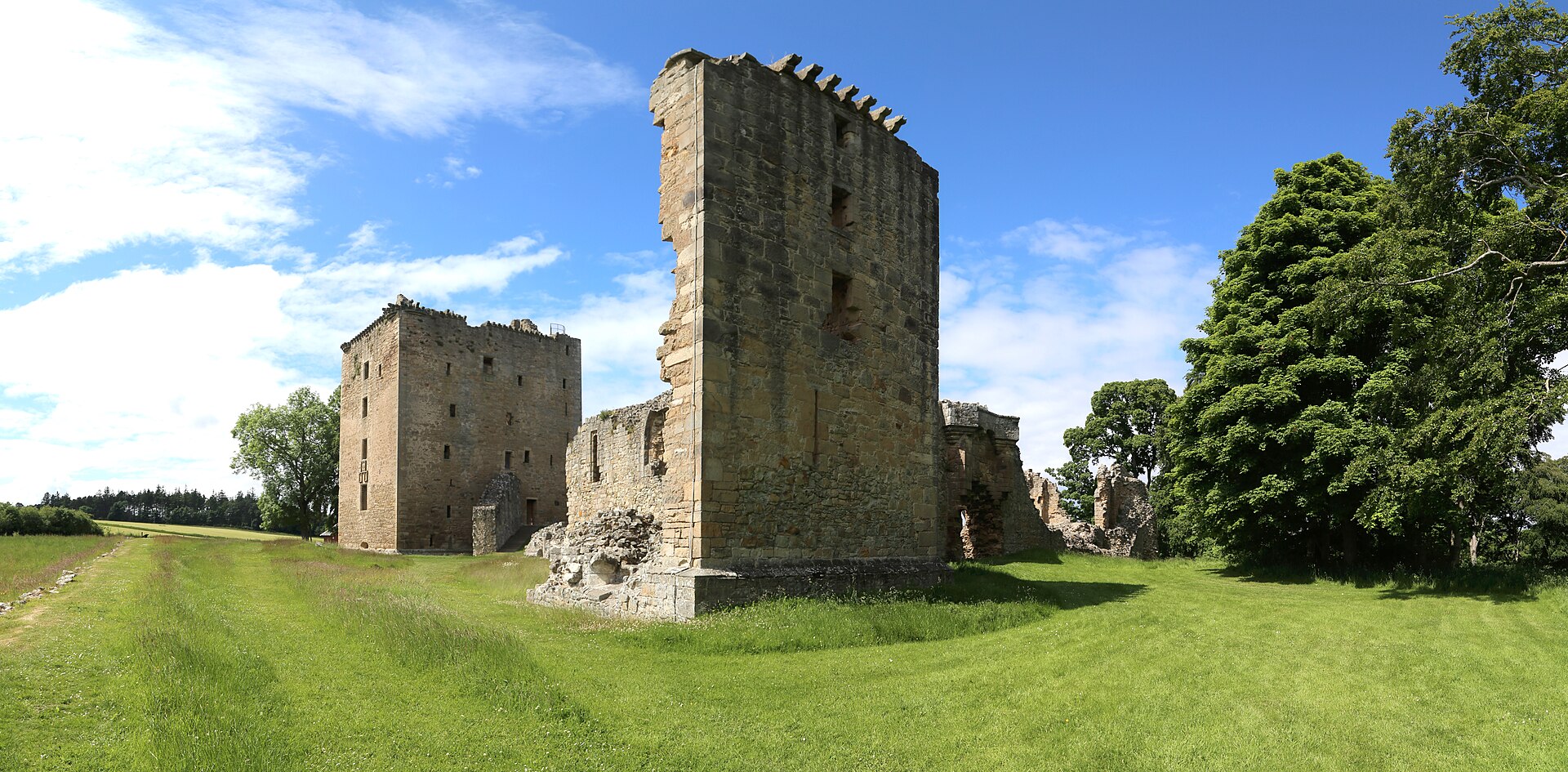
For roughly five hundred years this was the working seat of the Bishops of Moray, and its tower still stands as the largest medieval tower house in…
- Near Elgin
- Some walking

Sacred place · Prehistoric
Elgin Cathedral
Moray
Known as the Lantern of the North, it was Scotland's second-largest medieval cathedral and uniquely combined an English-style octagonal chapter hou…
- Near Elgin
- Easy path

Carved stone · Pictish & early medieval
Elgin Pillar
Moray
A tall granite Pictish (of the Picts, the people of northern and eastern Scotland from about AD 300 to 900) stone found buried beneath Elgin's old…
- Near Elgin
- Easy path
Questions people ask
- What are the jougs?
- A hinged iron collar locked round an offender's neck and chained to a post, wall or cross for public punishment. A hole in this shaft was probably cut to take one.
- Who built the Michael Kirk?
- Dame Elizabeth Dunbar, in 1705, as a mausoleum in memory of her husband Sir Robert Gordon of Gordonstoun, who had died the previous year.
- What is the building used for now?
- It serves as the chapel for Gordonstoun School and remains an ecclesiastical building in the charge of the Scottish Episcopal Church.
- Why is the altar at the west end?
- It was moved there to increase the seating available in a small three-bay church.
Sources
The Ancient Codex, in your pocket
Get the Pocket Codex app
Carry the directory with you — Ogston Market Cross, Michael Kirk, Gordonstoun and thousands of ancient places across Britain and Ireland, offline, wherever you roam.