
A broch excavated twice within four decades of Highland archaeology before being levelled entirely for a wartime runway — its erasure is now the clearest record of what once stood there.
Where a stone tower once rose between the villages of Killimster and North Killimster in Caithness, flat airfield ground stretches instead. Skitten Broch was levelled in the 1940s to make way for a runway, and nothing of its walls remains above ground today — the site survives only in excavation notes and old photographs, not in stone.
Like the broch towers raised across Caithness during the Iron Age, it was a drystone structure built centuries before written record reached the county. It drew the attention of antiquarians long after its builders were forgotten: first examined in 1904, then dug again in 1940 in the brief window before wartime construction swept it away.
The ground it once occupied did not fall quiet after the broch’s destruction. It became part of an operational airfield, and from that same stretch of Caithness a mission departed that would be remembered for very different reasons — a reminder that a single patch of ground can carry two entirely separate histories, one buried and one airborne.
What follows is drawn from published sources, with each claim labelled by how firmly it is established.
History
Skitten Broch was raised during Scotland's Iron Age, one of the many drystone broch towers built across Caithness in the centuries before and after the Roman era. Little is documented about its original form, but it took its place among a landscape dense with such stone towers, sited between the settlements that would later be called Killimster and North Killimster.
In 1904 Sir Francis Tress Barry undertook a partial excavation of Skitten Broch, part of his wider campaign of investigating Caithness brochs in the early twentieth century. His work exposed sections of the structure and added Skitten to the record of sites examined during this first wave of scientific interest in the county's Iron Age towers, though the dig did not extend across the whole monument.
By 1940 the broch stood in the path of the new Killimster aerodrome, then under construction for the Royal Air Force, and Charles S. T. Calder carried out a second excavation ahead of its destruction. Calder's dig, conducted under wartime pressure, was the last opportunity to record the structure in any detail before the site was cleared for the airfield's runways and buildings.
Skitten Broch was destroyed during the 1940s as the aerodrome took shape, its stonework cleared to make way for the runways and buildings of what became RAF Skitten. That same airfield later served as the departure point for Operation Freshman, tying the vanished Iron Age tower's ground to one of the more consequential missions launched from wartime Caithness.
People
-
Sir Francis Tress Barry
Partially excavated Skitten Broch in 1904 as part of his wider campaign of investigating Caithness brochs.
-
Charles S. T. Calder
Carried out a second, fuller excavation of Skitten Broch in 1940, ahead of its destruction for the Killimster aerodrome.
Cultural influences
-
Wartime reuse of an ancient site
The broch’s position was later absorbed by Killimster aerodrome, where the former tower ground became part of RAF Skitten’s wartime infrastructure.
Connections
-
RAF Skitten (Killimster Aerodrome)
Built directly over the site of Skitten Broch in the 1940s, absorbing the ground where the broch had stood.
-
Operation Freshman
This airborne mission departed from the aerodrome built on the broch's former site.
Discovery & excavation
Skitten Broch was examined twice: first partially in 1904 by Sir Francis Tress Barry, then more fully in 1940 by Charles S. T. Calder in the brief window before the site was destroyed for wartime construction. Calder's excavation record remains the fullest documentation of the broch's structure, since no physical remains survived the clearance that followed.
What to look for
-
The site today
No visible remains survive; the location lies within the ground of the former Killimster aerodrome, RAF Skitten, between the villages of Killimster and North Killimster.
Plan your visit
- Location
- 58.4919°N · 3.1623°W
- Nearest settlement
- Killimster
- Access
- Open access
- Terrain
- Easy going
- Time needed
- About 10 minutes
- What survives
- No visible broch remains survive: the site was cleared for the wartime aerodrome and is now known through excavation records.
Opening & admission
- Broch was destroyed in the 1940s during aerodrome construction; visible remains are not confirmed by the record.
Nearby places

Sacred place · Prehistoric
Stone Lud
Highland
Its scale rivals the Ring of Brodgar, yet a fallen twin thirty metres off suggests it once anchored a deliberate sightline to the summer solstice s…
- Near Bower
- Easy path
Tomb or burial place · Prehistoric
Grey Cairns of Camster
Highland
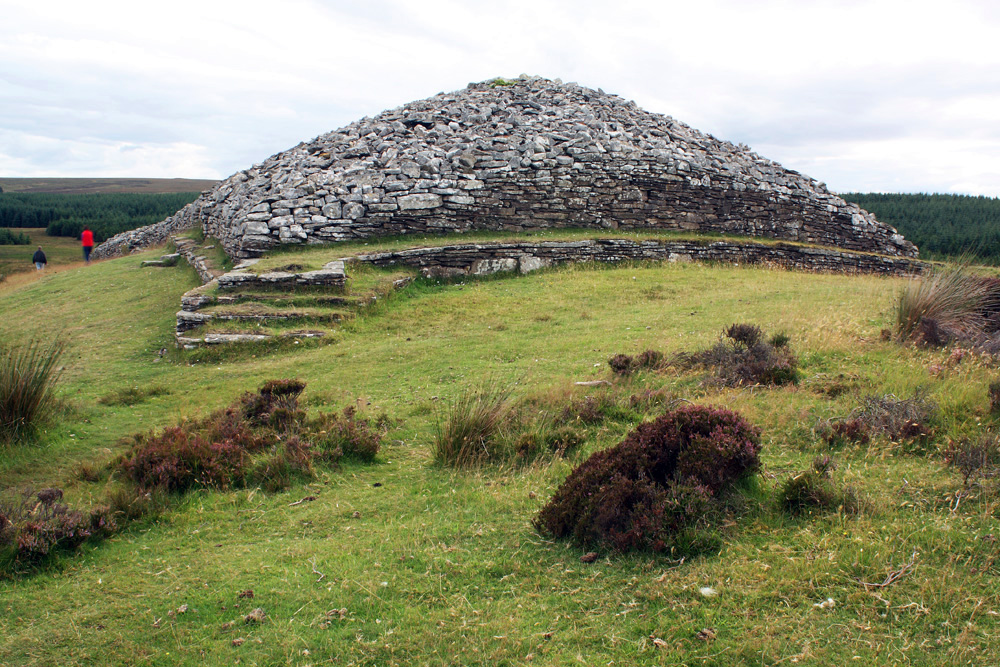
Two Neolithic tombs raised on land so fertile that people farmed it: before the Bronze Age (roughly 2500–800 BC, when metal tools first spread) bur…
- Near Lybster
- 120 metres from car park
- Easy path

Fortified place · Medieval
Castle of Mey
Highland
The only home Queen Elizabeth the Queen Mother ever owned outright, rescued from near-ruin in 1952 and still kept in family use by King Charles III…
- Near Mey
Carved stone · Prehistoric
Hill o' Many Stanes
Highland
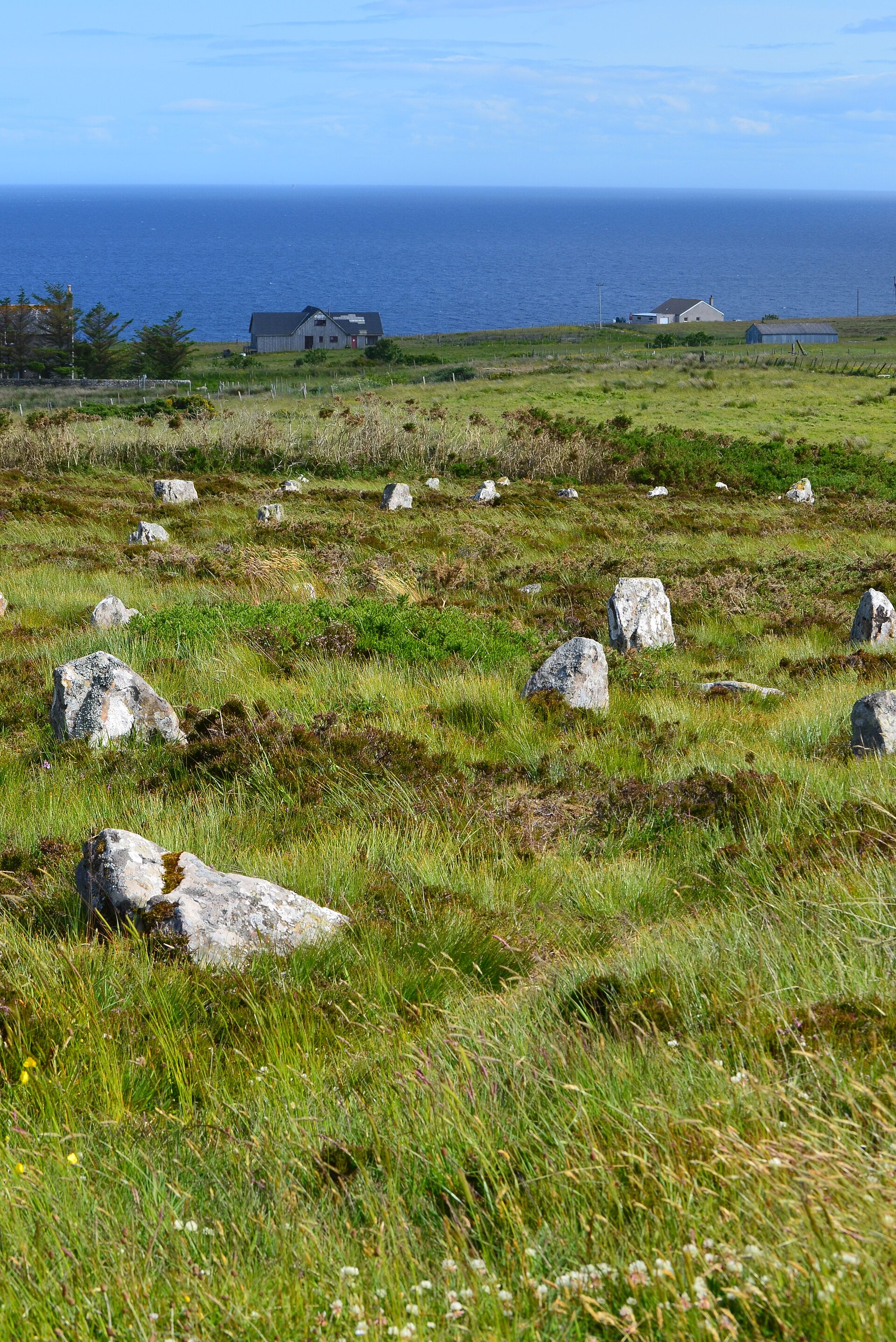
Alexander Thom argued these modest stones once tracked the moon's 18.6-year cycle: a claim no other Caithness stone row has earned.
- Near Lybster
- Easy path
Questions people ask
- What happened to Skitten Broch?
- It was destroyed in the 1940s during construction of the Killimster aerodrome, which became RAF Skitten; no remains survive above ground.
- Where was Skitten Broch located?
- Between the villages of Killimster and North Killimster in Caithness, on the site later occupied by RAF Skitten.
- Who excavated Skitten Broch?
- Sir Francis Tress Barry partially excavated it in 1904, and Charles S. T. Calder carried out a fuller excavation in 1940 before its destruction.
- What is the connection between Skitten Broch and Operation Freshman?
- The airfield built over the broch's site, RAF Skitten, was the departure point for the Operation Freshman mission.
- Can Skitten Broch still be visited?
- No structure remains; the site lies within the former airfield grounds, with nothing of the broch visible today.
Sources
- Wikipedia: Skitten Broch
- Wikidata: Skitten Broch
- Canmore 9129 — SKITTEN (broch (iron age)) (accessed 2026-08-03)
Explore more: Fortified places · Iron Age · Highland
The Ancient Codex, in your pocket
Get the Pocket Codex app
Carry the directory with you — Skitten Broch and thousands of ancient places across Britain and Ireland, offline, wherever you roam.