
Its scale rivals the Ring of Brodgar, yet a fallen twin thirty metres off suggests it once anchored a deliberate sightline to the summer solstice sunset, not a solitary grave marker.
A single slab of stone stands upright in farmland in the parish of Bower, its bulk and weathered grey face making it one of the most imposing standing stones anywhere in Caithness. Local tradition has long called it the grave of Ljot Thorfinnsson, a tenth-century Earl of Orkney, but the stone rises to roughly three metres above the ground, a height that sits oddly with anything the Norse of that period are known to have raised over a burial.
A short distance away, about thirty metres off, a second stone now lies fallen where it once stood behind the first when viewed from the direction of the midsummer sunset. Surveyors have puzzled over what the pairing was meant to achieve: the bearing between the two stones points further north than a simple solstice sightline for this latitude would suggest, until the surrounding high ground and its long, unobstructed view of the Atlantic horizon are taken into account.
The stone’s name has also drawn it into a much older strand of story. Ljot’s resemblance to Lot, or Loth, the legendary king of Orkney and Lothian in Arthurian tradition, led one early twentieth-century writer to trace a line back further still, into Welsh legend and the figure of a British god. Later scholarship has treated that chain of association with considerable caution.
What follows is drawn from published sources, with each claim labelled by how firmly it is established.
History
Long before any written account of it survives, whoever raised the Stone Lud also set a second, smaller stone roughly thirty metres away, positioning it so that, seen from the first stone, it stood behind the far horizon in the direction of the summer solstice sunset. That second stone has since fallen, but its position relative to the first remains the clearest evidence that the pairing was a deliberate arrangement rather than a coincidence of two separate monuments sharing a field.
By local tradition, the stone came to be identified as the grave marker of Ljot Thorfinnsson, a tenth-century Earl of Orkney, giving the monument a name and a specific historical figure to attach to. The attribution has persisted in local memory even though the stone's considerable height, at around three metres, sits uneasily with what is otherwise known of Norse grave-marking practice in that period, making the claim more a piece of inherited tradition than an established fact.
In 1912 the writer Charles Squire, in Celtic Myths and Legends, picked up on the closeness between the name Ljot and Lot, or Loth, the legendary king of Orkney and Lothian who appears in Arthurian material, and proposed a further link back to Lludd Llaw Eraint, a figure remembered in medieval Welsh legend as a late form of an earlier British god. The chain of identification stretched the stone's name across several centuries and several distinct traditions at once.
In 2003 Leslie J Myatt surveyed the site for his book The Standing Stones of Caithness and recorded the bearing between the fallen and standing stones as 322 degrees. Myatt noted that this figure looked too far north for a straightforward summer solstice sunset alignment at this latitude, before reconciling it with the unusually high ground the stones occupy and its clear sightline to a distant Atlantic horizon, which shifts where the sun appears to set.
People
-
Ljot Thorfinnsson
Tenth-century Earl of Orkney to whom local tradition attributes the stone as a grave marker, an identification the stone's unusual height calls into question.
-
Charles Squire
Author of Celtic Myths and Legends (1912), who linked the name Ljot to the legendary king Lot and, further back, to the Welsh figure Lludd Llaw Eraint.
-
Leslie J Myatt
Author of The Standing Stones of Caithness (2003), who surveyed and recorded the alignment between the Stone Lud and its fallen companion stone.
Cultural influences
-
Paired standing-stone setting
The Stone Lud and its fallen companion were deliberately positioned as a pair on high ground, with the companion lying on the solstice horizon line from the standing stone.
Connections
-
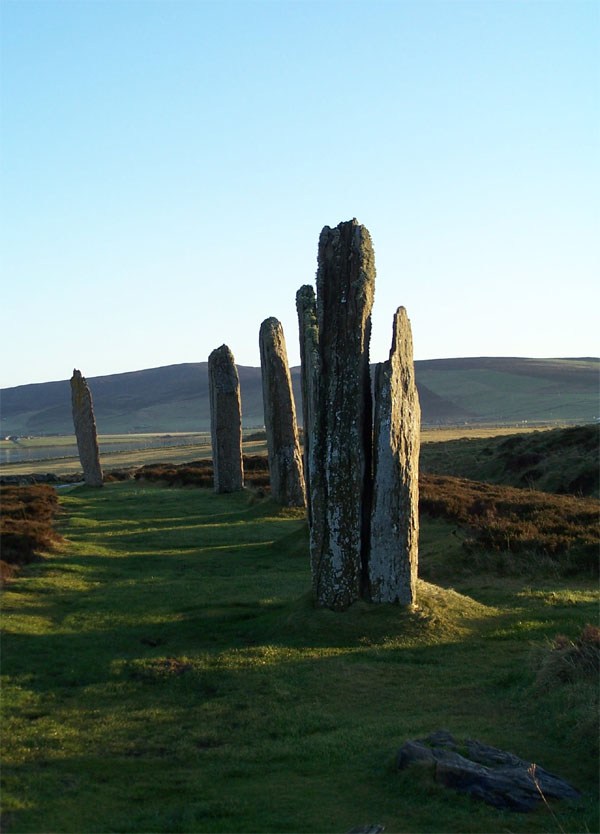
Photo: Original uploader was Otter at nl.wikipedia (Original text : Hopmans) / Wikimedia Commons / CC BY-SA 3.0 Cited as a comparison for the Stone Lud's mass and size, placing it among the more substantial standing stones associated with the Northern Isles tradition.
-
Maeshowe, Orkney
A chambered cairn whose entrance is built to admit sunlight at the winter solstice sunset, offered as a contrast to the Stone Lud's apparent summer solstice orientation.
What to look for
-
The standing stone itself
A single upright slab roughly three metres tall, notably larger and more massive than most other standing stones in Caithness.
-
The fallen companion stone
A second stone lying roughly thirty metres away, which once stood upright behind the first when viewed toward the summer solstice sunset.
-
The Atlantic sightline
The stones occupy raised ground, around seventy-five metres in altitude, giving a clear view toward a distant Atlantic horizon that shapes the apparent solstice alignment.
What is said
Folklore and tradition, recorded as what is said — not as established fact.
-
A grave for a Norse earl
The stone is said to mark the grave of Ljot Thorfinnsson, a tenth-century Earl of Orkney, though its height is thought by some to make a Norse origin unlikely.
-
Echo of an Arthurian king
Charles Squire suggested that the name Ljot preserves a memory of Lot, the legendary king of Orkney and Lothian, himself believed by Squire to descend from the Welsh figure Lludd Llaw Eraint, a connection modern scholars treat with scepticism.
Plan your visit
- Location
- 58.5367°N · 3.3361°W
- Nearest settlement
- Bower
- Access
- Open access
- Terrain
- Easy going
- Time needed
- About 20 minutes
- Best time
- Clear evening light around the summer solstice, when the paired-stone horizon alignment is most apparent.
- What survives
- One roughly three-metre stone remains upright while its smaller companion has fallen about 30 metres away.
Opening & admission
- Standing stone in the parish of Bower; access rights are not stated in the record.
Nearby places
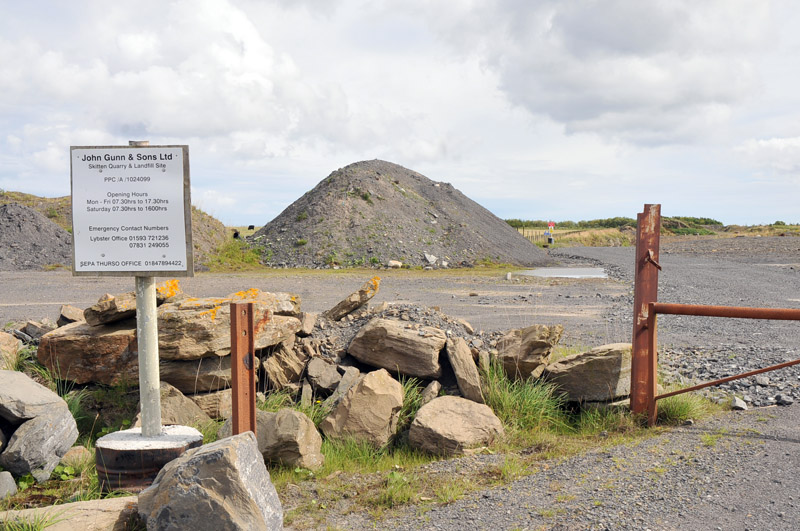
Fortified place · Iron Age
Skitten Broch
Highland
A broch excavated twice within four decades of Highland archaeology before being levelled entirely for a wartime runway: its erasure is now the cle…
- Near Killimster
- Easy path

Fortified place · Medieval
Castle of Mey
Highland
The only home Queen Elizabeth the Queen Mother ever owned outright, rescued from near-ruin in 1952 and still kept in family use by King Charles III…
- Near Mey
Tomb or burial place · Prehistoric
Tulach an t-Sionnaich
Highland
Excavation found the earliest known heel-shaped cairn (a mound of piled stones, often covering a burial) on the Scottish mainland folded inside two…
- Near Watten
- Some walking
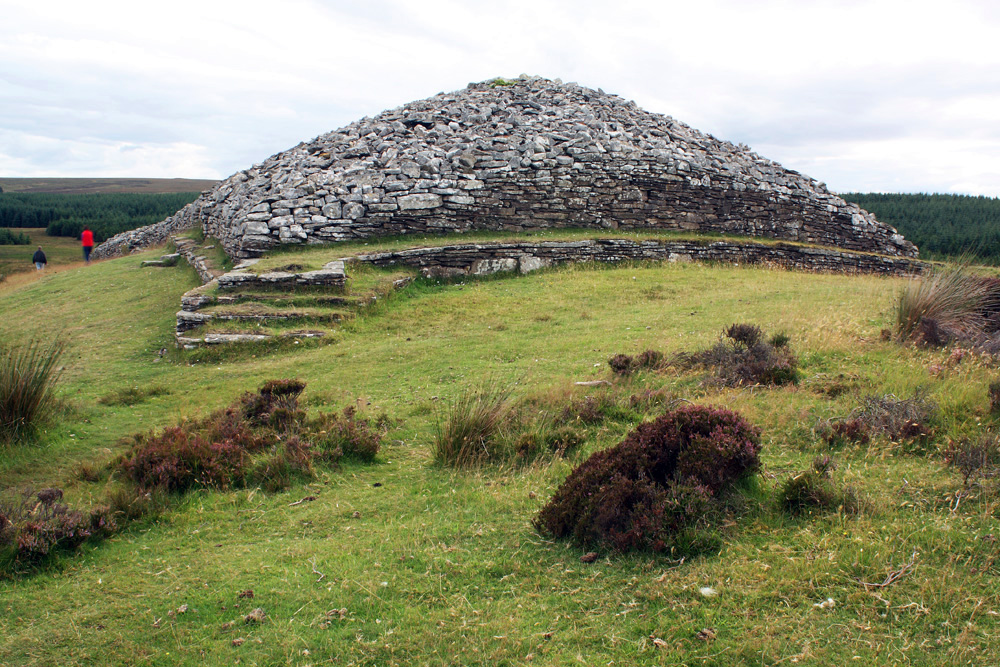
Tomb or burial place · Prehistoric
Grey Cairns of Camster
Highland
Two Neolithic tombs raised on land so fertile that people farmed it: before the Bronze Age (roughly 2500–800 BC, when metal tools first spread) bur…
- Near Lybster
- 120 metres from car park
- Easy path
The setting
Near Stone Lud, about 634 metres away.
Photo: Peter Wood / Wikimedia Commons / CC BY-SA 2.0
Near Stone Lud, about 646 metres away.
Photo: Steven Brown / Wikimedia Commons / CC BY-SA 2.0
Near Stone Lud, about 731 metres away.
Photo: John Ferguson / Wikimedia Commons / CC BY-SA 2.0
Questions people ask
- How tall is the Stone Lud?
- The stone stands at about three metres above ground level, making it one of the more imposing standing stones in Caithness.
- Is the Stone Lud really the grave of Ljot Thorfinnsson?
- That is the local tradition, but the stone's height sits oddly with what is known of tenth-century Norse grave markers, so the claim is not confirmed.
- What is the second stone near the Stone Lud?
- A now-fallen stone about thirty metres away that once stood behind the Stone Lud in line with the summer solstice sunset.
- What alignment did Leslie J Myatt record?
- Myatt recorded a bearing of 322 degrees between the fallen and standing stones, reconciled with the site's high ground and Atlantic horizon.
- Why is the Stone Lud linked to Arthurian legend?
- Charles Squire noted that the name Ljot resembles Lot, the legendary king of Orkney and Lothian, though modern scholars are sceptical of the connection.
Sources
- Wikipedia: Stone Lud
- Wikidata: Stone Lud
- Myatt, The Standing Stones of Caithness (2003)
- Squire, Celtic Myths and Legends (1912)
Explore more: Sacred places · Prehistoric · Highland
The Ancient Codex, in your pocket
Get the Pocket Codex app
Carry the directory with you — Stone Lud and thousands of ancient places across Britain and Ireland, offline, wherever you roam.