
A carved crescent, v-rod and a pair of spirals fused into a pelta survive on a single stone that sat unknown until 1992 — a Pictish (of the Picts, the people of northern and eastern Scotland from about AD 300 to 900) symbol carver's work rediscovered in a working churchyard.
A slab of stone standing in the churchyard at Poolewe carries symbols cut by Pictish hands: a crescent crossed by a broken v-shaped rod, and within the crescent’s curve a cluster of shallow hollows alongside two spirals that wind into and out of one another to form a pelta, a symbol built from paired spiral terminals. These are among the most recognisable motifs in the Pictish symbol repertoire, appearing on carved stones across eastern and northern Scotland, but this particular example went unrecorded for centuries.
The stone was found in 1992 in the graveyard serving the village, whose own name preserves an older one: Poolewe renders the Gaelic Poll Iùbh, a name that long predates the discovery of the carving. Whoever placed the stone there, and whenever it first stood, its symbols had already gone unremarked by antiquarians and surveyors until the closing years of the twentieth century.
It is classified as a Class I Pictish stone, meaning it bears incised symbols alone rather than the high relief carving, crosses and figural scenes found on later Class II monuments. The stone remains in the churchyard today, a quiet survival from the far west of Pictish-influenced Scotland.
What follows is drawn from published sources, with each claim labelled by how firmly it is established.
The name
Poolewe is from Gaelic Poll Iùbh, ‘pool of yew trees’: poll means a pool or creek and iùbh means yew.
History
The stone lay unrecognised until 1992, when it was discovered in the cemetery at Poolewe in Wester Ross. Its emergence added a previously unknown example to the small corpus of Pictish symbol stones known from the far north-west, a region far removed from the classic symbol-stone heartlands of Angus, Aberdeenshire and Moray.
In 1999 the stone was formally catalogued as entry number 135 in the Royal Commission on the Ancient and Historical Monuments of Scotland's illustrated gazetteer of Pictish symbol stones, compiled by Iain Fraser and J. N. G. Ritchie among others, placing it on permanent record within the national inventory of Pictish carved stones.
Cultural influences
-
Class I Pictish symbol carving
The crescent, V-rod and double-spiral pelta are part of the incised Pictish symbol tradition, unusually far north-west of its principal heartlands.
Discovery & excavation
The stone was discovered in 1992 in the cemetery at Poolewe, a find that added a Class I Pictish symbol stone to a part of Wester Ross where such carvings are otherwise rare.
What to look for
-
Crescent and V-rod
A crescent shape crossed by a broken, v-shaped rod, one of the most common paired symbols found on Pictish Class I stones.
-
Incised hollows
A cluster of shallow hollows chiselled into the surface within the crescent.
-
Double spiral pelta
Two spirals carved so that they meet and combine into a single pelta-shaped motif, set inside the crescent alongside the hollows.
Plan your visit
- Location
- 57.7669°N · 5.6056°W
- Nearest settlement
- Poolewe
- Access
- Open access
- Terrain
- Easy going
- Time needed
- About 15 minutes
- Best time
- Daylight, when the incised crescent and inner spiral work can be seen clearly.
- What survives
- The symbol stone survives in Poolewe churchyard, with its crescent, shallow hollows and double-spiral pelta intact.
Opening & admission
- Stone lies in Poolewe churchyard.
Nearby places
.jpg?width=800)
Carved stone · Pictish & early medieval
Gairloch Stone
Highland
A carved salmon and the broken remains of a bird - rare survivors of a Pictish (of the Picts, the people of northern and eastern Scotland from abou…
- Near Gairloch
- Easy path
Tomb or burial place · Prehistoric
Carn Ban
Highland
A 30-metre chamber cut into compartments by upright stone slabs: one of the largest and best-preserved Clyde cairns in south-west Scotland, reached…
- Rough ground
Fortified place · Iron Age
Dun Skudiburgh
Highland
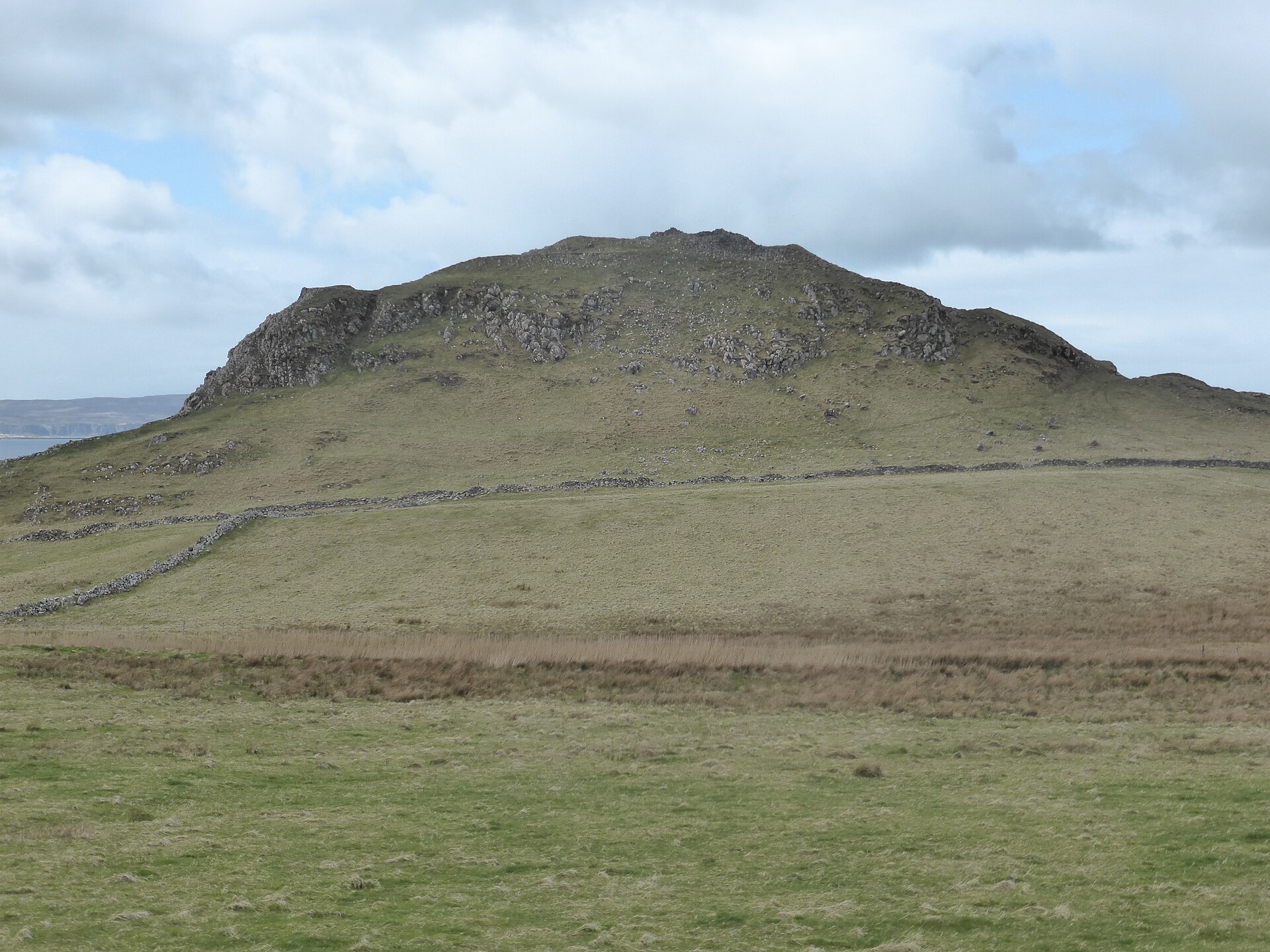
A vitrified (burnt so fiercely that the stone melted and set again) Iron Age (from about 800 BC until the Romans came) fort with a later dun built…
- Near Uig
- Rough ground

Fortified place · Iron Age
Dun Cruinn
Highland
A smaller broch or dun was built inside the ruins of an earlier hillfort on the same rocky knoll: two separate strongholds, one after the other, on…
- Near Dunvegan
- Rough ground
The setting
Near Poolewe Stone, about 11 metres away.
Photo: Richard Dorrell / Wikimedia Commons / CC BY-SA 2.0
Near Poolewe Stone, about 61 metres away.
Photo: Tom Parnell / Wikimedia Commons / CC BY-SA 4.0
Near Poolewe Stone, about 94 metres away.
Photo: Richard Dorrell / Wikimedia Commons / CC BY-SA 2.0
Questions people ask
- What is the Poolewe Stone?
- A Class I Pictish symbol stone carved with a crescent and v-rod plus spiral motifs, standing in the churchyard at Poolewe in Wester Ross.
- When was the Poolewe Stone discovered?
- It was discovered in 1992 in the cemetery at Poolewe, having previously gone unrecorded.
- What symbols are carved on the stone?
- A crescent and v-rod, plus hollows and two spirals that join to form a pelta, carved within the crescent.
- Where is the Poolewe Stone today?
- It remains in the churchyard at Poolewe in Wester Ross, Highland.
- Where is the Poolewe Stone formally recorded?
- It is catalogued as number 135 in the RCAHMS illustrated gazetteer of Pictish symbol stones, published in 1999.
Sources
- Wikipedia: Poolewe Stone
- Fraser & Ritchie, Pictish Symbol Stones: An Illustrated Gazetteer
- Wikidata: Poolewe Stone
- megalithic.co.uk photograph of the Poolewe Stone
Explore more: Carved stones · Pictish & early medieval · Highland
The Ancient Codex, in your pocket
Get the Pocket Codex app
Carry the directory with you — Poolewe Stone and thousands of ancient places across Britain and Ireland, offline, wherever you roam.