
A carved salmon and the broken remains of a bird - rare survivors of a Pictish (of the Picts, the people of northern and eastern Scotland from about AD 300 to 900) monument that spent decades built into a graveyard wall before anyone recognised what it was.
A fish curves along the lower edge of a weathered slab, its outline still legible despite everything the stone has been through; above it survive only the legs and part of the body of a bird, the rest sheared away by time and reuse. This is the Gairloch Stone, an incised Pictish monument recovered at Achtercairn on the edge of Gairloch, in Wester Ross on Scotland’s north-west coast.
It belongs to a group known to archaeologists as Class I stones - rough, undressed blocks carrying symbols cut straight into the rock surface, without the crosses or interlace patterns added to later Pictish carvings. Found around 1880, the slab did not stay on view. It was instead built into the wall enclosing the cemetery around Gairloch’s parish church, pressed into service as ordinary masonry for a purpose that had nothing to do with the meaning it once carried.
That long spell as building stone explains why so little of the carving remains legible today. The fish is generally read as a salmon, a species with an obvious connection to the rivers and lochs around Gairloch, while the bird above it has been argued over ever since rediscovery - most likely an eagle, a common figure on Pictish stones, though a goose has also been put forward as a reading of the same broken outline. The stone has since left the wall behind and is now held at Gairloch Heritage Museum.
What follows is drawn from published sources, with each claim labelled by how firmly it is established.
History
Around 1880, a carved stone slab came to light at Achtercairn, a settlement on the edge of Gairloch in Wester Ross on Scotland's north-west coast. It was recognised as an incised Pictish monument, one of the so-called Class I stones - undressed slabs bearing symbols cut directly into the rock, without the crosses or interlace that mark the later, more elaborate Class II carvings found elsewhere in Pictland.
The stone did not remain on display. Not long after its discovery it was taken up and built into the fabric of the wall enclosing the cemetery around Gairloch's parish church, treated as no more than a convenient block of dressed stone. That reuse, common enough for older monuments once their original meaning had faded from local memory, left the carved face exposed to weather and handling for decades before it was recognised again as something worth preserving.
As a result of that long spell built into the wall, the stone survives only imperfectly today. Enough of the original carving remains, however, to show a fish, most likely a salmon, incised along the lower part of the slab, with the truncated form of a bird above it - its legs and part of its body cut into the stone, though the upper portion has been lost or worn away entirely.
The identity of the bird has never been settled. Because eagles appear repeatedly among the animal symbols carved on Pictish stones elsewhere in Scotland, most students of the carving have taken it for an eagle, but a goose has also been proposed as an alternative reading of the same fragmentary outline, and the debate remains unresolved for lack of the missing upper section.
The Royal Commission on the Ancient and Historical Monuments of Scotland photographed the stone, with a record dated 1991 and published via Canmore in 2008; the stone itself has since been moved into the care of Gairloch Heritage Museum, where it remains on display today.
Cultural influences
-
Pictish symbol carving
The fish and bird belong to the incised animal imagery of Class I Pictish stones, although the damaged bird cannot be securely identified.
Connections
-
Gairloch Heritage Museum
Holds and displays the Gairloch Stone, which was moved there from the cemetery wall of Gairloch's parish church.
-
Royal Commission on the Ancient and Historical Monuments of Scotland (Canmore)
Documented and photographed the stone, with its record published via Canmore.
Discovery & excavation
The stone was found at Achtercairn, near Gairloch, around 1880, already separated from whatever standing or recumbent position it had originally occupied. Nothing in the surviving record indicates who uncovered it or under what circumstances, only that it later came to rest built into the fabric of the church cemetery wall.
Finds now held at: Gairloch Heritage Museum.
What to look for
-
The incised salmon
Along the lower part of the slab a fish is carved in outline, identified as most likely a salmon - a species long associated with the rivers and lochs of Wester Ross.
-
The truncated bird figure
Above the fish, the legs and lower body of a bird are cut into the stone; the upper part is lost, leaving its exact identity - eagle or goose - a matter of ongoing debate.
Plan your visit
- Location
- 57.7300°N · 5.6936°W
- Nearest settlement
- Gairloch
- Access
- Open access
- Terrain
- Easy going
- Time needed
- About 15 minutes
- Best time
- During Gairloch Heritage Museum opening hours.
- What survives
- The slab survives with its incised fish and a truncated bird; the bird’s upper part has been lost or worn away.
Opening & admission
- Stone is displayed at Gairloch Heritage Museum.
Nearby places

Carved stone · Pictish & early medieval
Poolewe Stone
Highland
A carved crescent, v-rod and a pair of spirals fused into a pelta survive on a single stone that sat unknown until 1992: a Pictish (of the Picts, t…
- Near Poolewe
- Easy path
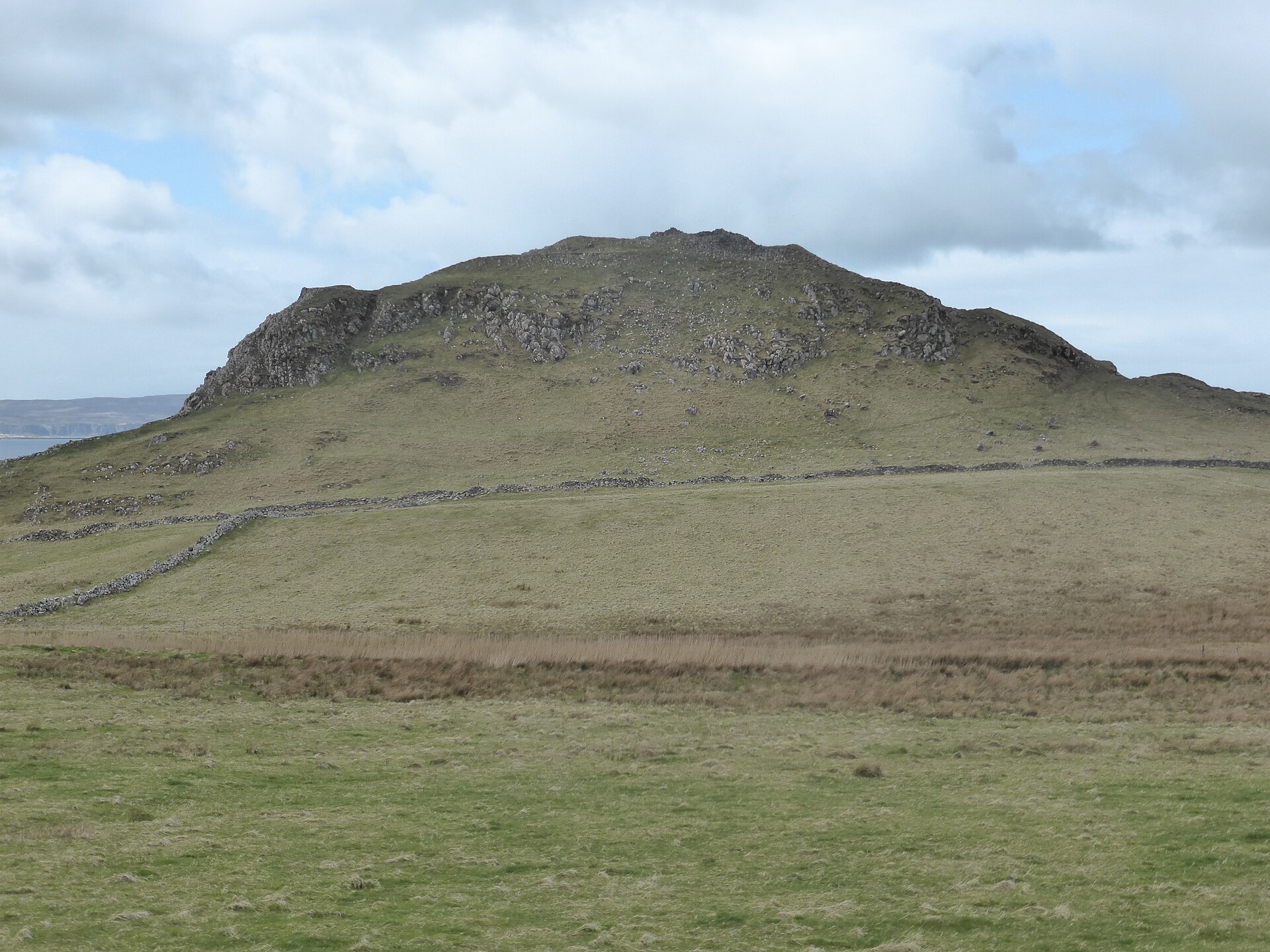
Fortified place · Iron Age
Dun Skudiburgh
Highland
A vitrified (burnt so fiercely that the stone melted and set again) Iron Age (from about 800 BC until the Romans came) fort with a later dun built…
- Near Uig
- Rough ground

Fortified place · Iron Age
Dun Cruinn
Highland
A smaller broch or dun was built inside the ruins of an earlier hillfort on the same rocky knoll: two separate strongholds, one after the other, on…
- Near Dunvegan
- Rough ground

Building or ruin · Medieval
Eilean Donan Castle
Highland
The castle photographed on countless shortbread tins is barely a century old: a 1930s recreation of a stronghold the Royal Navy blew apart in 1719.
- Near Inverness
The setting
Near Gairloch Stone, about 140 metres away.
Photo: Steven Brown / Wikimedia Commons / CC BY-SA 2.0
Near Gairloch Stone, about 141 metres away.
Photo: N Chadwick / Wikimedia Commons / CC BY-SA 2.0
Near Gairloch Stone, about 151 metres away.
Photo: Nilfanion / Wikimedia Commons / CC BY-SA 3.0
The setting near Gairloch Stone.
Photo: Macfack / Wikimedia Commons / CC BY-SA 4.0
Questions people ask
- What is the Gairloch Stone?
- An incised Class I Pictish stone found at Achtercairn, near Gairloch, around 1880, carved with a fish and the surviving lower part of a bird.
- What carvings survive on the stone?
- A fish, probably a salmon, and above it the lower part of a bird, most likely an eagle, though a goose has also been suggested.
- Where was the Gairloch Stone found?
- At Achtercairn, on the edge of Gairloch in Wester Ross, around 1880.
- Where is the Gairloch Stone now?
- It is held at Gairloch Heritage Museum, having previously been built into the cemetery wall of Gairloch's parish church.
- Why does the stone survive only in fragments?
- It was reused as masonry in a cemetery wall before being recognised as a carved monument, which damaged and lost part of the original design.
Sources
- Wikipedia: Gairloch Stone
- Royal Commission on the Ancient and Historical Monuments of Scotland — Canmore
- Wikidata: Gairloch Stone
Explore more: Carved stones · Pictish & early medieval · Highland
The Ancient Codex, in your pocket
Get the Pocket Codex app
Carry the directory with you — Gairloch Stone and thousands of ancient places across Britain and Ireland, offline, wherever you roam.