
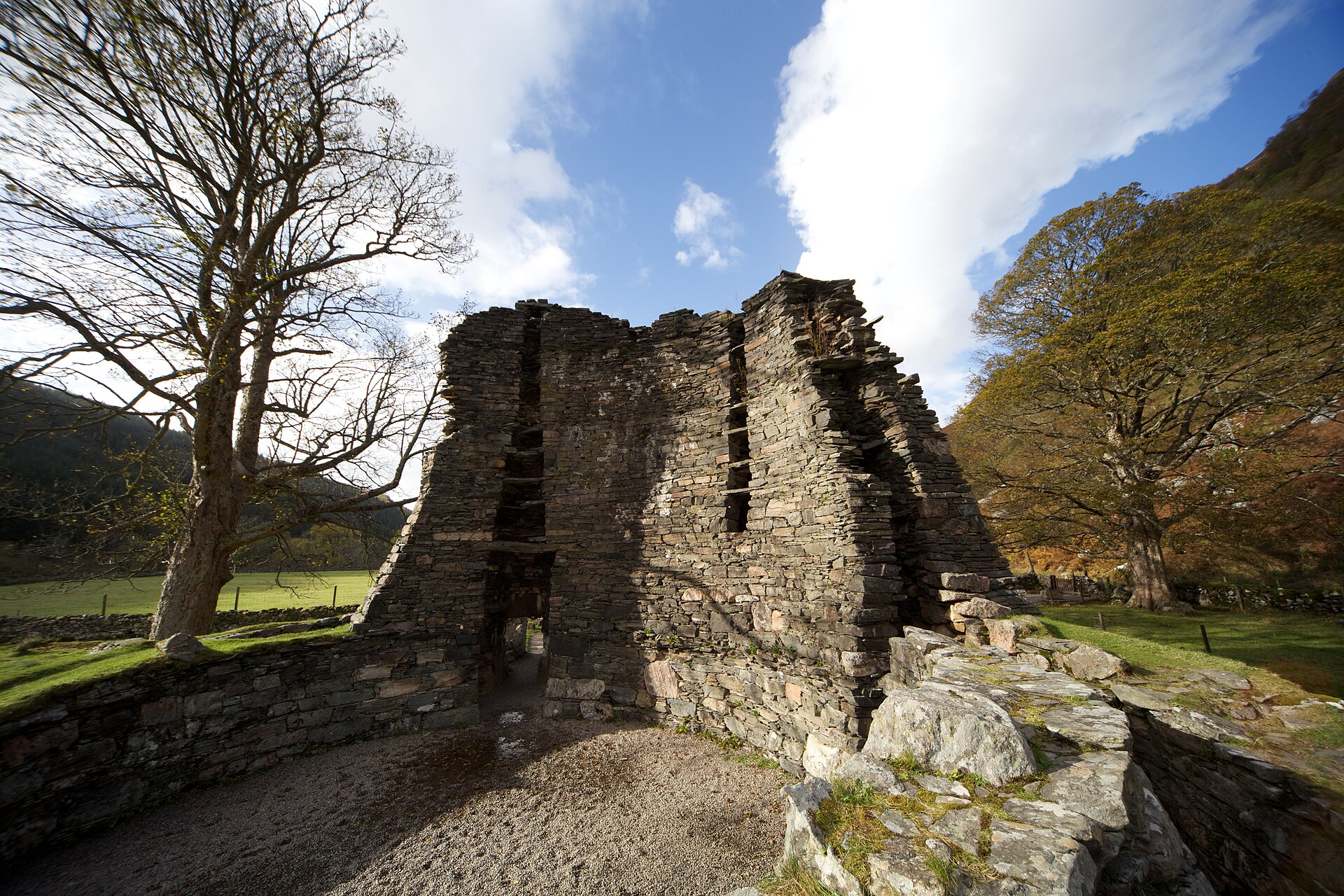
Its stairway still climbs to a first-floor landing inside a wall four and a half metres thick — one of Scotland's most intact broch (a tall circular tower of unmortared stone, found only in Scotland) interiors, still legible as a building rather than a footprint.
Inside the entrance passage, a narrow doorway in the surviving high wall opens onto a stone stairway, and nine steps still climb to a landing suspended within the thickness of the wall itself, with the first tread of a further flight visible beyond it. Few broch towers in Scotland preserve this much of their original structure above ground, and Dun Troddan is one of them, standing a full seven metres tall on the drystone base its Iron Age (from about 800 BC until the Romans came) builders laid roughly two thousand years ago.
The tower sits on a level rock platform in Gleann Beag, a quiet valley south of Kirkton in Glenelg, reached today by a steep path from the minor road below. Its near-perfectly circular central court, some eight and a half metres across, still holds a hearth with a broken quern-stone (a hand-turned grinding stone) built into it, along with postholes marking where a timber structure once stood inside the stone shell — details that have not survived at its close neighbour.
That neighbour, Dun Telve, stands less than half a kilometre to the west, and a smaller, part-ruined broch called Dun Grugaig lies a couple of kilometres to the southeast, together forming a tight cluster of Iron Age towers unmatched almost anywhere else in the country. What makes Dun Troddan distinct within that group is not its size but its state of repair: enough of the wall survives intact that the internal stair and landing, ordinarily lost to collapse, can still be walked.
What follows is drawn from published sources, with each claim labelled by how firmly it is established.
The name
The name is rendered in Scottish Gaelic as Dùn Trodan; "dun" denotes a fort or stronghold, a naming pattern shared with its neighbours Dun Telve and Dun Grugaig in the same glen.
History
Roughly two thousand years ago, during the Iron Age, the builders of Gleann Beag raised a massive drystone tower on a level rock shelf above the Abhainn a' Ghlinne Bhig, working in pairs of towers built within sight of one another along the glen. Dun Troddan rose barely half a kilometre from its twin, Dun Telve, and a smaller, part-collapsed broch called Dun Grugaig stood some two kilometres further southeast, suggesting a cluster of related households rather than a single isolated stronghold.
By 1720 Dun Troddan was still recognisably a tower rather than a ruin, and it was sketched that year while largely intact. An early account called it "by far the most entire of any in that Country", and it is thought to have stood over twelve metres high at the time, taller than either of its surviving neighbours would remain into the following century.
That survival proved short-lived. In 1722, only two years after it had been drawn as a near-complete building, the tower was stripped of stone to help build the Bernera Barracks nearby at Glenelg, part of the network of garrisons raised in the wake of the Jacobite risings. The robbing removed much of the upper structure that the 1720 sketch had recorded.
When the naturalist and traveller Thomas Pennant visited in 1772, the broch was still a substantial ruin, though by then it had lost its upper gallery to the earlier stone-robbing. His account is one of the few independent descriptions of the site's condition between the 1720s and the twentieth century, bridging the gap between the sketch and later archaeological clearance.
Between 1914 and 1920 the Office of Works cleared the interior of accumulated debris without archaeological supervision and consolidated the standing walls, work that fixed the broch's appearance largely as it survives today. The clearance recovered internal features, including postholes and a hearth with a broken quern-stone built into it, that are no longer visible at Dun Telve.
Dun Troddan remains in the care of Historic Environment Scotland, which manages it alongside Dun Telve as a linked pair of monuments in Gleann Beag. Together the two broch towers are presented as among the best-preserved examples of the building type surviving anywhere in Scotland.
People
-
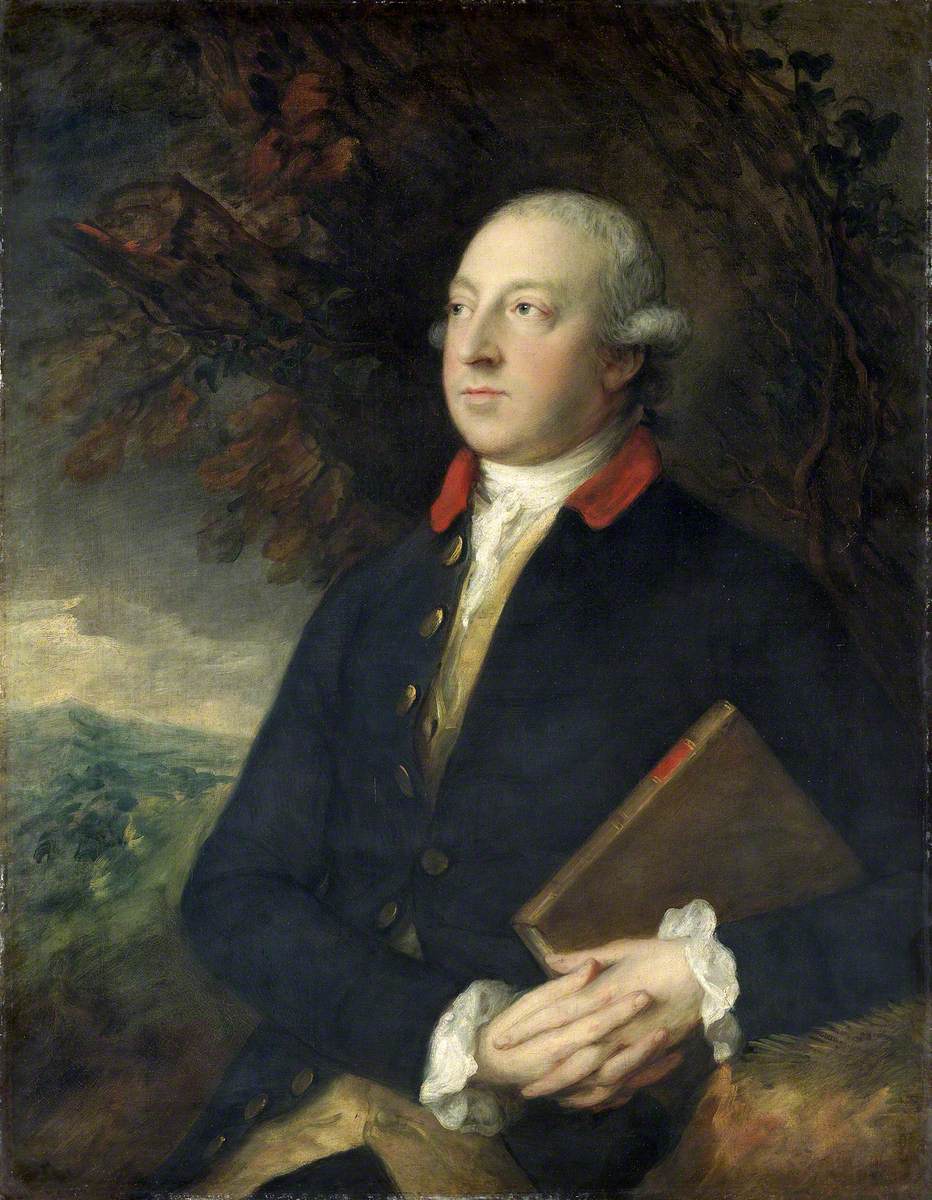
Photo: Thomas Gainsborough / Wikimedia Commons / Public domain Thomas Pennant
Naturalist and travel writer who visited the broch in 1772 and recorded it as a substantial ruin that had already lost its upper gallery.
Connections
-
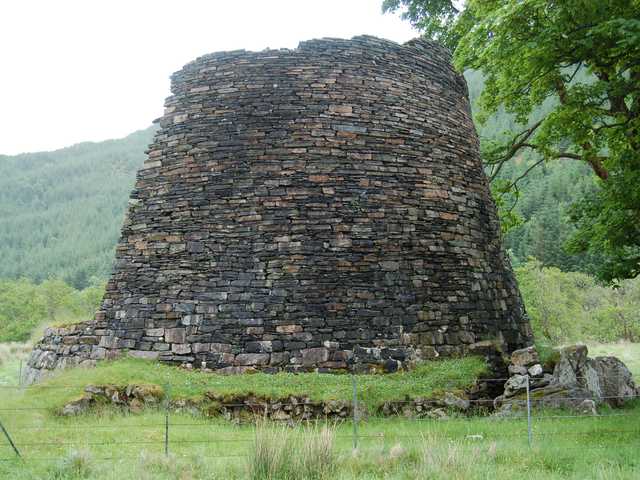
Photo: John Allan / Wikimedia Commons / CC BY-SA 2.0 Stands roughly 470 metres to the west and is managed jointly with Dun Troddan by Historic Environment Scotland as a linked pair of Gleann Beag brochs.
-

Photo: Otter / Wikimedia Commons / CC BY-SA 3.0 A smaller "semi-broch" around two kilometres to the southeast, forming a third element of the same cluster of Iron Age towers in the glen.
-
Bernera Barracks, Glenelg
Built from 1722 using stone robbed from Dun Troddan's upper structure.
Discovery & excavation
The Office of Works cleared debris from the interior and consolidated the walls between 1914 and 1920, work carried out without archaeological supervision but which recorded internal features such as postholes and a hearth with a broken quern-stone that do not survive at neighbouring Dun Telve.
What to look for
-
The internal stairway and landing
A doorway in the surviving high section of wall leads to a stone stair; nine steps climb to a landing 5.7 metres long, set 2.4 metres above the central court, with the first step of the next flight visible beyond it.
-
The hearth and quern-stone
A hearth in the central court has a broken quern-stone (a hand-turned grinding stone) built into it, alongside postholes marking where a timber structure once stood — features no longer visible at Dun Telve.
-
The entrance passage and guard cell
The roofless entrance on the southwest side has a small side-chamber, sometimes called a guard cell, opening off its left side.
-
The massive outer wall
The drystone tower is around 17.5 metres in diameter and stands to a maximum height of seven metres, with external walls 4.5 metres thick at the base.
Plan your visit
- Location
- 57.1947°N · 5.5867°W
- Nearest settlement
- Inverness
- Access
- Open access
- Terrain
- Moderate walking
- Time needed
- About 45 minutes
- Best time
- Visit in daylight and dry conditions, when the broch remains and surrounding landscape can be viewed safely.
- What survives
- Dun Troddan is a substantially preserved drystone broch; Historic Environment Scotland describes it as 7.6m high and better preserved than its nearby companion.
- Facilities
- No dedicated visitor facilities are documented at the broch; plan to use facilities in nearby settlements.
Opening & admission
Historic Environment Scotland lists the Glenelg Brochs as open all year round.
- Historic Environment Scotland cares for the broch; its visitor information notes a steep path.
Nearby places
Fortified place · Iron Age
Dun Telve
Highland
Its drystone wall still rises over ten metres without a scrap of mortar, making Dun Telve one of the tallest surviving brochs anywhere in Scotland.
- Near Inverness
- Easy path

Fortified place · Iron Age
Dun Grugaig
Highland
A rare surviving 'semi-broch': the transitional D-shaped form that shows how the great circular broch towers of the Highlands may have evolved.
- Near Glenelg
- Rough ground

Fortified place · Iron Age
Caisteal Grugaig
Highland
A drystone tower still rising over its own five-step internal stair and a triangular lintel massive enough to have never needed a keystone.
- Near Shiel Bridge
- Some walking

Building or ruin · Medieval
Eilean Donan Castle
Highland
The castle photographed on countless shortbread tins is barely a century old: a 1930s recreation of a stronghold the Royal Navy blew apart in 1719.
- Near Inverness
Questions people ask
- What is Dun Troddan?
- An Iron Age broch, or drystone tower, standing in Gleann Beag near Glenelg, Highland, and rated one of the best-preserved brochs in Scotland.
- How old is Dun Troddan?
- It dates from the Iron Age, roughly two thousand years ago.
- Why is Dun Troddan not taller today?
- It was robbed for stone in 1722 to build the nearby Bernera Barracks, having still stood over twelve metres high just two years earlier.
- Can visitors still see the internal stairway?
- Yes — nine steps climb from an internal doorway to a first-floor landing built within the thickness of the wall, one of the best-surviving broch stairways in Scotland.
- How does Dun Troddan relate to Dun Telve?
- The two brochs stand about 470 metres apart in the same glen and are managed together by Historic Environment Scotland as a linked pair.
Sources
- Wikipedia: Dun Troddan
- Historic Environment Scotland — Glenelg Brochs: Dun Telve and Dun Troddan
Explore more: Fortified places · Iron Age · Highland
The Ancient Codex, in your pocket
Get the Pocket Codex app
Carry the directory with you — Dun Troddan and thousands of ancient places across Britain and Ireland, offline, wherever you roam.