
A drystone tower still rising over its own five-step internal stair and a triangular lintel massive enough to have never needed a keystone.
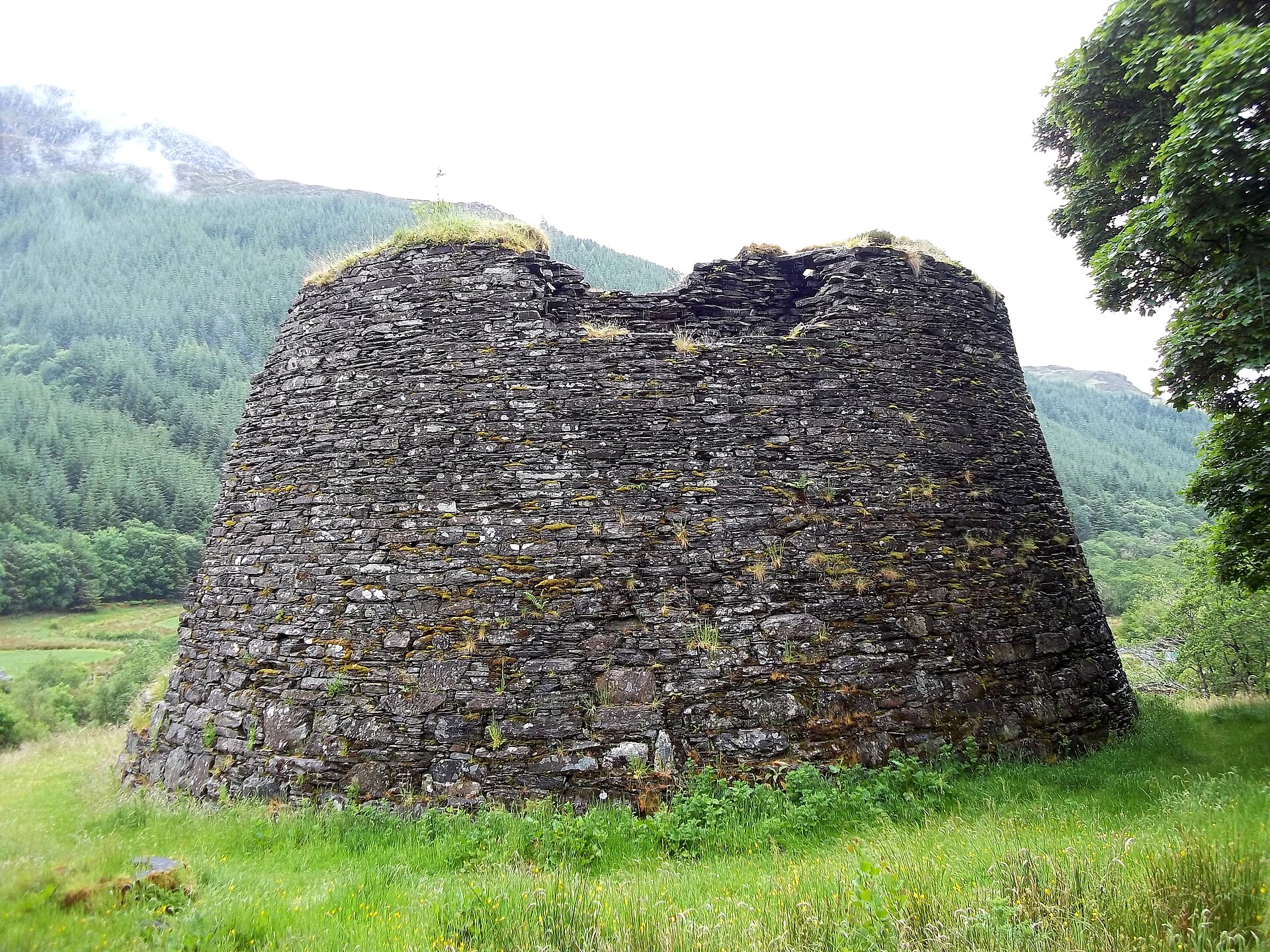
A rocky knoll above a grassy slope near the eastern end of Loch Alsh carries the broken but still-legible drystone shell of an Iron Age (the centuries before Rome arrived, from about 800 BC) tower. Caisteal Grugaig, also recorded as Dun Totaig, was raised without mortar, its builders instead relying on the sheer mass and careful coursing of its double walls to hold the structure upright on ground too uneven to give it a level floor.
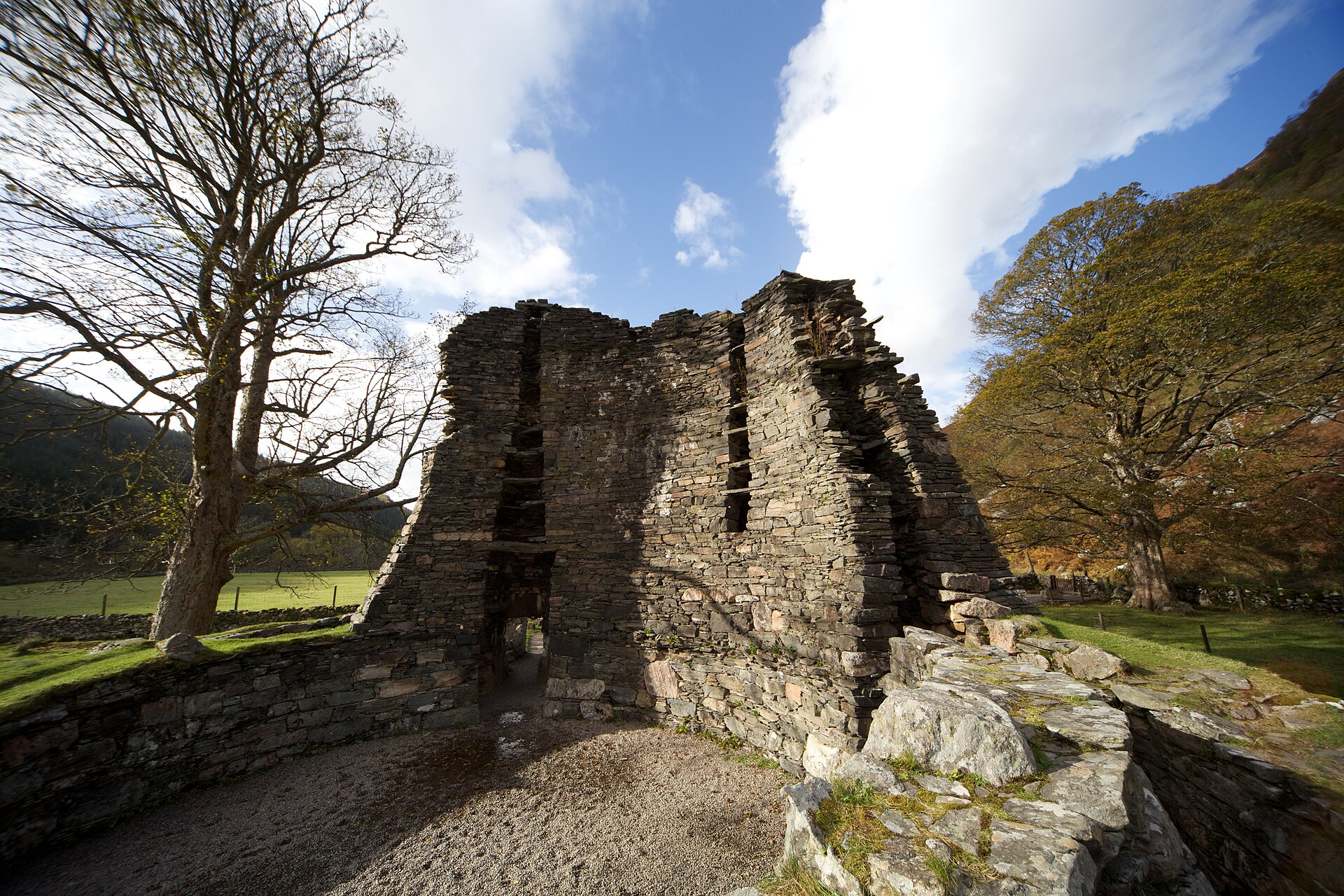
Inside, the broch keeps more of its architecture than most: a doorway leads into a mural stair whose five original steps still climb to a landing, from which a second flight once continued upward. A guard cell sits off the entrance passage, itself crossed by a triangular lintel stone so large it needed no supporting arch, and two intramural chambers survive at ground level, including a long gallery whose inner doorway was deliberately blocked at some point in its working life.
Few miles to the south stand the far better-known Glenelg brochs, Dun Telve and Dun Troddan, and the district also holds a separate, smaller structure called Dun Grugaig, a similar name that belongs to a different and simpler kind of building entirely. Caisteal Grugaig’s own history after abandonment is thin: two brief clearances a generation apart, and a single carved stone cup now resting in a museum case, are almost all that is recorded of what happened here once the tower’s people were gone.
What follows is drawn from published sources, with each claim labelled by how firmly it is established.
The name
Caisteal is Gaelic for ‘castle’, while the alternative name Dùn Totaig uses dùn, meaning ‘fort’; both names describe the broch as a fortified place, with the Gaelic vocabulary preserving how later communities understood the ruin.
History
During the Iron Age, communities in Lochalsh raised a broch on this rocky knoll above Loch Alsh, choosing ground that gave height and visibility over the surrounding slopes despite its uneven surface forcing the tower's own floor to sit at a tilt. The double drystone walls, entrance passage and internal stair were built to stand without mortar, relying on weight and careful stone-fitting for their strength. In 1889 the broch was cleared out, but whoever carried out the work left no detailed record of what was found or removed, so almost nothing is known of the contents uncovered during this first documented intervention at the site.
A further attempt at excavation in 1924 produced only minimal results, adding little to the sparse picture left by the 1889 clearance and leaving the broch's later history largely undocumented. A decorated steatite cup believed to come from the site survives and is now held in the National Museum of Scotland, one of the few tangible finds connecting the broch to the people who once used it.
Cultural influences
-
Broch construction on uneven ground
The broch’s walls, mural rooms and stair are characteristic of Iron Age tower building, but its sloping floor shows the builders adapting the structure to the rocky knoll rather than levelling it.
Connections
-
Dun Telve and Dun Troddan (the Glenelg Brochs)
Two well-preserved brochs standing a few miles to the south of Caisteal Grugaig, forming part of the same cluster of Iron Age towers in the Glenelg and Lochalsh area.
-

Photo: Otter / Wikimedia Commons / CC BY-SA 3.0 A separate, smaller 'semi-broch' also near Glenelg whose similar name is easily confused with Caisteal Grugaig, though the two are distinct structures.
Discovery & excavation
The broch was cleared out in 1889 without a surviving detailed record, and a second excavation attempt in 1924 yielded only minimal results. A decorated steatite cup apparently from the site is the principal find to have entered a public collection.
Finds now held at: National Museum of Scotland.
What to look for
-
Triangular entrance lintel
The entrance passage on the northeast side is crowned by a massive triangular lintel stone, set directly over the doorway without an arch.
-
Guard cell
An elongated cell opens off the left side of the entrance passage, likely used to control or watch over anyone approaching the doorway.
-
Mural stair and landing
A doorway inside the broch leads to a stair of five surviving steps rising to a long landing, from which a second flight of stairs originally continued.
-
Intramural chambers
Two rooms are built within the thickness of the walls at ground level: a small oval cell, and a longer mural gallery with a doorway that was deliberately blocked at some point.
-
Sloping interior floor
Because the broch was built on uneven rock, its natural floor slopes rather than sitting level, a direct result of the builders working with the knoll rather than levelling it first.
Plan your visit
- Location
- 57.2665°N · 5.5393°W
- Nearest settlement
- Shiel Bridge
- Access
- Open access
- Terrain
- Moderate walking
- Time needed
- About 45 minutes
- Best time
- Daylight, for the best view of the entrance lintel, mural stair and chambers.
- What survives
- The broch’s entrance, chambers and part of the mural stair remain legible, though the interior floor slopes across the uneven rock.
Opening & admission
- Broch stands on a small rocky knoll; access not established by the record.
Nearby places

Building or ruin · Medieval
Eilean Donan Castle
Highland
The castle photographed on countless shortbread tins is barely a century old: a 1930s recreation of a stronghold the Royal Navy blew apart in 1719.
- Near Inverness
Fortified place · Iron Age
Dun Troddan
Highland
Its stairway still climbs to a first-floor landing inside a wall four and a half metres thick: one of Scotland's most intact broch (a tall circular…
- Near Inverness
- Some walking
Fortified place · Iron Age
Dun Telve
Highland
Its drystone wall still rises over ten metres without a scrap of mortar, making Dun Telve one of the tallest surviving brochs anywhere in Scotland.
- Near Inverness
- Easy path

Fortified place · Iron Age
Dun Grugaig
Highland
A rare surviving 'semi-broch': the transitional D-shaped form that shows how the great circular broch towers of the Highlands may have evolved.
- Near Glenelg
- Rough ground
Questions people ask
- What is Caisteal Grugaig?
- An Iron Age broch, a drystone tower, standing on a rocky knoll near the eastern end of Loch Alsh in the Scottish Highlands.
- Is Caisteal Grugaig the same as Dun Grugaig?
- No. Dun Grugaig is a separate, smaller 'semi-broch' also near Glenelg, and the similar names are often confused.
- How big is the broch?
- Its external diameter is around 16.5 metres, with an internal diameter of around 9.6 metres.
- What has been found at the site?
- A decorated steatite cup thought to be from the broch now sits in the National Museum of Scotland; two excavations, in 1889 and 1924, otherwise recorded little.
- Are there other brochs nearby?
- Yes. Dun Telve and Dun Troddan, the Glenelg Brochs, stand a few miles to the south.
Sources
The Ancient Codex, in your pocket
Get the Pocket Codex app
Carry the directory with you — Caisteal Grugaig and thousands of ancient places across Britain and Ireland, offline, wherever you roam.