
A double-walled stone tower dating the period from roughly 800 BC to the Roman conquest stands on a loch-side knoll near Dunvegan, excavated in 1892 by a countess who went on to dig Dun Beag with far more care.
On a low rocky knoll surrounded by moorland, where a peninsula reaches into the eastern arm of Loch Dunvegan, stands the drum-shaped stone shell of a tower. Its outer wall, some 16.8 metres across, encloses an inner court barely half that width, and the long stone-lined passage that once formed its only guarded entrance can still be traced across the wet ground.
The wall itself does the real work of impressing: rather than a single skin of stone, it is built as a hollow shell, with a gallery running round the ground floor at the base and small chambers set into its thickness. A second, narrower gap breaks through the wall near the main mural gallery, and archaeologists have long argued over whether it was cut when the broch was built or added later, once the tower had begun to lose its original purpose.
Beneath the rubble and turf, a countess with more enthusiasm than method dug into the interior in 1892, pulling out pottery, iron debris, a stone quern for grinding grain, and a scatter of beads that hint at trade and status reaching this remote shore of Skye long before written records began.
What follows is drawn from published sources, with each claim labelled by how firmly it is established.
History
During the Iron Age, builders raised a broch on a low rocky knoll above the shore of Loch Dunvegan, choosing a peninsula site that let its inhabitants watch the water on almost every side. The tower's outer wall, some 16.8 metres across, was built hollow rather than solid, with a stairway and a ground-level gallery threaded through its thickness, and a single guarded passage on the west forming the only way in.
The entrance passage was built 3.7 metres long and flanked by two opposing guard cells, small chambers set into the wall on either side where someone could watch anyone approaching or leaving. Inside, a double cell was built into the side wall and a further guard cell placed at the foot of the stair, while the rest of the inner wall was given over to a mural gallery running around at ground level.
At some point, whether during construction or in a later modification, a second opening was cut right through the thickness of the wall from the mural gallery, forming a small subsidiary entrance to the broch. Elsewhere in Scotland similar second doorways through broch walls are usually judged to be later insertions rather than part of the original design, and the same uncertainty applies here, since nothing about this passage confirms which it was.
In 1892 the Countess Vincent Baillet de Latour excavated the broch, though she left little record of how the dig was conducted or what exactly was found where. The excavation recovered a substantial quantity of pottery, a large amount of corroded iron debris, and a set of worked stone tools including a rotary quern for grinding grain, a whetstone for sharpening blades, a hammerstone, and several spindle whorls used in spinning thread.
Among the smaller finds were a fragment of a stone or shale armlet, glass beads of several colours, and a necklace-like group of 59 amber beads shaped as short cylinders, evidence of ornament and probably trade reaching this Skye peninsula. A baked clay object recovered from the site was thought to represent a Roman votive model of a bale of wool, a small but striking sign of contact, directly or through intermediaries, with the wider Roman world to the south.
Around twenty years after digging Dun Fiadhairt, the same Countess Vincent Baillet de Latour returned to excavate the broch of Dun Beag elsewhere on Skye, this time working with noticeably greater care and better recording than she had applied here in 1892. The contrast between her two excavations means Dun Fiadhairt's finds survive with far less context than those from her later dig, even though the objects themselves still speak to a working, inhabited broch rather than an empty watchtower.
People
-
Countess Vincent Baillet de Latour
Excavated Dun Fiadhairt around 1892 and later, around twenty years afterward, excavated the broch of Dun Beag on Skye with more careful method.
Cultural influences
-
Broch construction and Roman-period contact
Its gallery wall and guard cells belong to the broch tradition, while Roman-style pottery, glass and the clay model suggest links extending beyond Skye.
Connections
-
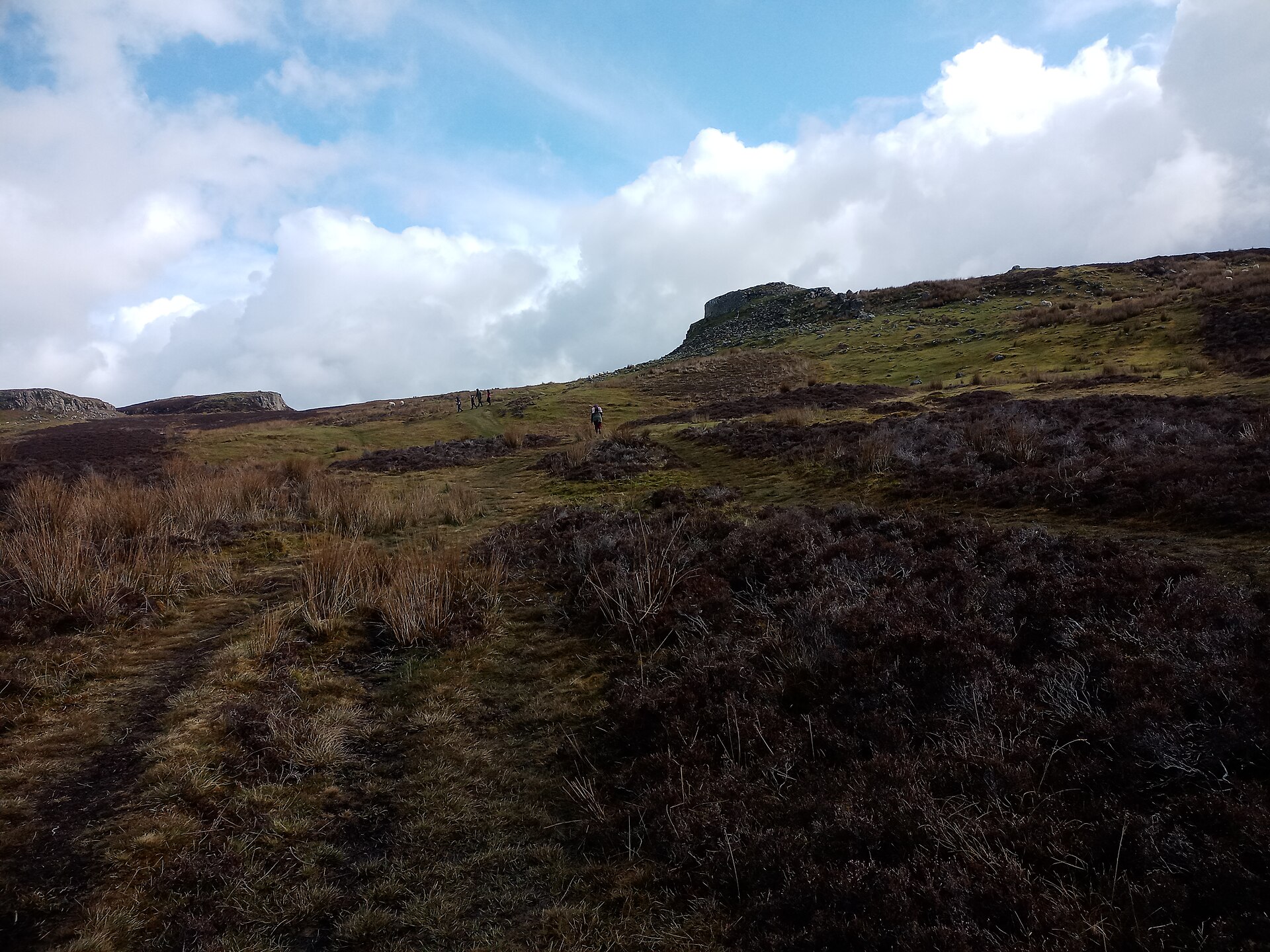
Photo: Victuallers / Wikimedia Commons / CC BY-SA 4.0 Excavated by the same Countess Vincent Baillet de Latour roughly twenty years after her 1892 dig at Dun Fiadhairt, and carried out with markedly more care and better recorded results.
Discovery & excavation
The Countess Vincent Baillet de Latour excavated Dun Fiadhairt around 1892, recovering pottery, a large quantity of corroded iron refuse, worked stone tools including a rotary quern, whetstone, hammerstone and spindle whorls, a fragment of an armlet, coloured glass beads, 59 cylindrical amber beads likely once strung as a necklace, and a baked clay object interpreted as a Roman votive model of a wool bale. Little record survives of the excavation's methods or exact find locations.
What to look for
-
The broch wall and mural gallery
The outer wall stands some 16.8 metres across, built hollow so a stairway and a ground-level gallery run through its thickness rather than a single solid mass of stone.
-
The entrance passage and guard cells
A 3.7-metre passage on the west side leads into the broch, flanked by two opposing guard cells set into the wall where the entrance could be watched.
-
The second, narrower opening
A smaller passage cuts right through the wall from the mural gallery, forming a subsidiary entrance whose age relative to the rest of the broch remains uncertain.
-
The loch-side knoll setting
The broch occupies a low rocky knoll on a peninsula reaching into the east side of Loch Dunvegan, giving wide views across the water and surrounding moorland.
Plan your visit
- Location
- 57.4593°N · 6.6186°W
- Nearest settlement
- Dunvegan
- Access
- Open access
- Terrain
- Rough ground — reasonable boots advised
- Time needed
- About 45 minutes
- Best time
- Daylight, for the loch-side knoll, entrance passage and mural gallery.
- What survives
- The broch’s 16.8-metre double wall, entrance passage, guard cells and mural gallery remain legible on the rocky knoll.
Opening & admission
- Moorland broch on a low knoll beside Loch Dunvegan; source gives location but not formal access.
Nearby places
Fortified place · Iron Age
Dun Hallin
Highland
Its walls still rise close to four metres, with an intact mural gallery and lintel in place: one of Skye's better-preserved brochs, and one never d…
- Near Hallin
- Some walking

Fortified place · Iron Age
Dun Borrafiach
Highland
A drystone tower on Skye's Waternish coast still stands over two and a half metres high, with its internal gallery wall exposed to view along the e…
- Near Halistra
- Rough ground
Fortified place · Iron Age
Dun Beag
Highland
A countess spent six years hand-sifting its spoil heaps, and coins running from Henry II to George III show this Skye tower stayed in use long afte…
- Near Inverness
- Some walking

Fortified place · Iron Age
Dun Ardtreck
Highland
A cliff-edge Skye fort twice built and twice destroyed by fire: one of the clearest examples anywhere of the transitional "semi-broch (a tall circu…
- Near Tokavaig
- Rough ground
The setting
Near Dun Fiadhairt, about 32 metres away.
Photo: PaulT (Gunther Tschuch) / Wikimedia Commons / CC BY-SA 4.0
Near Dun Fiadhairt, about 76 metres away.
Photo: PaulT (Gunther Tschuch) / Wikimedia Commons / CC BY-SA 4.0
Near Dun Fiadhairt, about 96 metres away.
Photo: PaulT (Gunther Tschuch) / Wikimedia Commons / CC BY-SA 4.0
Questions people ask
- What is Dun Fiadhairt?
- An Iron Age broch, a tall dry-stone tower, standing on a rocky knoll on a peninsula in Loch Dunvegan on Skye.
- How big is the broch?
- Its outer wall spans about 16.8 metres, enclosing an inner court roughly 9.6 metres across, with a 3.7-metre entrance passage on the west side.
- Who excavated Dun Fiadhairt?
- The Countess Vincent Baillet de Latour dug the site around 1892, though little record survives of her methods; she later excavated Dun Beag with more care.
- What was found inside the broch?
- Pottery, iron debris, a rotary quern, a whetstone, spindle whorls, an armlet fragment, glass beads, 59 amber beads, and a clay object thought to be a Roman votive wool-bale model.
- Where is Dun Fiadhairt located?
- On Skye, about 3.5 kilometres northwest of Dunvegan, on a peninsula on the east side of Loch Dunvegan.
Sources
- Wikipedia: Dun Fiadhairt
- Wikimedia Commons: Dun Fiadhairt
Explore more: Fortified places · Iron Age · Highland
The Ancient Codex, in your pocket
Get the Pocket Codex app
Carry the directory with you — Dun Fiadhairt and thousands of ancient places across Britain and Ireland, offline, wherever you roam.