A tower house said to have been built around a living holly tree, its site chosen by tradition after a gold-laden donkey lay down to rest beneath it.
At the core of Cawdor Castle stands a stunted, blackened stump, cased in stone at the foot of the tower — the remains of a holly tree that tradition holds decided where the castle would stand. According to the story, a donkey loaded with gold was turned loose to find a resting place, and the spot where it lay down under the tree was chosen as the site of the stronghold. Scientific dating of the wood has shown the tree died around 1372, a detail that fits remarkably well with the earliest stonework in the tower, itself dated to roughly the same period.
The formal history begins later, in 1454, when William Calder, 6th Thane of Cawdor, was granted a licence to fortify the site, and the tower house that still forms the castle’s heart rose in the years around that date. What followed was centuries of steady enlargement rather than a single building campaign: marriages brought new wealth and new wings, generations of the Campbell family who inherited the estate added ranges and gardens, and by the 19th century the tower had been enclosed within a full courtyard reached by drawbridge. The result is a building that reads, room by room, as a record of the family that has held it for over five hundred years.
Cawdor is also inseparable from a name it never earned in life: Shakespeare’s Macbeth, made “Thane of Cawdor” in the play, ruled and died more than three centuries before this castle was built, and the connection is a literary invention rather than a historical one.
What follows is drawn from published sources, with each claim labelled by how firmly it is established.
History
Architectural dating places the oldest stonework in the tower house at around 1380, and a tree once enclosed within its lowest level — the remains of which can still be seen — is known from scientific testing to have died around 1372, closely matching that estimate. Tradition explains the tree's presence with a story of a donkey laden with gold that lay down to rest beneath it, after which the spot was chosen as the site of the castle.
The earliest documented date for the castle is 1454, when a licence to fortify was granted to William Calder, 6th Thane of Cawdor, formalising work that may already have been under way. Around 1455 an iron yett, or gate, was brought to Cawdor from Lochindorb Castle after William had it dismantled on the orders of King James II, following its forfeiture by the Earl of Moray, and the gate remains at Cawdor today.
In 1510 Muriel Calder, heiress to the Thanes of Cawdor, married Sir John Campbell of Muckairn, bringing the castle into Campbell ownership, a line that continues to the present. The couple set about extending the castle, and their children included Katherine Campbell, later Countess of Crawford. Further improvements followed under John Campbell, 3rd of Cawdor, who also purchased substantial lands on the island of Islay.
By 1635 a garden had been laid out at Cawdor, and after the Restoration Sir Hugh Campbell of Cawdor added or improved the castle's north and west ranges, employing the masons James and Robert Nicolson of Nairn for the work. These additions extended the castle well beyond its original tower house footprint.
In the 1680s Sir Alexander Campbell, son of Sir Hugh, was stranded by a storm at Milford Haven in Wales, where he met and later married a local heiress, Elizabeth Lort of Stackpole Court. Afterwards the Campbells of Cawdor lived mainly on their Pembrokeshire estates, leaving younger sons of the family to manage Cawdor itself, where they built a walled flower garden in 1720 and established extensive new woodlands through the later 18th century.
John Campbell of Cawdor, a Member of Parliament, married a daughter of the Earl of Carlisle in 1789 and was ennobled as Lord Cawdor in 1796; his son was created Earl Cawdor in 1827. Through the 19th century Cawdor served mainly as a summer residence for the Earls, and during this period the architects Thomas Mackenzie and Alexander Ross were commissioned to add southern and eastern ranges, enclosing a courtyard reached by a drawbridge.
In the 20th century John Campbell, 5th Earl Cawdor, moved permanently to the castle, and his second son James Campbell was born there in 1942. The 5th Earl was succeeded by the 6th Earl, whose second wife, the Dowager Countess Angelika — born Countess Lažanský, from Bohemia — continues to live at Cawdor, having in 2001 opposed her stepson's plans to sow genetically modified rapeseed on the estate.
People
-
William Calder, 6th Thane of Cawdor
Granted the 1454 licence to fortify that gives the castle its earliest documented date.
-
Muriel Calder
Heiress of the Calders whose 1510 marriage to Sir John Campbell of Muckairn brought Cawdor into Campbell ownership.
-
Sir John Campbell of Muckairn
Married Muriel Calder in 1510 and began extending the castle under Campbell ownership.
-
John Campbell, 3rd of Cawdor
Purchased substantial lands on Islay and oversaw further improvements to the castle, active c.1576–c.1642.
-
Sir Hugh Campbell of Cawdor
Added or improved the north and west ranges after the Restoration, employing local masons.
-
Sir Alexander Campbell
Married Elizabeth Lort of Stackpole Court in the 1680s, shifting the family's main residence to Pembrokeshire.
-
Elizabeth Lort
Heiress of Stackpole Court whose marriage to Sir Alexander Campbell linked Cawdor to Pembrokeshire estates.
-
John Campbell, 1st Lord Cawdor
MP later ennobled as Lord Cawdor in 1796; his son became the 1st Earl Cawdor in 1827.
-
Thomas Mackenzie and Alexander Ross
Architects commissioned to add the southern and eastern ranges enclosing the courtyard.
-
Angelika Campbell, Dowager Countess Cawdor
Widow of the 6th Earl Cawdor, born Countess Lažanský of Bohemia, who still lives at the castle.
Cultural influences
-
Scottish tower-house development
Cawdor grew from a late medieval tower house into a larger courtyard castle through Campbell additions in the seventeenth century and nineteenth-century ranges by Thomas Mackenzie and Alexander Ross.
Connections
-
Lochindorb Castle
Cawdor's iron yett, or gate, was brought from Lochindorb Castle around 1455 after William Calder had it dismantled on the orders of King James II.
-
Stackpole Court, Pembrokeshire
The Campbells of Cawdor took on this Welsh estate through the 1680s marriage of Sir Alexander Campbell to its heiress, Elizabeth Lort, and made it their main residence for generations.
-
Islay
John Campbell, 3rd of Cawdor, purchased substantial lands on the island, extending the family's holdings beyond the Cawdor estate.
-
Shakespeare's Macbeth
The play gives its title character the invented title 'Thane of Cawdor', a fiction created by the 15th-century writer Hector Boece rather than a historical fact, and one the castle itself predates.
Discovery & excavation
Modern scientific testing on the remains of the holly tree enclosed within the tower's lowest level showed the tree died around 1372, a finding that supports architectural dating of the oldest stonework to approximately 1380 and pushes the castle's origins earlier than its first documentary record of 1454.
In culture
-
Macbeth
William Shakespeare's tragedy makes its title character 'Thane of Cawdor', giving the castle a lasting literary association even though the play never mentions the building directly and the historical King Macbeth lived long before it was built.
What to look for
-
The holly tree remains
A stump and roots of the original holly tree, cased within the tower's lowest level, said to have died around 1372.
-
The iron yett
An iron gate brought to Cawdor from the dismantled Lochindorb Castle around 1455.
-
The Walled Garden, Flower Garden, and Wild Garden
Three distinct gardens dating from the 17th century, the 18th century, and the 1960s respectively, set within grounds also holding extensive woodland and over 100 recorded species of lichen.
-
The courtyard and drawbridge
Southern and eastern ranges added by architects Thomas Mackenzie and Alexander Ross to enclose a courtyard, still reached by a working drawbridge.
What is said
Folklore and tradition, recorded as what is said — not as established fact.
-
The donkey and the holly tree
Tradition holds that a donkey laden with gold was released to choose the site of the castle, and that where it lay down to rest beneath a holly tree marked the spot selected for the tower house; the remains of the tree can still be seen in the castle's lowest level.
Plan your visit
- Location
- 57.5243°N · 3.9266°W
- Time needed
- About 120 minutes
- Best time
- Visit during published castle, garden or event opening periods and check current arrangements before travelling.
- What survives
- The inhabited castle retains its medieval tower around the holly-tree remains, later courtyard ranges and three historic gardens, with public access confined to the visiting season.
- Facilities
- Visitor facilities depend on the current estate operation; check the official information before travelling.
Opening & admission
Open daily from 25 April to 4 October 2026, 10am–5pm. Castle, gardens, grounds and nature trails require paid admission; tickets can be booked online or bought on arrival.
- Last entry is at 5pm.
Nearby places

Fortified place · Iron Age
Dun Evan
Highland
A double ring of vitrified (burnt so fiercely that the stone melted and set again) and rebuilt walls crowns a rock between two river valleys, with…
- Near Cawdor
- Some walking
Minor monument · Medieval
Dovecot, Kilravock Castle
Highland
Kilravock’s pigeon house, built to keep birds for winter meat, makes the estate’s long-running economy tangible within a building altered from medi…
- Near Cawdor

Tomb or burial place · Prehistoric
Clava cairn
Highland
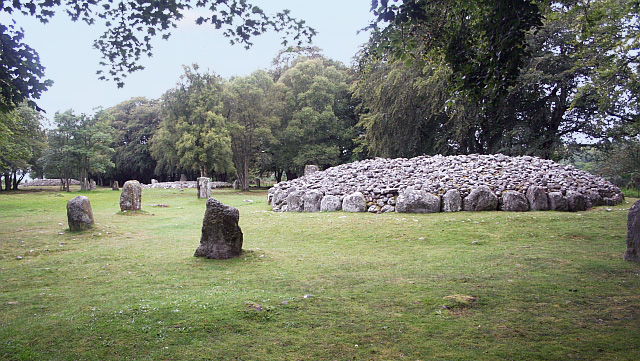
A burial mound of piled stones at Balnuaran of Clava, whose kerb stones were sorted by colour before they were laid.
- Near Inverness
- Some walking
Tomb or burial place · Prehistoric
Clava Cairns
Highland
Clava’s planned arrangement of cairns and standing stones offers rare evidence of a single communal decision about burial and remembrance, rather t…
- Near Inverness
- 149 metres from car park
- Easy path
Questions people ask
- Is Cawdor Castle connected to Shakespeare's Macbeth?
- Only by name. Shakespeare's play makes Macbeth 'Thane of Cawdor', but the historical Macbeth ruled centuries before the castle existed, and it is never mentioned in the play itself.
- How old is Cawdor Castle?
- The earliest documented date is 1454, when a licence to fortify was granted, though stonework and a tree remain dated to around 1380 and 1372 respectively.
- Why was the castle built around a holly tree?
- Tradition says a gold-laden donkey was let loose to choose the site, and it lay down to rest beneath the tree, which was then built into the tower's lowest level.
- Who owns Cawdor Castle today?
- It remains in Campbell ownership, currently home to Angelika Campbell, Dowager Countess Cawdor, widow of the 6th Earl Cawdor.
- What gardens are at Cawdor Castle?
- The Walled Garden (17th century), the Flower Garden (18th century), and the Wild Garden, added in the 1960s, along with woodland and over 100 lichen species.
Sources
- Wikipedia: Cawdor Castle
- The Book of the Thanes of Cawdor (Spalding Club, 1859)
Explore more: Fortified places · Medieval · Highland
The Ancient Codex, in your pocket
Get the Pocket Codex app
Carry the directory with you — Cawdor Castle and thousands of ancient places across Britain and Ireland, offline, wherever you roam.