Auchendavy was an Antonine Wall fort with an exceptional concentration of inscriptions, altars and military finds, despite severe damage from the Forth and Clyde Canal.
Between the Forth and Clyde Canal and the road north of Kirkintilloch, a mound marks the damaged footprint of Auchendavy. Much of the fort was destroyed by canal construction, yet its finds make it one of the most richly evidenced Antonine Wall sites.
Altars to a wide range of Roman deities and a substantial scatter of military material offer a rare glimpse of soldiers’ religious life and equipment. The fort also belonged to the chain guarding the southern bank of the River Kelvin.
Much of the archaeology of the site was destroyed by the builders of the Forth and Clyde Canal. Between Bar Hill and Balmuildy the wall roughly follows the southern bank of the River Kelvin, and the fort stood north of Kirkintilloch’s northern boundary; it can be made out as a mound midway between the canal and the road.
Sir George Macdonald, who wrote up the excavation, observed that Auchendavy is distinguished for the large number of antiquities found in and about it — the phrase taking in Shirva Farm at Twechar, where several tombstones were recovered.
A centurion named Marcus Cocceius Firmus, a soldier of the Second Augusta Legion, dedicated as many as five of the altars found here. A sandstone altar to Jupiter and Victory came from a pit south-west of the fort. There is also an altar to Silvanus; another sandstone altar dedicated to the Presiding Spirit of the Land of Britain, found nearby; another to Diana and Apollo; and yet another to Mars, which carries dedications besides to Minerva, the parade-ground goddesses, Hercules, Epona and Victory.
Other finds include a distance slab of the Twentieth Legion Valiant and a fragment of a male torso. Gordon and others speak of coins, among them a gold solidus of Trajan. The ballista bullets recovered are said to have numbered upwards of fifty, and two iron mallets were also found.
A garrison of about five hundred was the norm on this frontier, rising to a nominal thousand at the largest posts like Castlecary and Birrens. Soldiers were forbidden to marry, which did not prevent women and children living at the bigger forts, and civilian settlement gathered around them regardless.
What follows is drawn from published sources, with each claim labelled by how firmly it is established.
History
Auchendavy was a Roman fort on the Antonine Wall, north of Kirkintilloch’s northern boundary. Between Bar Hill and Balmuildy, the Wall follows the southern bank of the River Kelvin. Canal builders destroyed much of the archaeology when constructing the Forth and Clyde Canal, but the site can still be identified as a mound between canal and road.
The fort is distinguished by the large number of antiquities found in and around it. Marcus Cocceius Firmus, a centurion of the Second Augusta Legion, dedicated as many as five altars. Recorded dedications include Jupiter and Victory, Silvanus, the Presiding Spirit of Britain, Diana and Apollo, Mars, Minerva, Hercules, Epona and other divinities.
Other finds include a distance slab of the Twentieth Legion Valeria Victrix, a male torso fragment, coins including a gold solidus of Trajan, more than fifty ballista bullets and two iron mallets. Further material came from nearby Shirva Farm at Twechar, illustrating that the fort’s archaeological landscape extended beyond the surviving mound.
People
-
Marcus Cocceius Firmus
Centurion of the Second Augusta Legion who dedicated at least five altars at the fort.
Cultural influences
-
Auchendavy occupied the River Kelvin corridor of the Antonine Wall, between the larger forts at Bar Hill and Balmuildy.
Connections
-
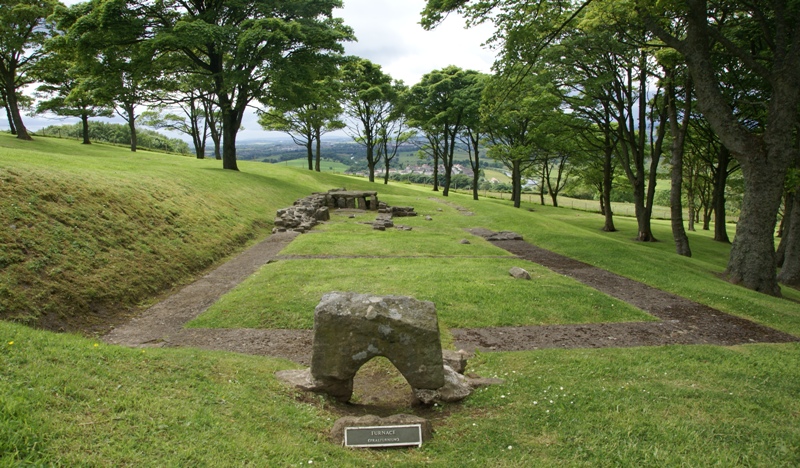
Photo: Otter / Wikimedia Commons / CC BY-SA 3.0 A neighbouring Antonine Wall fort, providing a direct comparison with Auchendavy’s role in the Roman frontier system.
-
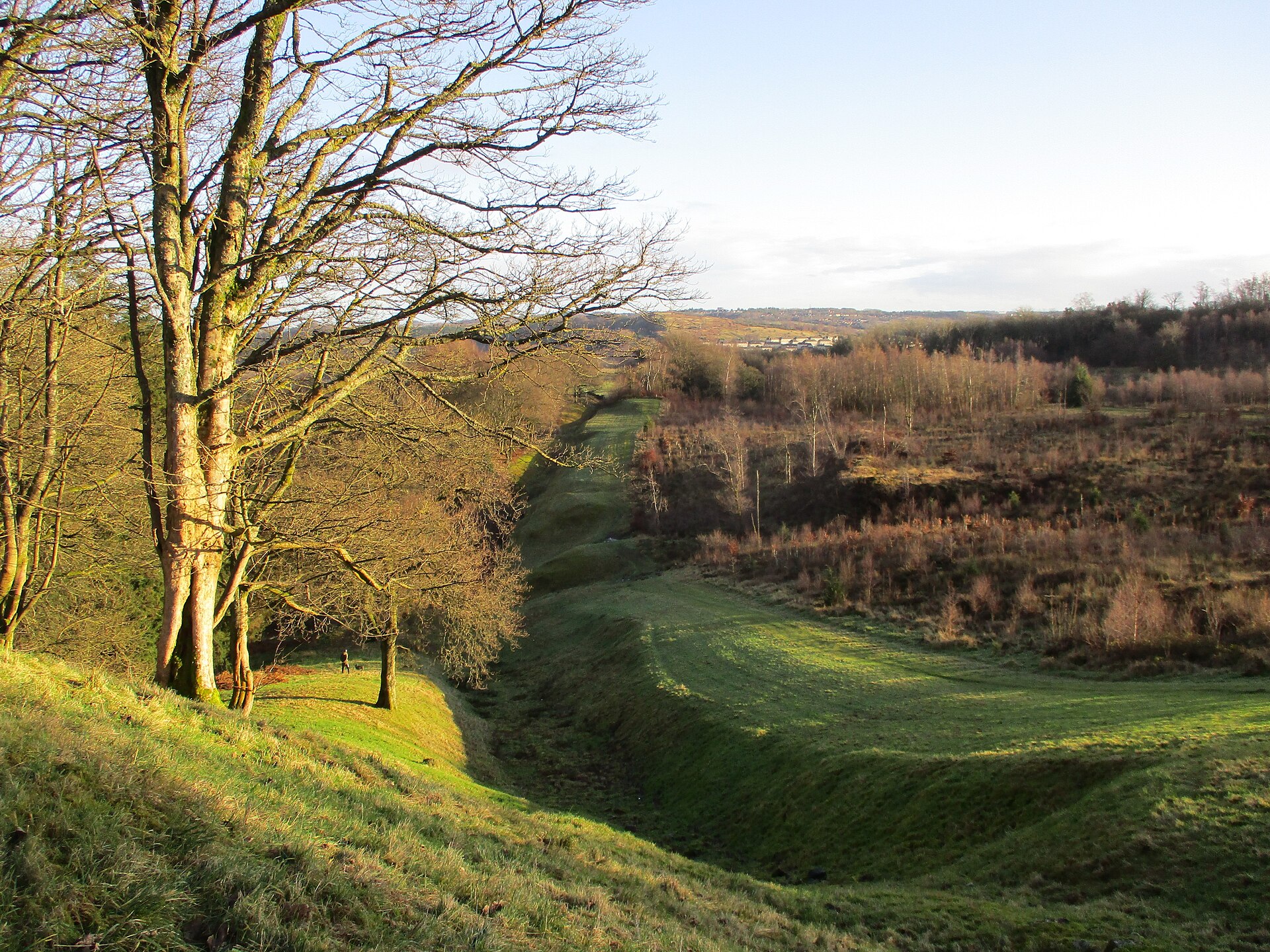
Photo: Alan O'Dowd / Wikimedia Commons / CC BY-SA 2.0 Auchendavy formed part of the Antonine Wall frontier, so the surviving fort record belongs to the wider barrier and its associated military installations.
-
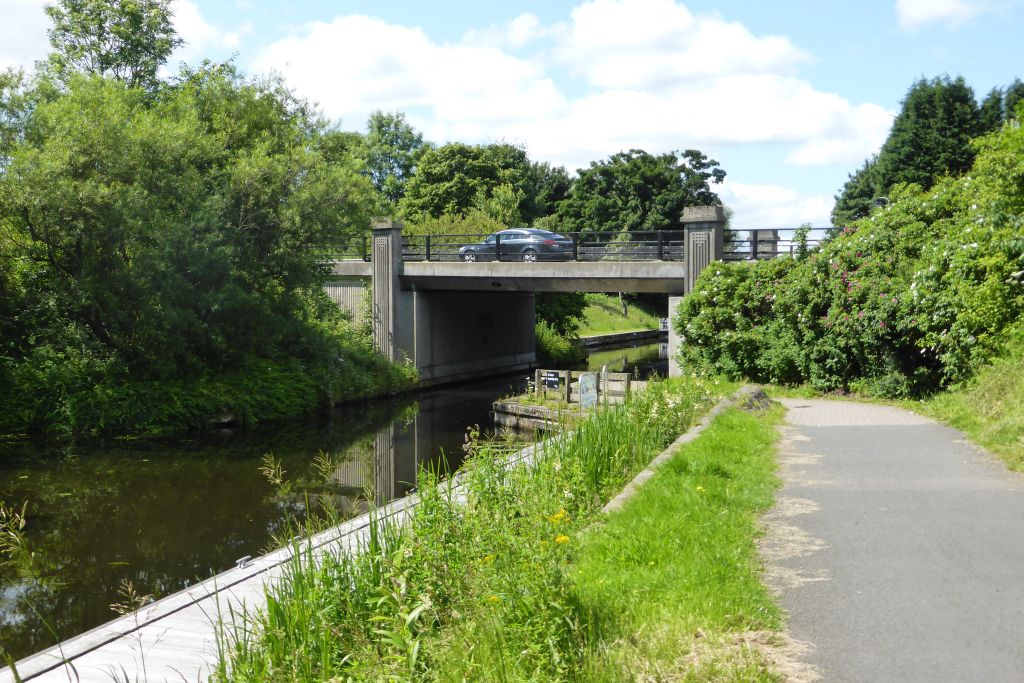
Photo: Robert Murray / Wikimedia Commons / CC BY-SA 2.0 Another Roman fort in the same frontier corridor, showing the concentration of military sites along this section of the Wall.
Discovery & excavation
Canal construction removed much of the fort, but a mound between canal and road still marks its site and its altars and distance slab record the garrison.
What to look for
-
The surviving mound
A mound between the Forth and Clyde Canal and road still marks the fort, despite canal construction destroying much of its archaeology.
-
The Kelvin corridor
Auchendavy lay in the River Kelvin corridor between Bar Hill and Balmuildy, where the Antonine Wall follows the southern bank of the river.
-
The canal cut
The canal corridor shows why the fort is fragmentary: its construction removed much of the Roman archaeology, leaving the mound as the main marker.
-
The altars found here
Finds record a diverse garrison shrine, including Firmus’s altars and a Twentieth Legion distance slab, alongside ballista bullets and a Trajan coin.
Plan your visit
- Location
- 55.9492°N · 4.1194°W
- Nearest settlement
- Kirkintilloch
- Access
- Open access
- Terrain
- Moderate walking
- Time needed
- About 45 minutes
- What survives
- A surviving mound marks the fort between the canal and road; its buildings are gone, but the Kelvin frontier corridor remains clear.
Opening & admission
The surviving mound can be viewed between the canal and road from lawful public approaches, but formal visitor access is not confirmed; check current local rights of way and take care beside traffic and water.
- Much archaeology was destroyed by canal construction.
- The fort is visible as a mound near the Forth and Clyde Canal.
Nearby places
Fortified place · Roman
Bar Hill Fort
East Dunbartonshire
Bar Hill’s fort, bathhouse and deep well preserve unusually direct evidence of Antonine Wall garrison life, including shoes that may point to women…
Fortified place · Roman
Antonine Wall
East Dunbartonshire
The Antonine Wall was Rome’s short-lived northern frontier, joining nineteen forts to carved distance slabs whose paint, imagery and military messa…
- Near Kirkintilloch
Crossing or structure · Roman
Glasgow Bridge, Kirkintilloch
East Dunbartonshire
Glasgow Bridge marks a largely invisible Antonine Wall fortlet known through aerial evidence, beside a canal crossing that now connects Kirkintillo…
- Near Kirkintilloch
- Easy path

Fortified place · Roman
Croy Hill
North Lanarkshire
Croy Hill is the Antonine Wall’s exceptional unditched sector, combining difficult geology, frontier forts, a bathhouse and rich religious finds.
Questions people ask
- What damaged Auchendavy’s archaeology?
- Much of the site was destroyed during construction of the Forth and Clyde Canal.
- What is Auchendavy especially known for?
- It is known for the large number of antiquities found in and around the fort, including numerous altars.
- Which legion dedicated a distance slab here?
- A distance slab of the Twentieth Legion Valeria Victrix was found at Auchendavy.
Sources
The Ancient Codex, in your pocket
Get the Pocket Codex app
Carry the directory with you — Auchendavy and thousands of ancient places across Britain and Ireland, offline, wherever you roam.