
Its 1637 prayer-book riot lit the fuse for the National Covenant and the Wars of the Three Kingdoms, earning St Giles' the title 'the Mother Church of World Presbyterianism'.
Above the High Street of Edinburgh’s Old Town, a crown of stone rises from the central tower of St Giles’ Cathedral: eight slender flying buttresses, four springing from the tower’s corners and four from the middle of each side, meeting at a small spire overhead. Dendrochronology dates this crown steeple to between 1460 and 1467, and it is one of only two medieval crown steeples to survive anywhere in Scotland. Seen from below on the Royal Mile, it has long served as one of the city’s most recognisable landmarks, on a site the Royal Commission on the Ancient and Historical Monuments of Scotland once called “the central focus of the Old Town.”
The building the steeple crowns has changed shape and purpose again and again. A small Romanesque parish church founded around 1124 was rebuilt as a Gothic collegiate church across the 14th and 15th centuries, then stripped of its altars and images when the Scottish Reformation reached Edinburgh in 1559 and John Knox became its minister. For much of the century that followed, the interior was carved up by partition walls into as many as four separate congregations, while parts of the building did service as a prison, a courtroom and a meeting place for the Parliament of Scotland. A market trader’s gesture in 1637 – tradition holds that Jenny Geddes threw her stool at the dean during a disputed prayer-book service – is remembered as the spark that led to the National Covenant and, in turn, the Wars of the Three Kingdoms.
St Giles’ remains an active parish church of the Church of Scotland, known also as the High Kirk of Edinburgh, and one of the country’s most visited historic buildings, drawing well over a million visitors in 2018 alone. It has continued to host events of state: in September 2022 the coffin of Queen Elizabeth II lay at rest inside for twenty-four hours, guarded by the Royal Company of Archers, and in July 2023 the Honours of Scotland were presented to King Charles III within its walls.
What follows is drawn from published sources, with each claim labelled by how firmly it is established.
The name
St Giles' is dedicated to Saint Giles, patron saint of lepers, who was chiefly associated with the Abbey of Saint-Gilles in what is now France but was widely venerated in medieval Scotland. The church was first held by monks of the Order of St Lazarus, who cared for lepers; if David I or his brother Alexander I founded the church, the dedication may connect to their sister Matilda, who founded a church of St Giles in the Fields in London. The name "High Kirk" is attested from the reign of James VI, and the building has also been known over the centuries as St Giles' Kirk, the Collegiate Church of St Giles, and, since 1633, St Giles' Cathedral.
History
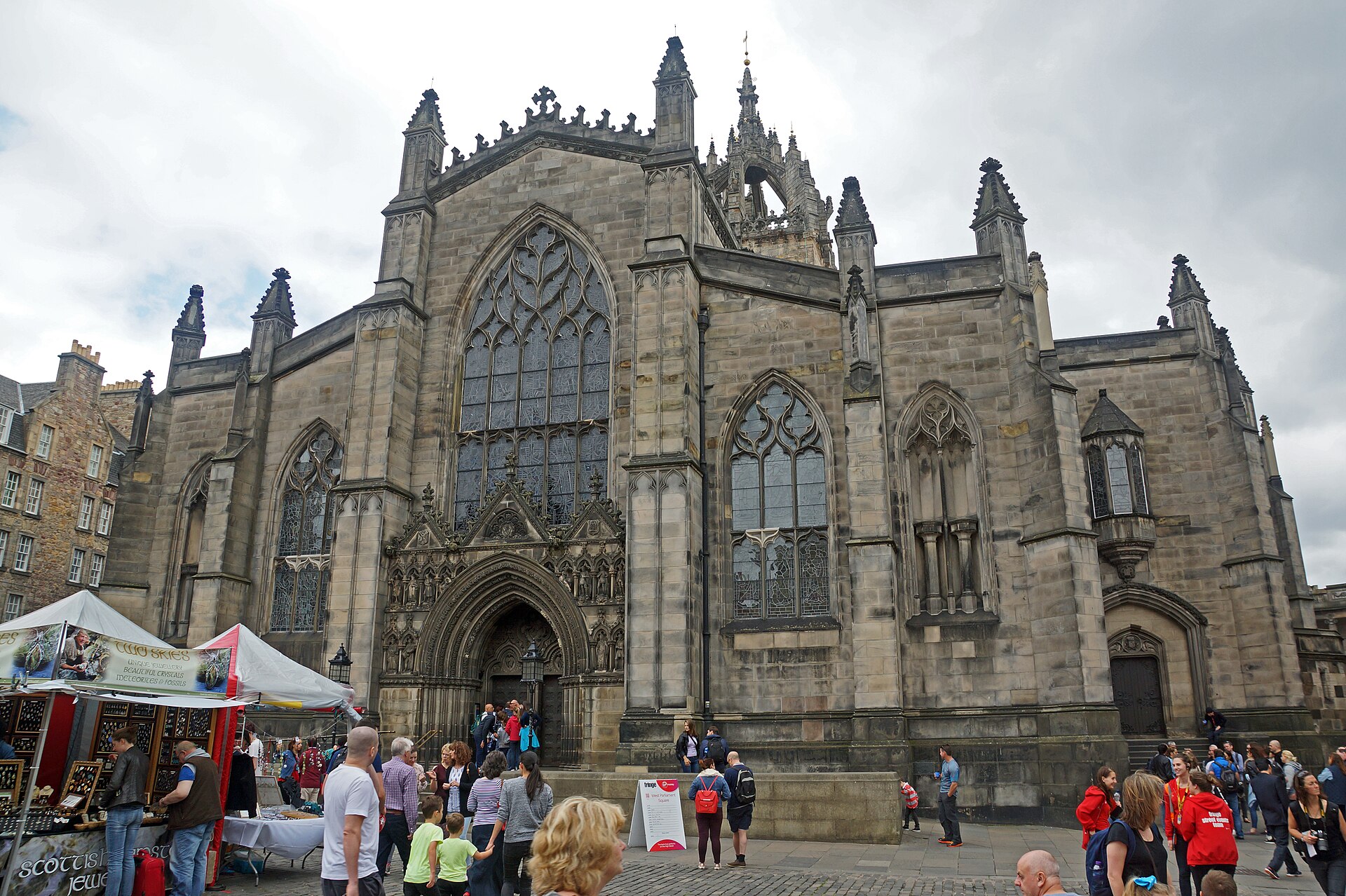
The foundation of St Giles' is usually dated to 1124 and attributed to King David I, in whose reign Edinburgh was raised to a burgh. The earliest church, a small Romanesque building held by monks of the Order of St Lazarus who ministered among lepers, was consecrated by David de Bernham, Bishop of St Andrews, on 6 October 1243. In August 1385, English troops burned Edinburgh, and scorch marks on the crossing pillars were reportedly still visible in the 19th century.
During the 14th century the Romanesque church was replaced by the current Gothic building, with the crossing and nave complete by 1387. Petitions to Rome finally succeeded in February 1467, when Pope Paul II elevated St Giles' to collegiate status, replacing its vicar with a provost, canons and choristers. Around the same period William Preston of Gorton brought the arm bone of Saint Giles from France, and the Preston Aisle was built to house the relic.
The Scottish Reformation reached St Giles' on 29 June 1559, when the Lords of the Congregation entered Edinburgh unopposed and John Knox first preached in the church that afternoon; he was elected minister the following week. After a brief Catholic reconsecration in November 1559, St Giles' became permanently Protestant on 1 April 1560, and workmen took nine days to clear its stone altars, paint its pillars green, and whitewash the walls with the Ten Commandments.
After the Reformation, parts of St Giles' served as a prison, a meeting place for the Parliament of Scotland and the Court of Session, and a weavers' loft. In 1633, Charles I made St Giles' a cathedral for the new Bishop of Edinburgh, but his attempt to impose an English-style prayer book provoked a riot on 23 July 1637, said to have begun when trader Jenny Geddes threw her stool at the dean. The unrest led directly to the National Covenant of February 1638.
St Giles' returned to Presbyterian use after the Covenant, but cathedral status was restored twice more, first from 1661 under Charles II and again before the Glorious Revolution. Cromwell's soldiers had occupied part of the church as a garrison in the 1650s, and Covenanter prisoners were later held above the north door in a cell known as Haddo's Hole. In 1689 the Parliament of Scotland abolished bishops for good, ending the church's formal cathedral status.
Two Victorian campaigns reshaped the church. Between 1829 and 1833, William Burn encased the exterior in ashlar and raised the roofline, work later credited with saving the building from collapse despite critics such as Robert Louis Stevenson condemning its effect. From 1872, William Chambers funded a restoration under William Hay to remove the last partitions and make St Giles' a 'Westminster Abbey for Scotland', reopening in 1883; Robert Lorimer's Thistle Chapel followed in 1911.
St Giles' lost ninety-nine members of its congregation in the First World War and thirty-nine in the Second, each commemorated in the Albany Aisle. In September 2022 the coffin of Queen Elizabeth II lay at rest there for 24 hours, guarded by the Royal Company of Archers, before her children held the Vigil of the Princes; in July 2023 the Honours of Scotland were presented to King Charles III in a national service of thanksgiving.
People
-
David I
King of Scots credited with founding St Giles' around 1124, in whose reign Edinburgh was raised to the status of a burgh.
-

Portrait: William Holl / Wikimedia Commons / Public domain John Knox
Foremost figure of the Scottish Reformation, who first preached in St Giles' on 29 June 1559 and served as its minister until his death in 1572.
-

Portrait: Unknown author / Wikimedia Commons / Public domain Jenny Geddes
Market trader who, according to tradition, threw her stool at the dean during the 1637 prayer-book riot that helped spark the National Covenant.
-
Charles I
King who elevated St Giles' to cathedral status in 1633 and whose attempt to impose a new prayer book provoked rioting in 1637.
-
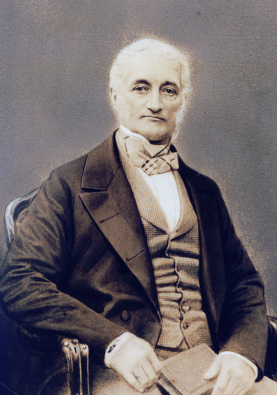
Portrait: Unknown author / Wikimedia Commons / Public domain William Burn
Architect who restored and substantially altered the church's exterior and nave between 1829 and 1833.
-
William Chambers
Publisher and Lord Provost of Edinburgh who funded the 1872–83 restoration aimed at making St Giles' a 'Westminster Abbey for Scotland'.
-
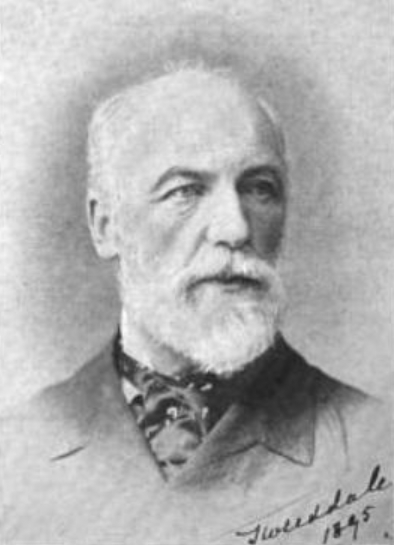
Portrait: Unknown author / Wikimedia Commons / Public domain William Hay
Architect who carried out the 1872–83 restoration, removing the church's last internal partitions.
-
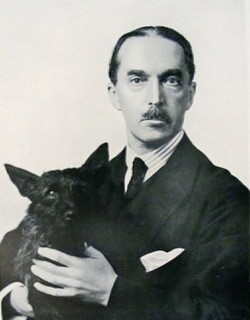
Portrait: Unknown author (The photographer died most probabely 70 / Wikimedia Commons / Public domain Robert Lorimer
Architect who designed the Thistle Chapel, built at the south-east corner of the church between 1909 and 1911.
-
Gilleasbuig Macmillan
Minister of St Giles' from 1973 to 2013, during whose incumbency the interior was reoriented around a central communion table.
Cultural influences
-
Durham Cathedral
When Charles I elevated St Giles' to a cathedral in 1633, work began to remove the internal partition walls and refurnish the interior in the manner of Durham Cathedral.
-
St Nicholas' Church, Newcastle
The design of St Giles' distinctive crown steeple originated in England at St Nicholas' Church, Newcastle, before being introduced to Scotland at St Giles'.
-
Bertel Thorvaldsen's font, Copenhagen
The Caen stone font by John Rhind, carved as a kneeling angel holding a scallop shell, is an exact replica of Bertel Thorvaldsen's font for the Church of Our Lady in Copenhagen.
Connections
-
King's College Chapel, Aberdeen
Shares with St Giles' one of only two surviving medieval crown steeples in Scotland; the Aberdeen steeple dates from after 1505.
-
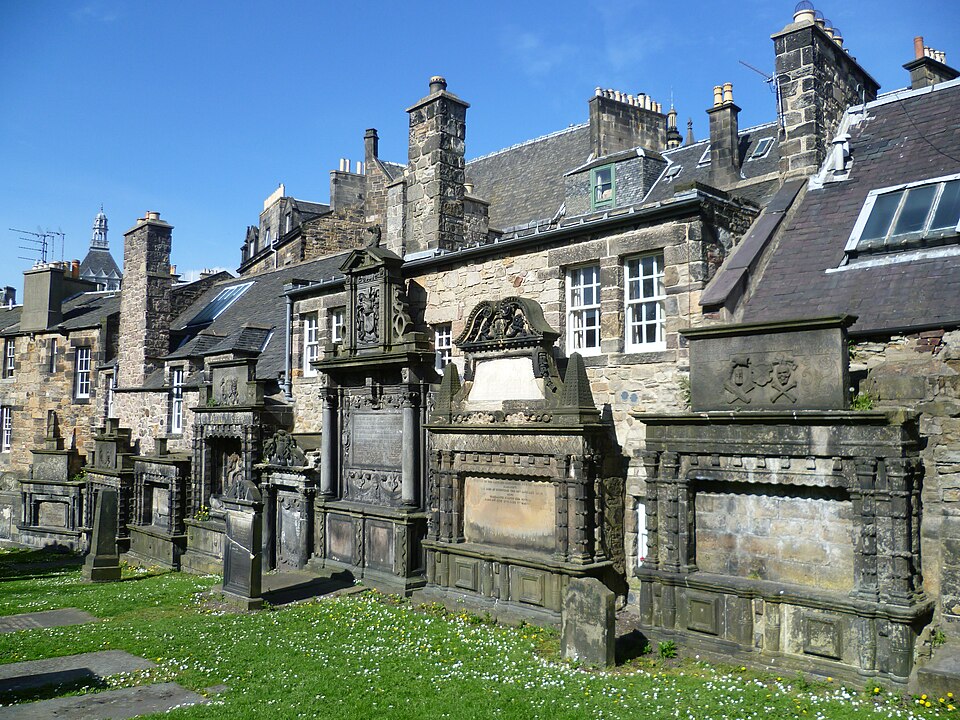
Photo: Kim Traynor / Wikimedia Commons / CC BY-SA 3.0 Became Edinburgh's main burial ground after St Giles' own kirkyard was closed to burials in 1561.
-

Photo: LASZLO ILYES from Cleveland, Ohio, USA / Wikimedia Commons / CC BY 2.0 Served as an alternative place of worship for Roman Catholics during the Reformation, and was the intended chapel of the Order of the Thistle before its interior was destroyed and the order moved to St Giles'.
-
St Mary's Cathedral, Edinburgh
One of Edinburgh's other two cathedrals alongside St Giles'.
-
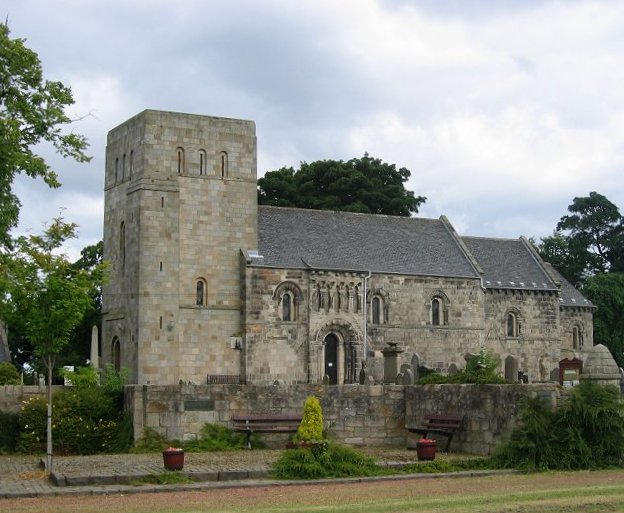
Photo: Richard Webb / Wikimedia Commons / CC BY-SA 2.0 Dalmeny Kirk
The destroyed 12th-century Romanesque church at St Giles' displayed close architectural similarities to this surviving Norman parish church, built between 1140 and 1166.
Discovery & excavation
Archaeological excavations carried out in the 1980s found that the first, 12th-century church was built of pink sandstone and grey whinstone on a substantial clay platform raised to level the sloping ground, with a boundary ditch surrounding the site. The same excavations showed that the choir had been extended to almost its present size in a single building phase before further mid-15th-century work, and uncovered fragments of medieval stained glass, some of it grisaille, within the church.
In culture
-
The Heart of Midlothian (1818)
Walter Scott's novel fictionalises the real-life escape of condemned smuggler George Robertson from the Tolbooth Kirk, part of St Giles', during divine service in 1736.
-
The Prime of Miss Jean Brodie (1961)
Muriel Spark's novel references St Giles' twice, first as a location passed on a walk around Edinburgh and again as one of the 'emblems of a dark and terrible salvation' contemplated by the protagonist, Sandy Stranger.
-
The Disorderly Knights (1966)
In the fourth book of Dorothy Dunnett's Lymond Chronicles, protagonist Francis Crawford of Lymond swears an oath in the Lauder Aisle of St Giles' and duels on the steps of the church's high altar.
-
Avengers: Infinity War (2018)
St Giles' features as one of the filming locations for a fight between the Avengers and Thanos' Black Order, with scenes shot around the cathedral in spring 2017.
What to look for
-
The crown steeple
Dating from between 1460 and 1467, the tower's crown of eight stone flying buttresses is unique among Scotland's medieval crown steeples and one of the city's most recognisable landmarks.
-
The Thistle Chapel
Built between 1909 and 1911 to Robert Lorimer's design at the south-east corner of the church, the chapel of the Order of the Thistle is richly carved by leading figures of the Scottish Arts and Crafts movement.
-
The King's Pillar and Town's Pillar
Two 15th-century pillars in the choir bear carved heraldic capitals recording the arms of James II, James III, Mary of Guelders, and civic figures including William Preston of Gorton.
-
The National Covenant of 1638
An original signed copy of Scotland's National Covenant, bearing signatures including that of the Marquess of Montrose, is displayed in an oak frame in the Chepman Aisle.
-
The great west window
Installed in 1985 and designed by Leifur Breiðfjörð, this stained-glass memorial to Robert Burns replaced an earlier window of 1886.
-
The pipe organ
Completed in 1992 by Rieger Orgelbau, the organ's case, designed by Douglas Laird, imitates the prow of a ship and houses 4,156 pipes.
What is said
Folklore and tradition, recorded as what is said — not as established fact.
-
Jenny Geddes and the stool
Tradition holds that a market trader named Jenny Geddes threw her stool at the dean, James Hannay, during the disputed prayer-book service of 23 July 1637, sparking the riot that led to the National Covenant. An 1885 plaque and a 1992 bronze sculpture of a stool now mark the putative spot.
-
Penance for the Albany Aisle
Local tradition holds that the Albany Aisle, donated by Robert Stewart, Duke of Albany, and Archibald Douglas, 4th Earl of Douglas around 1400, was given in penance for their involvement in the death of David Stewart, Duke of Rothesay, though neither man was otherwise closely associated with the church.
Plan your visit
- Location
- 55.9494°N · 3.1908°W
- Nearest settlement
- Edinburgh
- Access
- Paid entry — managed visitor site
- Terrain
- Easy going
- Time needed
- About 60 minutes
- Best time
- Visit during the published visitor hours and outside worship or major services, when the interior can be viewed respectfully.
- What survives
- St Giles’ is a working medieval cathedral on the Royal Mile, with historic stone pillars, chapels and stained glass; visitor access must accommodate worship and services.
- Facilities
- No dedicated visitor facilities are documented beyond the cathedral’s visitor operation; check the official site before travelling.
Opening & admission
This is a working cathedral open to visitors with an admission charge for some areas; check the official site for current details.
- Level, city-centre site on the Royal Mile
- A wheelchair access ramp was added at the west door
Nearby places

Carved stone · Pictish & early medieval
Bullion Stone
City of Edinburgh
The only Pictish carving to show a man drinking: a bald, bearded rider on a tired horse, lifting a horn that ends in a startled bird's head, cut ju…
- Near Edinburgh
- Easy path

Carved stone · Pictish & early medieval
Woodwrae Stone
City of Edinburgh
The Woodwrae Stone is a richly carved Class II Pictish (of the Picts, the people of northern and eastern Scotland from about AD 300 to 900) cross-s…
- Near Edinburgh
- Easy path
Questions people ask
- Why is St Giles' called a cathedral if the Church of Scotland has no bishops?
- St Giles' held cathedral status from 1633 to 1638 and again from 1661 to 1689, while the Church of Scotland had bishops. Since 1689 it has had none, but St Giles', like Glasgow and Dunblane cathedrals, kept the title anyway.
- What is the crown steeple and why is it significant?
- St Giles' crown steeple, a stone crown of flying buttresses atop the tower, dates from between 1460 and 1467. It is one of only two medieval crown steeples surviving in Scotland, the other at Aberdeen's King's College Chapel.
- What happened at St Giles' in 1637?
- On 23 July 1637, reading a new prayer book modelled on the Church of England's provoked rioting inside St Giles'. Tradition says trader Jenny Geddes threw her stool at the dean, and the unrest led to the National Covenant of 1638.
- What is the Thistle Chapel?
- The Thistle Chapel is the chapel of the Order of the Thistle, added to St Giles' south-east corner between 1909 and 1911 to Robert Lorimer's design, who gathered leading Scottish Arts and Crafts craftspeople to build it.
- Has St Giles' hosted recent royal events?
- Yes. In September 2022, Queen Elizabeth II's coffin lay at rest in St Giles' for 24 hours, guarded by the Royal Company of Archers. In July 2023, King Charles III received the Honours of Scotland there.
Sources
- St Giles' Cathedral, Wikipedia
- Historic Environment Scotland: High Street and Parliament Square, St Giles (High) Kirk, LB27381
- Canmore: Edinburgh, High Street, St Giles Cathedral
- St Giles' Cathedral website
Explore more: Building or ruins · Medieval · City of Edinburgh
The Ancient Codex, in your pocket
Get the Pocket Codex app
Carry the directory with you — St Giles' Cathedral and thousands of ancient places across Britain and Ireland, offline, wherever you roam.