The National Covenant was signed in a graveyard. Not in the kirk beside it — in the yard, on 28 February 1638, because the ground outside was a place of free legal public assembly and the building was not. Later pictures of the scene show men leaning on flat table stones to write; there were no such stones in the kirkyard at the time, central gravestones being under a ban, so the artists supplied furniture the occasion did not have.
Greyfriars Kirkyard surrounds Greyfriars Kirk at the southern edge of Edinburgh’s Old Town, next to George Heriot’s School. It takes its name from the Franciscan friary that stood here — grey habits, grey friars — which was dissolved in 1560. Two years later, in August 1562, royal sanction was granted to lay out a burial ground on the site to replace the one at St Giles’ Cathedral; the burgh council had resolved on the change on 23 April 1561, and St Giles’ ground fell out of use around 1600. Burials have been taking place here ever since, and a long list of notable Edinburgh residents lies in the ground.
The Covenanting story did not end with the signing. After the militant Covenanters were beaten at Bothwell Bridge on 22 June 1679, some 1,200 prisoners were brought to Edinburgh, more than the prison or the castle could take. A field south of the kirkyard was pressed into service for about 400 of them: enclosed by the Flodden Wall on two sides, by the high wall of George Heriot’s School on the west, and on the fourth side by a picket fence that could be watched from the churchyard. The name Covenanters’ Prison stayed with the ground long after the prisoners left. Most of it was built over by the city Bedlam around 1690, and a strip between the Bedlam and the school was taken into the burial ground from about 1700 — which is why that section is dominated by enclosed vaults. The vaults look like cells and are often described as such. They were built after the prisoners had gone.
That corner was open to view until around 1990, when the City of Edinburgh Council locked it against persistent vandalism and use by drug users. It can still be entered by day by arrangement with the guides at Greyfriars Kirk, and at night on a City of the Dead tour, which takes visitors to the Black Mausoleum.
The kirkyard’s other fame is smaller and warmer. Greyfriars Bobby, the dog said to have kept watch over his master’s grave, has a headstone at the entrance, put up by the Dog Aid Society in 1981, marking his reputed burial place — though no part of the kirkyard is unconsecrated ground, so it is also held that he was buried under a tree outside the gates. His statue stands opposite the gate at the junction of George IV Bridge and Candlemaker Row. The grave of John Gray, the Pentland Hills shepherd known as Auld Jock, where the dog is said to have slept for fourteen years, lies on the eastern path some thirty metres north of the entrance. The stone there is modern; the grave was originally unmarked.
In the 1840s the yard served a quite different purpose. David Octavius Hill and Robert Adamson, working in the first years of photography, used it as a setting for portraits and staged tableaux, among them The Artist and The Gravedigger — the stones and the light doing work that a studio could not.
The kirkyard and its monuments are protected as a category A listed building. The ground is operated by the City of Edinburgh Council in liaison with a charitable trust, linked to but separate from the church.
What follows is drawn from published sources, with each claim labelled by how firmly it is established.
History
The kirkyard was founded in August 1562, after royal sanction was granted to replace the burial ground at St Giles' Cathedral, which went out of use around 1600. The Edinburgh burgh council resolved on the change on 23 April 1561. Burials have been taking place here since the late sixteenth century, and a great many notable residents of the city are interred in the ground. The name comes from the Franciscan friary that stood on the site, whose friars wore grey habits. That house was dissolved in 1560, two years before the burial ground was laid out over its ground.
The National Covenant was signed at Greyfriars on 28 February 1638, in the graveyard rather than inside the kirk, because the yard was a place of free legal public assembly. Some depictions show the signatories leaning on table stones; those stones did not exist at the time, the signing falling within the period when central gravestones were banned.
After the defeat of the militant Covenanters at Bothwell Bridge on 22 June 1679, some 1,200 prisoners were brought to Edinburgh. There were too many for the prison or the castle, so a makeshift enclosure was formed in a field south of the kirkyard to hold around 400 of them, closed on two sides by the Flodden Wall, on the west by the high wall of George Heriot's School, and on the fourth by a picket fence that could be patrolled from the churchyard.
The name Covenanters' Prison stuck to the ground even after its use changed. Most of the area was built over by the city Bedlam around 1690, and a remaining strip between the Bedlam and George Heriot's School was taken into the burial ground from about 1700. The enclosed vaults that now dominate that section were built afterwards, so despite their appearance they were never used as cells.
That part of the yard was open to public view until around 1990, when the City of Edinburgh Council locked it to stop persistent vandalism and use by drug users. It can be entered by day by arrangement with the guides at Greyfriars Kirk during opening hours, and at night on a City of the Dead tour, which visits the Black Mausoleum.
The graveyard is associated with Greyfriars Bobby, the dog said to have guarded his master's grave. His headstone at the entrance was erected by the Dog Aid Society in 1981 and marks his reputed burial place, though since no part of the kirkyard is unconsecrated it is also held that he was buried under a tree outside the gates. The grave of the Pentland Hills shepherd John Gray, known as Auld Jock, where the dog is said to have slept for fourteen years, lies on the eastern path about thirty metres north of the entrance, under a modern stone; the grave was originally unmarked.
In the 1840s, in the early days of photography, David Octavius Hill and Robert Adamson used the kirkyard as a setting for several portraits and tableaux, among them The Artist and The Gravedigger. The kirkyard and its monuments are protected as a category A listed building, and the ground is operated by the City of Edinburgh Council in liaison with a charitable trust that is linked to but separate from the church.
What to look for
-
The Covenanters' Prison
A strip of enclosed vaults south of the yard, on ground where some 400 prisoners were held after Bothwell Bridge in 1679. The vaults came later and were never cells. It is locked, and reachable by arrangement or on an evening tour.
-
Auld Jock's grave
On the eastern path, about thirty metres north of the entrance — the grave of the shepherd John Gray, where Greyfriars Bobby is said to have slept for fourteen years. The stone is modern; the burial was originally unmarked.
-
The line of the Flodden Wall
The town wall closes two sides of the old prison ground, which is why that field could be used to hold prisoners at short notice.
-
The absence of table stones
Central gravestones were banned when the National Covenant was signed here in 1638, so the flat stones shown in later depictions of the scene are an invention.
Plan your visit
- Location
- 55.9470°N · 3.1927°W
Nearby places

Carved stone · Pictish & early medieval
Bullion Stone
City of Edinburgh
The only Pictish carving to show a man drinking: a bald, bearded rider on a tired horse, lifting a horn that ends in a startled bird's head, cut ju…
- Near Edinburgh
- Easy path

Carved stone · Pictish & early medieval
Woodwrae Stone
City of Edinburgh
The Woodwrae Stone is a richly carved Class II Pictish (of the Picts, the people of northern and eastern Scotland from about AD 300 to 900) cross-s…
- Near Edinburgh
- Easy path
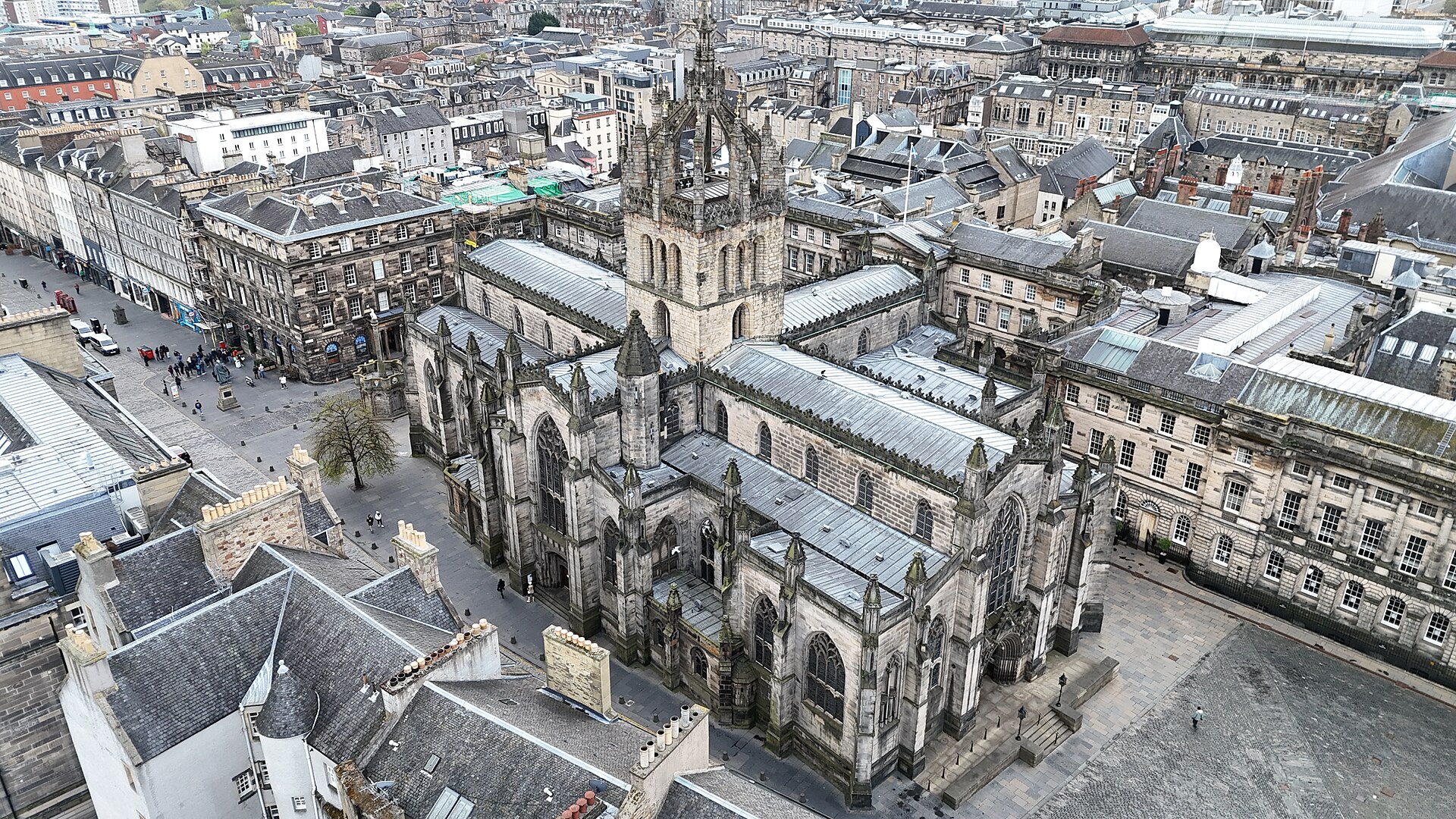
Building or ruin · Medieval
St Giles' Cathedral
City of Edinburgh
Its 1637 prayer-book riot lit the fuse for the National Covenant and the Wars of the Three Kingdoms, earning St Giles' the title 'the Mother Church…
- Near Edinburgh
- Easy path
Questions people ask
- Why is it called Greyfriars?
- After the Franciscan friary that stood on the site — the friars wore grey habits. The house was dissolved in 1560, and the burial ground was laid out here two years later.
- What happened here in 1638?
- The National Covenant was signed on 28 February, in the graveyard rather than inside the kirk, because the yard was a place of free legal public assembly. Depictions showing signatories leaning on table stones are wrong: those stones did not exist then, central gravestones being banned at the time.
- What is the Covenanters' Prison?
- A makeshift enclosure formed in a field south of the kirkyard after the defeat at Bothwell Bridge on 22 June 1679, to hold around 400 of the 1,200 prisoners brought to Edinburgh. The vaulted tombs that now stand in that section were built later and were never used as cells.
- Is Greyfriars Bobby buried here?
- His headstone at the entrance, erected by the Dog Aid Society in 1981, marks his reputed burial place, but since no part of the kirkyard is unconsecrated it is also held that he was buried under a tree outside the gates. The grave of John Gray, Auld Jock, where the dog is said to have slept for fourteen years, lies about thirty metres north of the entrance on the eastern path.
The Ancient Codex, in your pocket
Get the Pocket Codex app
Carry the directory with you — Greyfriars Kirkyard and thousands of ancient places across Britain and Ireland, offline, wherever you roam.