The only Pictish carving to show a man drinking — a bald, bearded rider on a tired horse, lifting a horn that ends in a startled bird's head, cut just as the kingdom of the Picts was giving way to Alba.
A bald, bearded man rides a horse whose head has dropped with tiredness, a round shield on one arm and a drinking horn raised in the other hand — a horn so large that its tip curls back behind his shoulder and finishes in the head of a bird with a startled expression. Nothing else quite like it survives from Pictish Scotland, the Picts being the people of the north and east of the country from roughly AD 300 to 900, and it is the figure rather than the slab that repays crossing a museum floor.
The stone stands about 1.88 metres tall, 0.73 metres wide and some 0.15 metres thick, and is dated to roughly AD 900–950. That puts it at the very end of the Pictish sequence, in the generation when the kingdom of the Picts was giving way to Alba, and it belongs to the latest group of Pictish sculpture — the one that carves figures and Christian scenes rather than the older abstract symbols. It is catalogued as Invergowrie II, the second of three carved slabs recovered from the same parish.
It was found in 1933, in a field called Bullion at Invergowrie on the north shore of the Tay, turned up by roadworks rather than by excavation. That matters for what can be said about it: nobody recorded how it stood, what faced it, or what lay in the ground around it. Angus County Council handed the slab to the National Museum in Edinburgh in 1935, and it has been on display there ever since.
Invergowrie was no accidental findspot. The parish church, dedicated to St Curetán and set on a mound above the Gowrie Burn, was an early Christian site, and two more carved stones have come from it. Invergowrie I is an early-ninth-century cross-slab worked on five faces, an interlaced cross on the front and, on the back, three stylised clerics — one apparently holding a charter with its seal — above a pair of dragon-like beasts. A third slab, smaller and damaged, is also in Edinburgh but is not displayed. Set beside those two, the Bullion Stone is the latest and the odd one out: where the others are church sculpture, this one shows a man drinking.
The horn has drawn more comment than the horseman. Its bird’s-head terminal has been likened to the Torrs Horns, a pair of decorated bronze horns held in the same museum and made the better part of a thousand years earlier. Whether that resemblance is a survival, a deliberate revival, or nothing at all has never been settled — the two objects sharing a building makes the comparison easy to reach for, which is not the same as making it true.
What follows is drawn from published sources, with each claim labelled by how firmly it is established.
History
The slab was cut and carved at some point around AD 900 to 950, at the very close of the Pictish sequence, in the generation when the kingdom of the Picts was giving way to the kingdom of Alba. It belongs to the latest group of Pictish sculpture, carved with figures and Christian imagery rather than the older abstract symbols, and it is catalogued as Invergowrie II — the second of three carved stones recovered from the same parish.
Its subject is a single rider, and no other Pictish carving repeats it. A bald, bearded man sits a horse whose head has dropped with tiredness. He carries a shield on one arm and lifts a drinking horn with the other, and the horn is enormous, its tip curling back behind his shoulder to finish in the head of a bird with a startled expression.
The bird's-head terminal has invited comparison with the Torrs Horns, a pair of decorated bronze horns held in the same museum and made the better part of a thousand years before this slab was cut. Whether the resemblance represents a survival, a deliberate revival or nothing at all has never been settled, and the two objects sharing a building makes the comparison easy rather than demonstrated.
The stone came to light in 1933 in a field called Bullion at Invergowrie, turned up during the building of a road rather than by excavation, so nothing is known of how it stood or what lay around it. Angus County Council transferred it to the National Museum in Edinburgh in 1935, and it has been on display there since.
Invergowrie was not an accidental findspot. The parish church, dedicated to St Curetán and standing on a mound above the Gowrie Burn, was an early Christian foundation, and two further carved slabs have come from it. Invergowrie I is an early-ninth-century cross-slab carved on five faces, with an interlaced cross on the front and, on the back, three stylised clerics — one of them apparently holding a charter with its seal — above a pair of dragon-like beasts. A third, smaller and damaged, is also in Edinburgh but is not on public display.
Cultural influences
-
Late Pictish sculpture at the coming of Alba
The slab belongs to the late Pictish tradition of figurative and Christian carving, made around AD 900–950 as Pictish kingdoms gave way to Alba.
Connections
-
Invergowrie
The stone was found in a field in this parish on the north shore of the Tay, and is catalogued as the second of three carved slabs recovered there.
-
Old Parish Church of Invergowrie
The early Christian site, dedicated to St Curetán, that produced the other two Invergowrie carved stones; the Bullion Stone is the latest and the least ecclesiastical of the three.
-
National Museum of Scotland, Edinburgh
The slab has been in the museum's care since 1935 and is displayed there, alongside the Torrs Horns its drinking horn has been compared with.
Discovery & excavation
Road construction uncovered the slab in 1933 in Bullion field at Invergowrie. Its original setting and any associated remains were not recorded.
What to look for
-
The horn and its bird's head
The drinking horn is out of all proportion to the rider, curving back over his shoulder and ending in a bird's head with a startled expression — the detail that makes the carving unmistakable.
-
The horse's dropped head
The animal is carved with its head hanging, an unusual departure from the alert mounts of most Pictish riding scenes.
-
Shield and beard
The rider is bald and bearded and carries a round shield on his free arm, the only martial element in an otherwise convivial scene.
-
The scale of the slab
The stone stands about 1.88 metres tall by 0.73 wide and roughly 0.15 thick, large enough that the single figure occupies it almost entirely.
Plan your visit
- Location
- 55.9470°N · 3.1892°W
- Nearest settlement
- Edinburgh
- Access
- Open access
- Terrain
- Easy going
- Time needed
- About 15 minutes
- Best time
- Visit during National Museum of Scotland opening hours, when the rider, horn and bird-head terminal can be examined indoors.
- What survives
- The large carved slab is preserved and displayed at the National Museum of Scotland; the original Invergowrie field is not the visitor site.
- Facilities
- Visitor facilities are provided by the National Museum of Scotland during its opening hours; check the museum site before travelling.
Opening & admission
The Bullion Stone is on display in the National Museum of Scotland, Level -1, Scotland Galleries, Early People.
- The stone was found at Bullion field in Invergowrie but is no longer there.
- The page should not imply field access to the original findspot.
Nearby places

Carved stone · Pictish & early medieval
Woodwrae Stone
City of Edinburgh
The Woodwrae Stone is a richly carved Class II Pictish (of the Picts, the people of northern and eastern Scotland from about AD 300 to 900) cross-s…
- Near Edinburgh
- Easy path
Building or ruin · Medieval
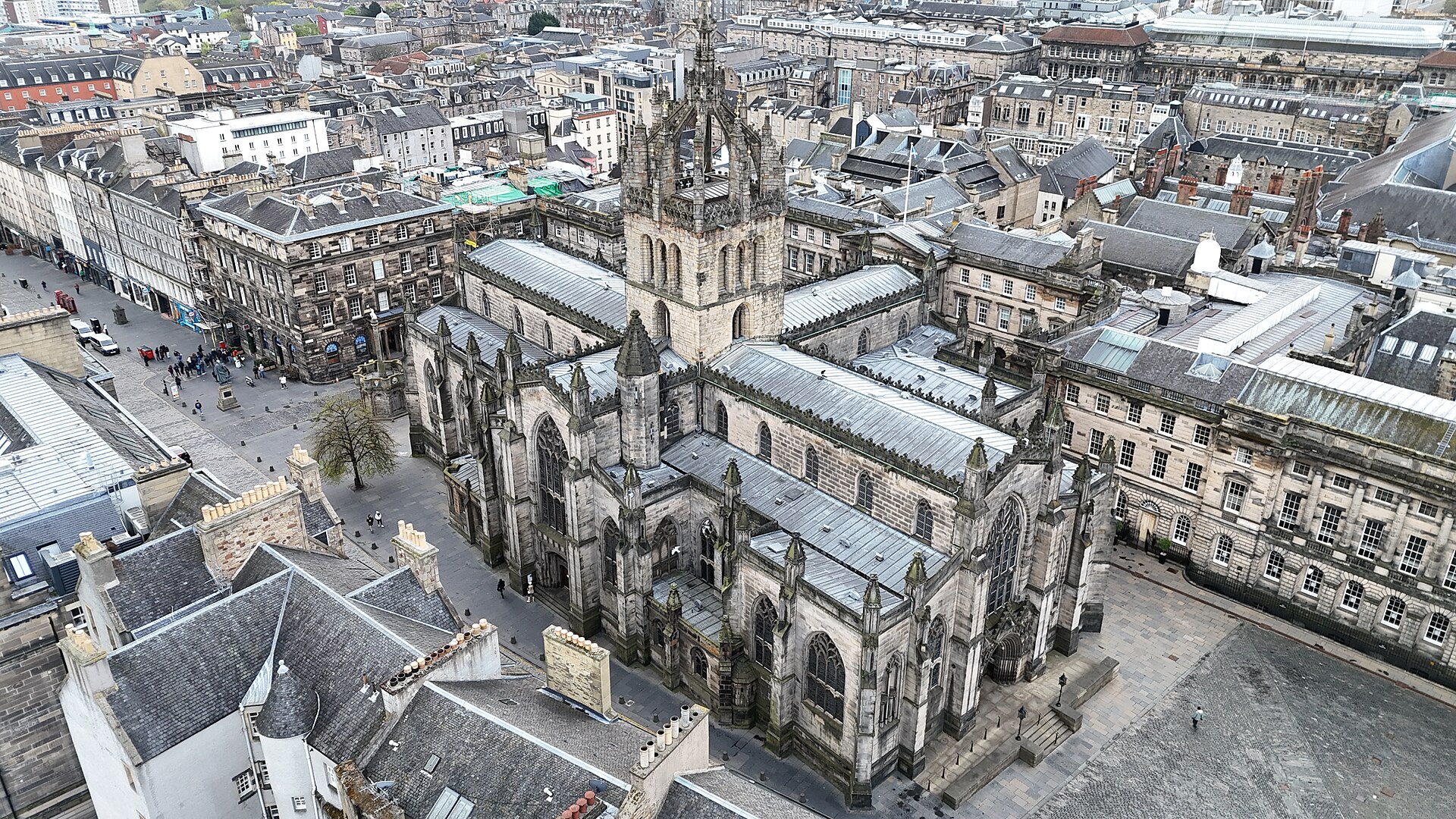
St Giles' Cathedral
City of Edinburgh
Its 1637 prayer-book riot lit the fuse for the National Covenant and the Wars of the Three Kingdoms, earning St Giles' the title 'the Mother Church…
- Near Edinburgh
- Easy path
Questions people ask
- What is carved on the Bullion Stone?
- A single rider — a bald, bearded man on a visibly tired horse, carrying a round shield and drinking from an outsized horn whose tip ends in a bird's head. No other surviving Pictish stone carries the same scene.
- How old is it?
- It is dated to roughly AD 900–950, placing it at the end of the Pictish sequence, and it belongs to the latest class of Pictish sculpture, which uses figures rather than abstract symbols.
- Where was it found, and where is it now?
- It was turned up during road construction in 1933 in Bullion field at Invergowrie. Angus County Council passed it to the National Museum in Edinburgh in 1935, and it is displayed there.
- Are there other carved stones from Invergowrie?
- Two. Invergowrie I is an early-ninth-century cross-slab carved on five faces, showing three clerics and two dragon-like beasts; a third, smaller and damaged, is in Edinburgh but not on display.
- What is the connection with the Torrs Horns?
- The bird's-head terminal on the drinking horn has been likened to the Torrs Horns in the same museum, made almost a thousand years earlier. The comparison is offered as a resemblance, not a demonstrated link.
Sources
The Ancient Codex, in your pocket
Get the Pocket Codex app
Carry the directory with you — Bullion Stone and thousands of ancient places across Britain and Ireland, offline, wherever you roam.