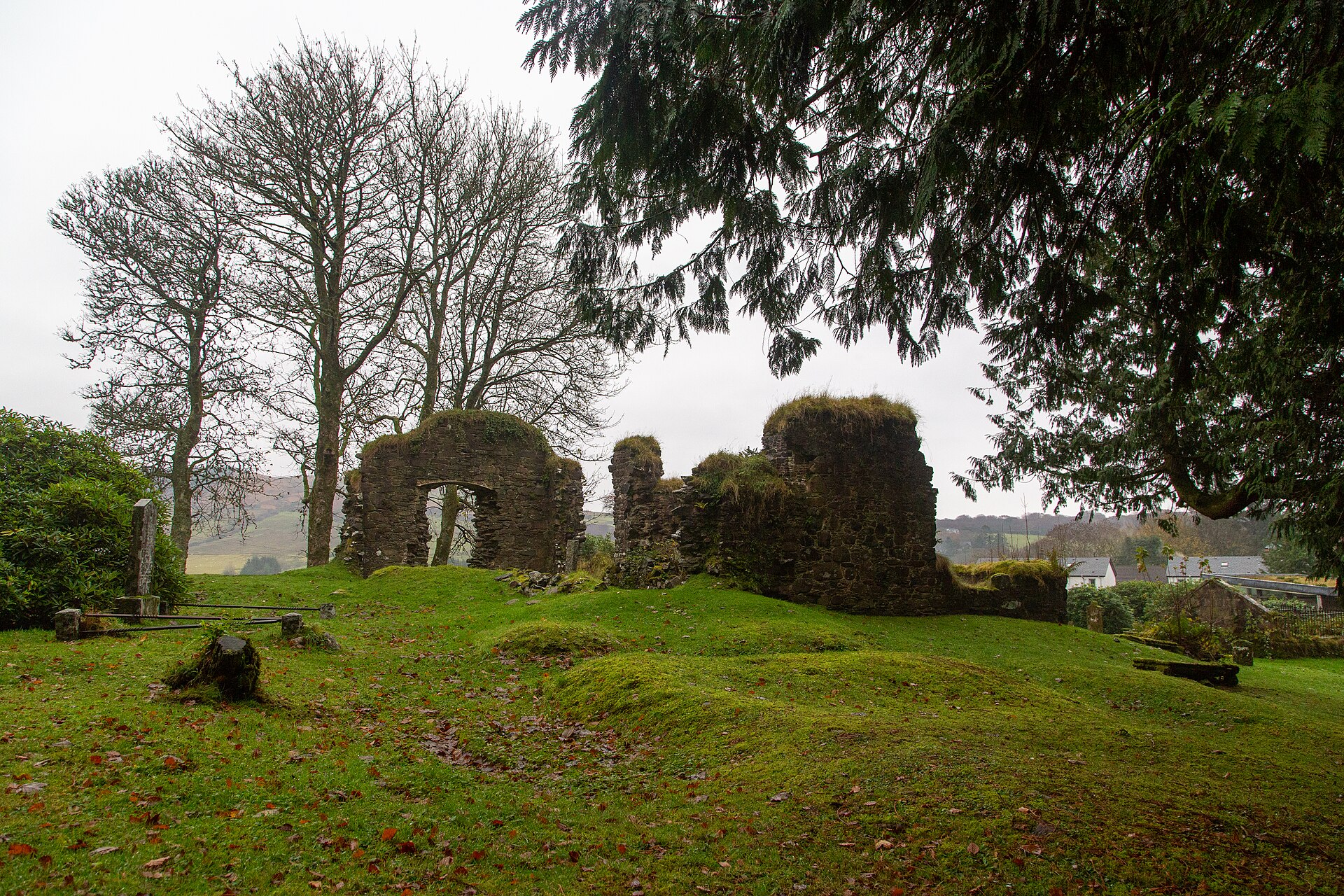
On a bluff above the confluence of Saddell Water and Allt nam Manach — the Water of the Monks — stand the fragmentary remains of a Cistercian monastery founded around 1160. Little of the original fabric survives: an assemblage of stone walls set within a burial ground marks the church's north transept, the side arm crossing the main body, and its nave, where the congregation gathered. A section of low walling remains from the refectory, the monks' dining hall, and the undercroft, built of random rubble laid in lime mortar.
On a bluff above the confluence of Saddell Water and Allt nam Manach — the Water of the Monks — stand the fragmentary remains of a Cistercian monastery founded around 1160. Little of the original fabric survives: an assemblage of stone walls set within a burial ground marks the north transept and nave of the church. A section of low walling remains from the refectory, where the monks ate, and the undercroft, all built of random rubble laid in lime mortar.
Saddell Abbey is best known for its collection of life-sized stone carvings and burial slabs worked between the 14th and 16th centuries. A cross, six grave slabs and five effigies are displayed under a shelter at the entrance to the site, with further slabs — including late 17th-century recumbent stones — lying outside the ruined church walls.
What follows is drawn from published sources, with each claim labelled by how firmly it is established.
The name
The abbey stands above the confluence of Saddell Water and the Allt nam Manach, which translates as the Water of the Monks — a name reflecting the monastic community that once occupied the site.
History
Somerled, Lord of Kintyre, established the abbey as a house of Cistercian monks around 1160, dedicating it to the Virgin Mary. Somerled was killed at the Battle of Renfrew in 1164; his son Ragnall succeeded him as Lord of Kintyre and completed construction, and is also named as the abbey's founder.
The north transept is thought to have been reconstructed in the 13th century, with the chancel probably remodelled at a later date. The abbey was abandoned around 1470, when James IV of Scotland forfeited the Lordship of the Isles and its lands to the Bishopric of Argyll. Most buildings survived until the 16th century, when they were dismantled and the stone reused elsewhere on the Saddell Castle estate. Historic Environment Scotland established the site as a scheduled monument in 1975.
People
-
Somerled, Lord of Kintyre
Norse nobleman who founded the abbey around 1160; killed at the Battle of Renfrew in 1164
-
Ragnall
Somerled's son, who succeeded him as Lord of Kintyre, completed the abbey's construction and is also referred to as its founder
-

Photo: Unknown author / Wikimedia Commons / Public domain James IV of Scotland
Forfeited the Lordship of the Isles and its lands to the Bishopric of Argyll around 1470, by which time the abbey was abandoned
Cultural influences
-
West Highland carving school
The effigies are believed to have been carved on Iona and brought to the abbey, while the remaining stones were worked by skilled craftsmen on site — placing Saddell within the tradition of West Highland medieval sculpture.
Connections
-
Saddell Castle
Estate to which the abbey's dismantled stone was removed and reused in the 16th century
-
Iona
Island where the abbey's effigies are believed to have been carved before being brought to Saddell
-
MacDonalds, Lords of the Isles
Descendants of Somerled who remained patrons of the abbey for many years
Discovery & excavation
The abbey was scheduled as a monument of national importance in 1975, recognising the surviving remains of the medieval Cistercian house.
What to look for
-
Sheltered carvings
A cross, six grave slabs and five effigies from the 14th to 16th centuries, displayed under a special shelter at the entrance to the site.
-
North transept and nave
An assemblage of stone walls, surrounded by a burial ground, marking the north transept and nave of the original cruciform church.
-
Refectory and undercroft walls
A surviving section of low stone walling, built of random rubble in lime mortar, that once formed part of the refectory and undercroft.
-
The holy well
A holy well on the site, with an early 19th-century stone drinking basin embellished with a Latin cross.
-
Recumbent stones outside the church
Further grave slabs lying beyond the ruined church walls, including several late 17th-century recumbent stones.
Plan your visit
- Location
- 55.5314°N · 5.5111°W
- Nearest settlement
- Carradale
- Access
- Open access
- Terrain
- Easy going
- Time needed
- About 45 minutes
- What survives
- Fragmentary stone walls survive within the burial ground, including parts of the church, refectory and undercroft.
Opening & admission
Free to visit, but check the managing body's site for current visitor information before travelling.
- Reached via the B842 coast road from Campbeltown toward Carradale, with a signposted car park at Saddell village.
- Ruins sit on a bluff above the Saddell Water; a holy well with a 19th-century stone drinking basin is on site.
Nearby places
Fortified place · Medieval
Kildonan Dun
argyll-and-bute
Most duns are round. This one is D-shaped, and its double stair up the rampart and a round wall niche both survive intact.
Fortified place · Medieval
Dun Ugadale
Argyll and Bute
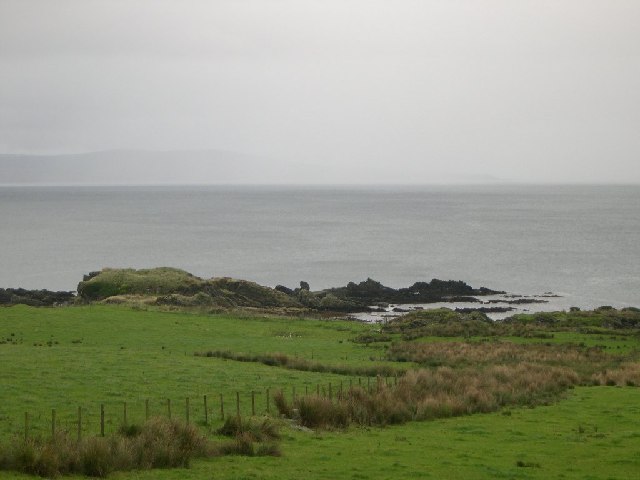
Its Gaelic name preserves a memory of owls in the glen below, while a brooch once kept by its owners carries a tradition linking the fort to Robert…
- Near Ugadale
- Rough ground
Building or ruin · Medieval
Airds Castle
Argyll and Bute
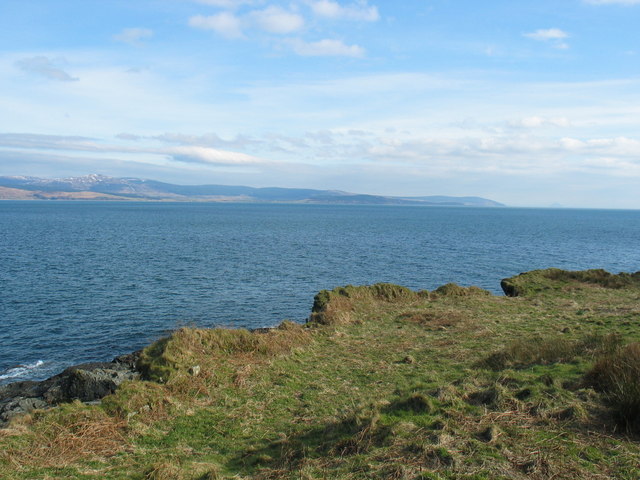
For a century after the Lordship of the Isles fell, this headland castle changed hands between an Ayrshire family and the MacDonalds of Dunnyveg: K…
- Near Carradale
- Rough ground
Fortified place · Medieval
Tangy Loch Castle
Argyll and Bute
A causeway now vanished beneath the water once linked this island stronghold to the shore, leaving a ruin that in the seventeenth century belonged…
- Near Campbeltown
- Rough ground
Questions people ask
- Who founded Saddell Abbey and when?
- It was founded around 1160 by Somerled, Lord of Kintyre, as a house of Cistercian monks dedicated to the Virgin Mary. After Somerled was killed in 1164, his son Ragnall completed the construction.
- What can visitors see at the abbey today?
- Little of the original abbey survives. Visitors can see walls marking the north transept and nave, low walling from the refectory and undercroft, a holy well, and a collection of medieval carved crosses, grave slabs and effigies displayed under a shelter at the entrance.
- Where is Saddell Abbey?
- The abbey stands eight miles north of Campbeltown on the east coast of Kintyre, above the confluence of Saddell Water and the Allt nam Manach. It is reached via the B842 from Campbeltown toward Carradale to the village of Saddell, where a signpost directs visitors to the car park.
- Why is the abbey known for its stone carvings?
- Saddell holds an important collection of life-sized stone carvings and burial slabs made between the 14th and 16th centuries. The effigies are believed to have been carved on Iona and brought to the abbey, while the other carvings were made on site by skilled craftsmen.
- When was Saddell Abbey abandoned?
- The abbey was abandoned around 1470, when James IV of Scotland forfeited the Lordship of the Isles to the Bishopric of Argyll. Most of the buildings stood until the 16th century, when they were dismantled and the stone reused on the Saddell Castle estate.
Sources
- Wikipedia: Saddell Abbey (accessed 2026-07-18)
- Ian B. Cowan and David E. Easson, Medieval Religious Houses: Scotland (2nd edn, London, 1976), pp. 77-8 (accessed 2026-07-18)
- D.E.R. Watt and N.F. Shead (eds.), The Heads of Religious Houses in Scotland from the 12th to the 16th Centuries (Edinburgh, 2001), pp. 186-7 (accessed 2026-07-18)
- Wikidata
Explore more: Building or ruins · Medieval · Argyll and Bute
The Ancient Codex, in your pocket
Get the Pocket Codex app
Carry the directory with you — Saddell Abbey and thousands of ancient places across Britain and Ireland, offline, wherever you roam.